Facts
The petitioner was prosecuted in Crime No. 11/2018 registered by the Narcotics Control Bureau under Sections 8/21, 28, 29 and 60 of the Narcotic Drugs and Psychotropic Substances Act, 1985 (“NDPS Act”).
Source reference: no citationOn 2 September 2018, the NCB allegedly seized 22.145 kg of heroin from three co-accused travelling in a vehicle and subsequently recovered a further 38.070 kg of heroin from near the residence of one of them.
Source reference: pp. 12–14The petitioner remained unavailable for approximately five years and surrendered before the Trial Court on 15 May 2024; he was formally arrested on 19 May 2024 after a statement allegedly admitting the supply of the contraband.
Source reference: pp. 14–15A supplementary complaint was filed against him, and charges under Sections 8/21, 28, 29 and 60 of the NDPS Act were framed on 8 February 2025.
Source reference: p. 15The trial remained at the stage of prosecution evidence, with no prosecution witness having been examined when the bail application was considered.
Source reference: pp. 15, 20–21Issues
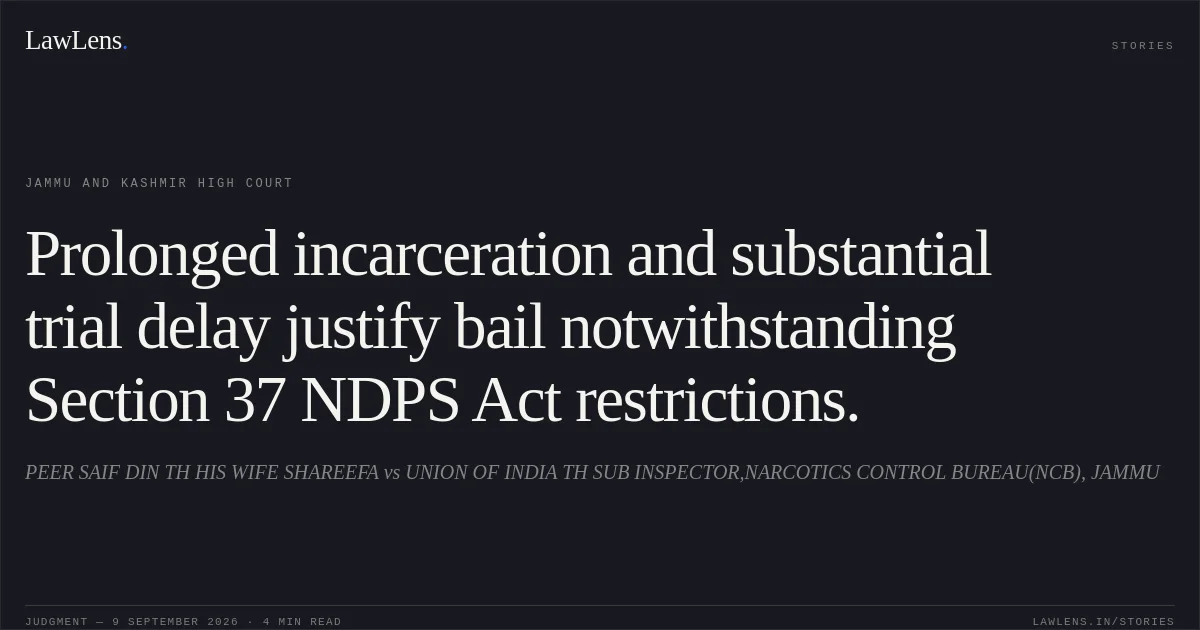
Whether the petitioner was entitled to bail despite the restrictions imposed by Section 37 of the NDPS Act in a case involving commercial quantity of heroin?
Source reference: pp. 34–36; para. 28–30Whether the material relied upon by the prosecution—including statements under Section 67 of the NDPS Act and CDR/CAF material—was sufficient, at the bail stage, to deny the petitioner’s release?
Source reference: pp. 21–26; paras. 14–17Whether prolonged incarceration, the advanced stage of custody compared with the slow progress of trial, parity with co-accused, and the petitioner’s age and medical condition justified grant of bail?
Source reference: pp. 20–21, 26; para. 13, 17–18What conditions were necessary to secure the petitioner’s presence at trial and prevent interference with the administration of justice?
Source reference: pp. 36–38; paras. 31–33Law Applied
The Court applied Section 37 of the NDPS Act, under which bail in cases involving commercial quantity requires the Public Prosecutor to be heard and the Court to be satisfied that there are reasonable grounds for believing that the accused is not guilty and is unlikely to commit an offence while on bail.
Source reference: pp. 34–36; para. 28–29Relying on Narcotics Control Bureau v. Mohit Aggarwal, the Court held that “reasonable grounds” means credible and plausible grounds, without requiring a conclusive finding of innocence or a detailed assessment of evidence at the bail stage.
Source reference: p. 35–36; para. 30The Court considered Toofan Singh v. State of Tamil Nadu on the inadmissibility of confessional statements made under Section 67 of the NDPS Act to officers treated as police officers for evidentiary purposes.
Source reference: pp. 7–9, 21–22; paras. 14–15It also applied the constitutional principle that pre-trial detention is not punitive and that bail ordinarily secures the accused’s attendance at trial, as stated in State of Rajasthan v. Balchand, Sanjay Chandra v. CBI, Prahlad Singh Bhati v. NCT, Delhi and State of U.P. v. Amarmani Tripathi.
Source reference: pp. 27–33; paras. 19–26The Court further relied on decisions recognising prolonged incarceration and delayed trial as relevant considerations in NDPS bail matters, including Rubi Prakash v. State of Odisha and Nitish Adhikary @ Bapan v. State of West Bengal.
Source reference: pp. 16–18; paras. 9–10Reasoning
The Court acknowledged that the alleged recovery involved commercial quantity and that Section 37 therefore applied.
Source reference: pp. 34–36; paras. 28–30However, it held that the bail inquiry was limited and did not require a preliminary trial or a definitive determination of guilt.
Source reference: no citationThe prosecution case against the petitioner substantially relied on statements of co-accused and the petitioner’s own alleged Section 67 statement, together with CDR/CAF material showing communication between the accused persons; the evidentiary value and sufficiency of that material were matters better determined at trial.
Source reference: pp. 21–26; paras. 14–17The Court also took into account that the petitioner had remained in custody for more than two years after surrender, that the main complaint had been pending since 2019, that the trial had not progressed beyond prosecution evidence, and that the co-accused had already been granted bail.
Source reference: pp. 20–21; para. 13His age, cardiac condition and implanted stent were additional humanitarian considerations.
Source reference: p. 26; para. 17Balancing these factors against the petitioner’s previous abscondence and the seriousness of the alleged offence, the Court concluded that continued detention was not justified subject to stringent conditions securing his attendance and preventing witness interference.
Source reference: pp. 26–28, 36–38; paras. 17–20, 31–33Holding
The High Court allowed the bail application and admitted the petitioner to bail in Crime No. 11/2018/File No. 19/2024 under Sections 8/21, 28, 29 and 60 of the NDPS Act, without expressing any final opinion on the merits of the prosecution case.
Bail was conditional upon furnishing personal and surety bonds of ₹1,00,000 each, with two near-relative sureties liable to the extent of ₹50,000 each.
Source reference: pp. 36–38; para. 31The petitioner was directed to remain present at trial, refrain from influencing or threatening prosecution witnesses, not leave the Union Territory of Jammu Kashmir without permission, and not commit any further offence.
Source reference: p. 37; para. 31The Trial Court was authorised to proceed under Sections 491 and 492 of the BNSS in the event of breach of the bail conditions.
Source reference: p. 38; para. 33Acts & Sections Cited
19 provisions across 3 statutes referred to in this judgment. Each provision opens on LawLens.
Code of Criminal Procedure, 19732
Bharatiya Nagarik Suraksha Sanhita, 20233
Narcotic Drugs and Psychotropic Substances Act, 1985
Original Court PDF
PEER SAIF DIN TH HIS WIFE SHAREEFAvsUNION OF INDIA TH SUB INSPECTOR,NARCOTICS CONTROL BUREAU(NCB), JAMMU
Click to open original judgment
Original judgment, available to read, download and summarize on LawLens.in