01Facts
The appellants, Abdul Kader and Firoz, were Accused Nos. 19 and 20 respectively in S.C. No. 2 of 2023 before the Special Court for NIA Cases, Ernakulam.
¶ 1They were arrested on 24.04.2022 and 26.04.2022 respectively in Crime No. 318 of 2022 of Palakkad Town South Police Station concerning the murder of S.K. Sreenivasan, and were formally arrested by the NIA on production warrants on 10.02.2023 after the NIA took over investigation of the connected offence.
¶ 2The prosecution alleged that the appellants were active PFI cadres who participated in a larger conspiracy, underwent arms training, attended conspiracy meetings, travelled with the assault team to the scene, assisted in the murder, and later destroyed or concealed evidence.
¶ 9–16, 51–52The prosecution relied, inter alia, on witness and approver statements, CCTV footage, call-data records, recoveries, forensic evidence, and alleged detection of the victim’s DNA on clothing connected with both appellants.
¶ 51–52, 76–77Their bail application under Section 439 Cr.P.C. was rejected by the Special Court on 09.09.2025, which held that the accusations under Chapter IV of the UA(P) Act were prima facie true and that the bar under the proviso to Section 43-D(5) applied.
¶ 15The appellants challenged that order, relying on the alleged non-supply of written grounds of arrest, parity with co-accused granted bail, and prolonged incarceration coupled with the absence of a foreseeable early trial.
¶ 17–17.202Issues
i.Whether the appellants’ arrests were rendered illegal under Article 22(1) of the Constitution and Section 43-B(1) of the UA(P) Act because written grounds of arrest were not supplied to them.
¶ 19–42ii.Whether the materials in the case diary and final report disclosed reasonable grounds for believing that the accusations against the appellants were prima facie true, thereby attracting the embargo under the proviso to Section 43-D(5) of the UA(P) Act.
¶ 43–59iii.Whether the appellants were entitled to bail on the ground of parity with co-accused who had been released on bail.
¶ 60–82iv.Whether their prolonged incarceration, the volume of the prosecution case, and the delay or anticipated delay in trial justified release on bail under Articles 21 and 22 of the Constitution notwithstanding Section 43-D(5) of the UA(P) Act.
¶ 83–15703Law Applied
Article 22(1) of the Constitution requires an arrested person to be informed of the grounds of arrest, and Section 43-B(1) of the UA(P) Act contains a corresponding statutory safeguard.
¶ 19, 32–34*Pankaj Bansal v. Union of India* directed written communication of grounds of arrest as a matter of course “henceforth,” and *Ram Kishor Arora v. Directorate of Enforcement* held that the written-ground requirement operated prospectively from 03.10.2023, while oral communication before that date could constitute sufficient compliance.
¶ 20–31, 42Under Section 43-D(5) of the UA(P) Act, bail must be refused where, on a perusal of the case diary or police report, there are reasonable grounds to believe that the accusation is prima facie true.
¶ 53–57Under *NIA v. Zahoor Ahmad Shah Watali*, the court conducts a limited assessment on broad probabilities without a mini-trial.
¶ 53–57, 130Section 18 of the UA(P) Act covers conspiracy, facilitation, or preparatory acts relating to a terrorist act, even without proof of actual commission by the accused.
¶ 48–49, 129, 140*Union of India v. K.A. Najeeb*, *Shaheen Welfare Association v. Union of India*, *Javed Gulam Nabi Shaikh v. State of Maharashtra*, and *Syed Iftikhar Andrabi v. NIA* held that constitutional courts may grant bail despite Section 43-D(5) where prolonged incarceration and an unlikely timely trial result in a violation of Article 21; however, delay is not an automatic or mechanical ground for bail and must be assessed contextually.
¶ 84–93, 108–139For parity, *Ramesh Bhavan Rathod v. Vishanbhai Hirabhai Makwana* and *Tarun Kumar v. Enforcement Directorate* held that parity depends on the accused’s specific role and cannot perpetuate an erroneous or unjustified bail order.
¶ 61–62, 78–81Provisions in the judgment · 75 · Linked ones open on LawLens
Indian Penal Code, 1860 25 provisions
Section 34Section 109Section 115Section 118Section 119Section 121Section 122Section 143Section 144Section 147Section 148Section 149Section 201Section 202Section 212Section 302Section 307Section 323Section 324Section 326Section 341Section 427Section 449Section 505Section 506Code of Criminal Procedure, 1973 Section 2Section 50Section 173Section 436Section 437Section 438Section 439
Bharatiya Nagarik Suraksha Sanhita, 2023 Section 2Section 47Section 193Section 479Section 482
Bharatiya Nyaya Sanhita, 2023 Section 61Section 191
Unlawful Activities (Prevention) Act, 1967 16 provisions
Section 2Section 3Section 10Section 13Section 15Section 16Section 17Section 18Section 19Section 20Section 21Section 23Section 38Section 39Section 40Section 43National Investigation Agency Act, 2008 Section 8Section 11Section 19Section 21
Prevention of Money-Laundering Act, 2002 Section 3Section 4Section 19Section 44Section 45Section 62
Narcotic Drugs and Psychotropic Substances Act, 1985 Section 8Section 21Section 22Section 25Section 29Section 37
Arms Act, 1959 Section 25
Religious Institutions (Prevention of Misuse) Act, 1988 Section 3Section 7
Explosive Substances Act, 1908 Section 3
04Reasoning
The appellants could not challenge their arrests merely because written grounds of arrest had not been supplied. Their arrests occurred in April 2022, and their formal NIA arrests occurred on 10.02.2023, all before *Pankaj Bansal* was pronounced on 03.10.2023; under *Ram Kishor Arora*, written communication was not mandatory before that date if the grounds were otherwise communicated.
¶ 42On the merits, the Court found substantial prima facie material against both appellants, including their alleged PFI membership, arms training, participation in conspiracy meetings, movement with the assault team to and from the crime scene, CCTV identification, recovery of relevant clothing and vehicles, alleged concealment of evidence, and forensic material linking the victim to their clothing or vehicles.
¶ 57–59, 76–77These materials were sufficient to attract Sections 16 and 18 of the UA(P) Act and the statutory bar under Section 43-D(5), without the Court conducting a detailed evidentiary evaluation.
¶ 129–130The plea of parity failed because the co-accused in *Muhammed Bilal v. Union of India* were alleged to have played a different, principally defensive or peripheral role, whereas the appellants were specifically linked to the movement of the assault team and to forensic evidence, including alleged detection of the victim’s DNA.
¶ 63–64, 79–82Although the appellants had undergone approximately four years and four months of custody and the case involved 71 accused, 1,001 witnesses, 1,688 documents, 692 material objects, and extensive forensic material, the Court held that the delay was substantially affected by the Supreme Court’s interim stay on framing of charges and that the stay could not be attributed to the prosecution.
¶ 146–148Given the offences under Section 302 IPC and Section 16(1)(a) of the UA(P) Act, punishable with death or imprisonment for life, the period undergone had not exceeded a substantial part of the possible sentence; consequently, the Article 21 exception recognised in *K.A. Najeeb* was not attracted.
¶ 148–15505Holding
The absence of written grounds of arrest did not invalidate arrests made before the prospective requirement recognised in *Pankaj Bansal*.
¶ 42The prosecution materials disclosed a prima facie case under Chapter IV of the UA(P) Act, attracting the proviso to Section 43-D(5).
¶ 57–59The appellants were not entitled to bail on parity because their alleged roles and the forensic material against them materially differed from those of the co-accused released in *Muhammed Bilal*.
¶ 82Their incarceration and the delay in trial did not amount to a violation of Article 21 warranting constitutional bail, having regard to the gravity of the offences, the maximum punishment, the prima facie evidence, and the procedural circumstances causing delay.
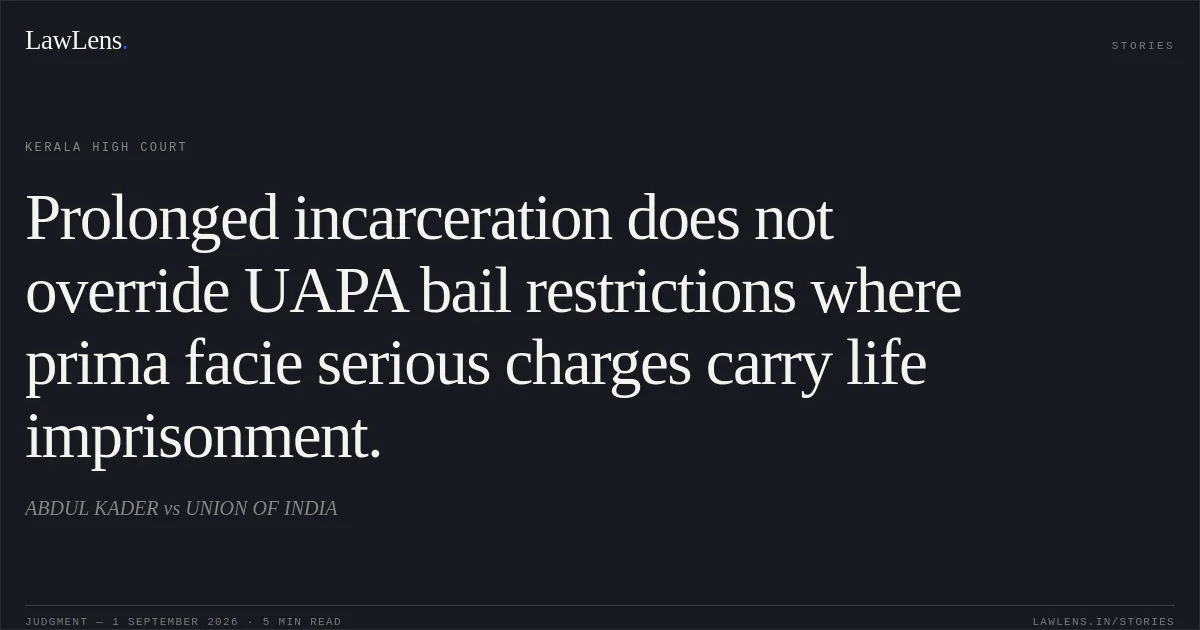
¶ 148–157The criminal appeal was accordingly dismissed, and the Special Court’s order dated 09.09.2025 refusing bail was affirmed.
¶ 157Original Court PDF
ABDUL KADERvsUNION OF INDIA
Click to open original judgment
Original judgment, available to read, download and summarize on LawLens.in