01Facts
On 2 October 2002, acting on secret information, a police raiding team apprehended Sunita near a railway track and recovered a bag containing charas.
pp. 2–4 · ¶ 4–9A total of 105 grams was allegedly recovered; 50 grams was separated, sealed, and sent to the Forensic Science Laboratory, which confirmed the substance as charas.
pp. 2–4 · ¶ 4–9The Trial Court convicted her under Section 20(b) of the Narcotic Drugs and Psychotropic Substances Act, 1985, and sentenced her to one year’s rigorous imprisonment and a fine of ₹5,000, with five months’ simple imprisonment in default.
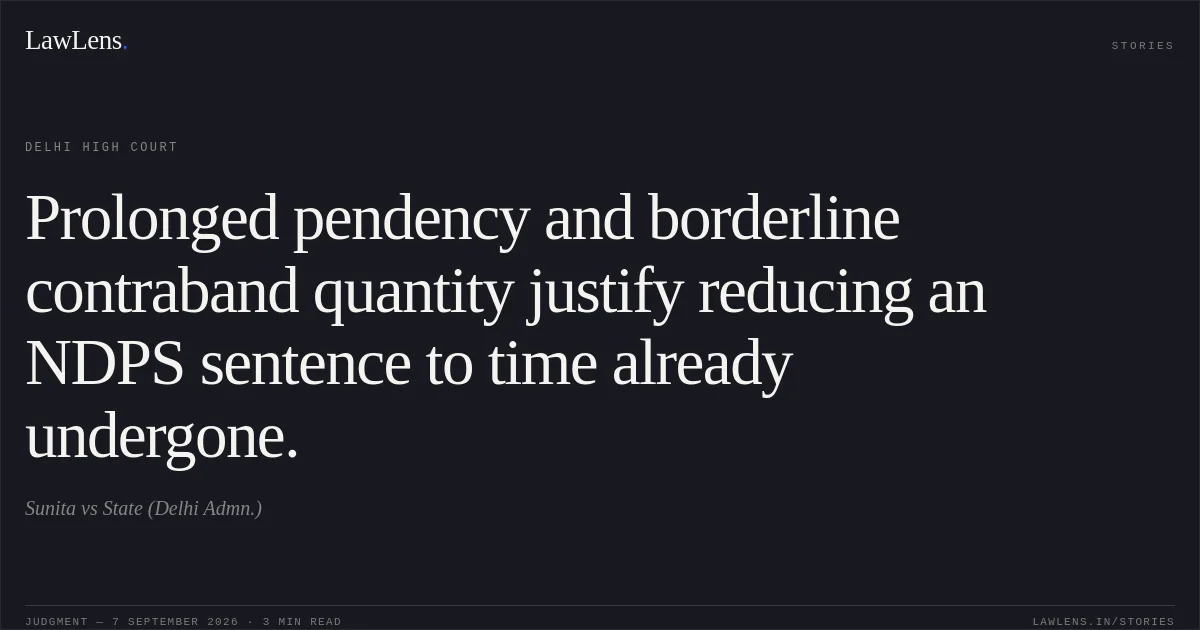
p. 1 · ¶ 1In appeal, the conviction was not challenged; Sunita sought only reduction of sentence, contending that the manual weighing process could have involved a margin of error of five grams and that the quantity ought to be treated as 100 grams rather than 105 grams.
pp. 1–2 · ¶ 1–302Issues
i.Whether the alleged inaccuracy in the manual weighing process justified treating the recovered charas as weighing 100 grams instead of 105 grams for the purpose of imposing a lesser sentence.
pp. 4–6 · ¶ 10–15ii.Whether, notwithstanding the confirmation of conviction, the sentence should be reduced in view of the quantity involved, the period already undergone, prolonged pendency, personal circumstances, and absence of any proved prior conviction.
pp. 6–10 · ¶ 16–25iii.Whether the Court should require the appellant to execute a bond under Section 34 of the NDPS Act to abstain from committing further offences under Chapter IV of the Act.
pp. 9–10 · ¶ 25–2703Law Applied
The Court applied Section 20(b) of the NDPS Act, under which punishment depends upon the quantity of cannabis recovered, and Section 34, which authorises the convicting or appellate court to require execution of a bond for abstaining from offences under Chapter IV for a period not exceeding three years.
pp. 1, 9–10 · ¶ 1, 25The Court also considered Section 428 Cr.P.C., under which the period spent in custody as an undertrial is set off against the sentence imposed.
p. 7 · ¶ 17The Court relied on the reformative and proportionate sentencing approach reflected in the NDPS Act, as discussed in Indul Shah v. State and Sultan v. State .
p. 8 · ¶ 22The Court further relied on Israfil alias Pappu alias Naimuddin Khan v. State of Madhya Pradesh , which recognised prolonged passage of time, sentence already undergone, absence of proved criminal antecedents, and other mitigating circumstances as relevant to sentence reduction, and on Jagdish Ram v. State of Punjab regarding the mitigating significance of prolonged exposure to criminal proceedings in non-heinous offences.
pp. 7–8 · ¶ 20–21Provisions in the judgment · 8 · Linked ones open on LawLens
Narcotic Drugs and Psychotropic Substances Act, 1985 Section 20Section 50Section 34
Code of Criminal Procedure, 1973 Section 313Section 428Section 106
Indian Penal Code, 1860 Section 467Section 468
04Reasoning
The Court declined to interfere with the conviction because the appellant had expressly confined the appeal to sentencing.
p. 4 · ¶ 12It rejected the specific inference that the FSL report established a two-gram discrepancy in the weighing process: the report recorded the sample’s gross weight, including polythene, as 52.22 grams, which was consistent with the prosecution’s case that 50 grams of charas had been sent for analysis.
pp. 5–6 · ¶ 14–15Nevertheless, the Court held that weighing had taken place near a railway track using a manual scale, where vibrations and the difference between field and laboratory conditions created a reasonable possibility of a small error; the five-gram excess over the relevant threshold was considered insignificant in the sentencing context.
p. 6 · ¶ 15The Court then weighed the appellant’s five months and twenty-nine days of custody, twenty-four-year delay, age and socio-economic condition at the time of the offence, family responsibilities, and the fact that her other criminal cases had not resulted in convictions.
pp. 6–9 · ¶ 16–24Applying a reformative and proportionate approach, it concluded that continued rigorous imprisonment was unwarranted, while considering the alleged antecedents sufficient to justify a preventive bond under Section 34.
pp. 9–10 · ¶ 25–2605Holding
The conviction under Section 20(b) of the NDPS Act was affirmed, as it was not challenged and no ground for interference with the finding of guilt was established.
p. 4 · ¶ 12However, the substantive sentence was reduced to the period already undergone.
p. 10 · ¶ 27The fine of ₹5,000 and the default sentence were left unaltered.
p. 10 · ¶ 27The appellant was directed to furnish a bond of ₹20,000 under Section 34 of the NDPS Act, in the prescribed form, for a period of two years before the Trial Court.
p. 10 · ¶ 27The appeal was accordingly disposed of, and copies of the judgment were directed to be sent to the Trial Court and prison authorities for compliance.
p. 11 · ¶ 28–29Original Court PDF
SunitavsState (Delhi Admn.)
Click to open original judgment
Original judgment, available to read, download and summarize on LawLens.in