Facts
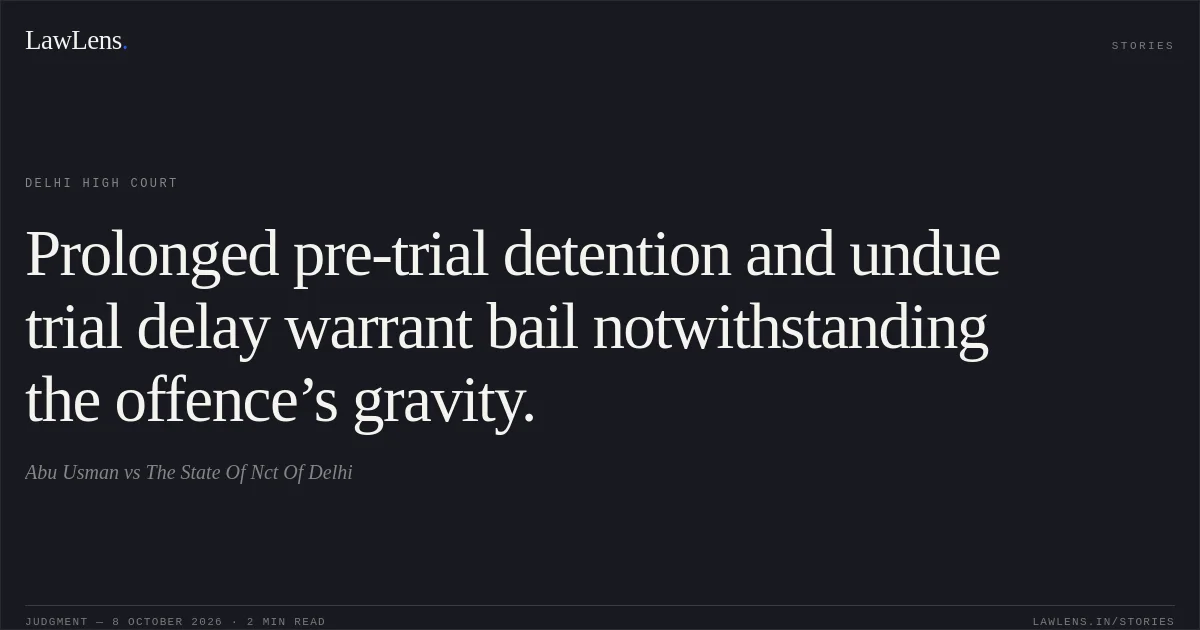
The applicant sought regular bail under Sections 483 and 528 of the Bharatiya Nagarik Suraksha Sanhita, 2023, in a case registered under Sections 302/34/120B IPC.
Source reference: p. 1The prosecution alleged that the applicant and co-accused conspired to murder Anwarul Haque, who was stabbed to death on 31 July 2022.
Source reference: p. 1–2The prosecution relied on witness identification from CCTV footage and call-detail records; the applicant disputed the strength of that evidence and submitted that no recovery had been made at his instance.
Source reference: p. 2–3This was his second application before the High Court; an earlier application had been withdrawn with liberty to seek bail after examination of material witnesses.
Source reference: p. 2–3By the present application, the applicant had been in custody since 16 December 2022, and the remaining witnesses were stated to be official witnesses.
Source reference: p. 3–4Issues
1. Whether the applicant should be released on regular bail in light of the period of pre-trial detention, the status of the evidence, and the anticipated duration of the trial.
Source reference: p. 3–52. Whether the gravity of the alleged offence and the prosecution’s reliance on CCTV identification and call-detail records justified continued detention despite the delay in trial.
Source reference: p. 3–5Law Applied
Sections 483 and 528 BNSS provide the procedural basis invoked for the regular-bail application and the High Court’s inherent jurisdiction.
Source reference: p. 1Article 21 of the Constitution protects an accused’s right to a speedy trial; where trial delay is not attributable to the accused and no timely conclusion is in prospect, prolonged pre-trial incarceration may support release on bail.
Source reference: p. 4Relying on Arvind Dham v. Enforcement Directorate, (2026) 7 SCC 330, and the authorities discussed therein, including Javed Gulam Nabi Shaikh v. State of Maharashtra, (2024) 9 SCC 813, and Manish Sisodia v. Enforcement Directorate, (2024) 12 SCC 660, the Court reiterated that the seriousness of the alleged offence cannot, by itself, justify refusing bail where the accused’s speedy-trial right is impaired.
Source reference: p. 4–5Reasoning
The Court considered that the applicant had been incarcerated for approximately three years and nine months, the public and material witnesses had been examined, and the remaining witnesses were official witnesses, reducing the stated concern about witness influence.
Source reference: p. 3–4The CCTV identification and call-detail records were matters for assessment at trial, while no recovery had been made at the applicant’s instance.
Source reference: p. 3–5The trial remained pending despite the earlier request to expedite the material witnesses’ evidence, and no delay was shown to be attributable to the applicant.
Source reference: p. 3–5Weighing these circumstances against the gravity of the charge, the Court found that continued detention was not warranted.
Source reference: p. 4–5Holding
The Court allowed the application and admitted the applicant to regular bail on a personal bond of ₹50,000 with two sureties of the like amount, subject to conditions including attendance at trial, restrictions on travel, disclosure of and notification of changes to his address and phone number, cooperation with the investigating officer, monthly reporting to the concerned SHO, and non-interference with witnesses or evidence.
The Court clarified that its observations did not express an opinion on the merits and disposed of the petition.
Source reference: p. 7Acts & Sections Cited
4 provisions across 2 statutes referred to in this judgment. Each provision opens on LawLens.
Bharatiya Nagarik Suraksha Sanhita, 20232
Indian Penal Code, 18602
Original Court PDF
Abu UsmanvsThe State Of Nct Of Delhi
Click to open original judgment
Original judgment, available to read, download and summarize on LawLens.in