Facts
The Delhi Police Crime Branch registered an FIR in March 2024 alleging a criminal syndicate manufactured and sold spurious cancer medicines (Opdyta and Keytruda).
Source reference: p. 6-7The Enforcement Directorate (ED) subsequently registered an ECIR under the PMLA.
Source reference: p. 7The five applicants were arrested for various roles: supplying empty vials (Pravez Khan), misappropriating vials from hospitals (Neeraj Chauhan), manufacturing spurious drugs (Suraj Shat), and distributing/selling them in the market (Lovee Narula and Rajesh Kumar).
Source reference: p. 8-10Applicants Rajesh Kumar and Lovee Narula were not named in the predicate offence.
Source reference: p. 28Previously, a coordinate bench of the High Court and the Supreme Court (in limine) had rejected bail for two applicants.
Source reference: p. 22-23Issues
1. Whether a High Court can grant bail after a coordinate bench’s rejection and the Supreme Court’s dismissal of an SLP in limine.
Source reference: p. 23-25 / para. 5.2-5.42. Whether self-incriminating statements recorded under Section 50 of the PMLA while the accused is in custody are admissible.
Source reference: p. 26-28 / para. 5.7-5.103. Whether the prosecution established "foundational facts" under Section 24 regarding the existence of "proceeds of crime" linked to the predicate offence.
Source reference: p. 30-33 / para. 6.2-6.54. Whether prolonged incarceration without trial violates the fundamental right to liberty under Article 21, overriding PMLA statutory restrictions.
Source reference: p. 39-40 / para. 9Law Applied
The court applied Section 45 of the PMLA, which mandates a twin-test for bail: reasonable grounds to believe the accused is not guilty and is unlikely to commit further offences.
Source reference: p. 17-18It relied on Vijay Madanlal Choudhary v. Union of India regarding the necessity of established "foundational facts" for the Section 24 presumption.
Source reference: p. 30The court followed Prem Prakash v. Union of India, which held that custodial statements to the same agency are inadmissible due to lack of a "free mind".
Source reference: p. 26-27It applied the principle from Kusal Toppo v. State of Jharkhand that dismissal of an SLP in limine does not affirm the lower court's judgment.
Source reference: p. 23-24It invoked Arvind Dham v. ED and V. Senthil Balaji v. State, affirming that Article 21 (right to speedy trial) takes precedence over statutory bail restrictions during prolonged incarceration.
Source reference: p. 39-40Reasoning
The Court observed that since the Supreme Court dismissed previous SLPs in limine, it was not barred from reconsidering bail on fresh grounds.
Source reference: p. 23-24It analyzed the Section 50 PMLA statements and determined they were recorded while applicants were in ED custody, rendering the self-incriminating portions inadmissible as they lacked voluntariness.
Source reference: p. 28-29The Court found the ED failed to establish "foundational facts": there was no evidence linking the doctors/hospitals to the "empty vials," no end-users were examined to prove the drugs were spurious, and forensic reports showed the majority of seized vials actually contained genuine medicine.
Source reference: p. 33-37Given that the ED requested six more months for investigation after applicants had already spent over two years in jail, the Court found a violation of Article 21.
Source reference: p. 40-41Holding
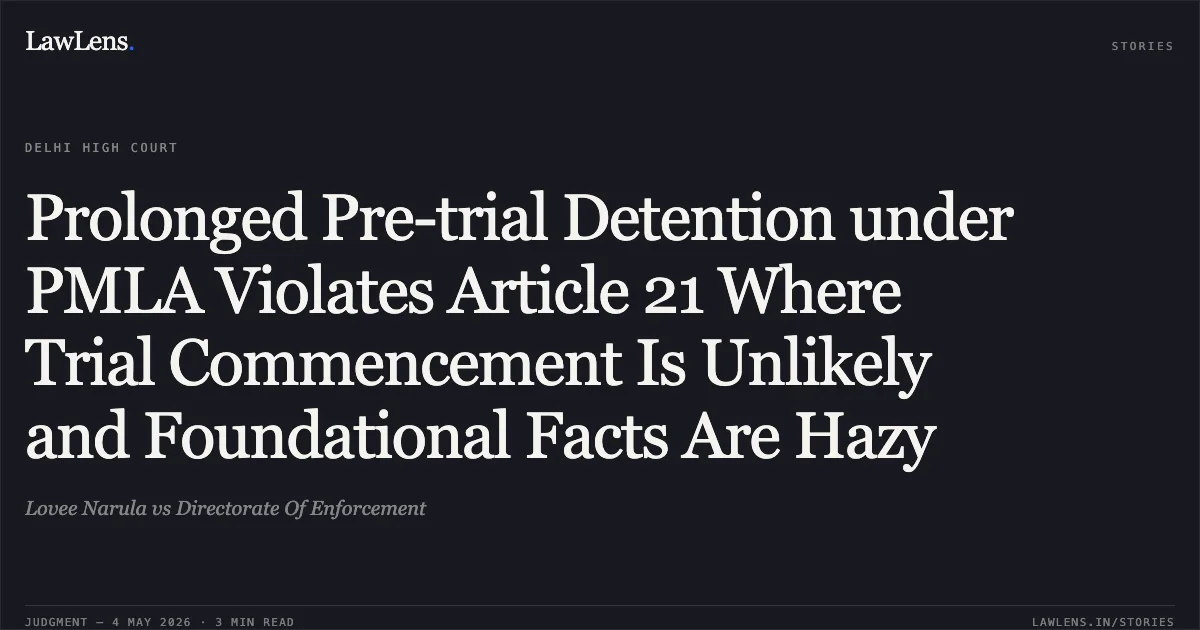
The Court answered the issues in the affirmative, holding that the "twin conditions" of Section 45 were satisfied as there were reasonable grounds to believe the applicants were not guilty due to the "hazy" nature of the evidence and lack of established "proceeds of crime".
The Court granted regular bail to all five applicants (Pravez Khan, Neeraj Chauhan, Rajesh Kumar, Suraj Shat, and Lovee Narula) subject to a personal bond of Rs. 1,00,000/- each, a surety of like amount, and a restriction on leaving the country without permission.
Source reference: p. 41Acts & Sections Cited
18 provisions across 3 statutes referred to in this judgment. Each provision opens on LawLens.
Prevention of Money-Laundering Act, 2002
Indian Penal Code, 18607
Code of Criminal Procedure, 19732
Original Court PDF
Lovee NarulavsDirectorate Of Enforcement
Click to open original judgment
Original judgment, available to read, download and summarize on LawLens.in


![Authorities must decide pensionary and retiral-benefit claims through a reasoned order within eight weeks.. Habibullah khan vs HOME DEPARTMENT. CAT - ['Srinagar']. LawLens](/stories/thumbnails/authorities-must-decide-pensionary-and-retiral-benefit-claims-through-a-reasoned-order-wit-d0cbe8a8119c48fbabe7df9f2d353488.webp)