Facts
The parties married on 11 September 2002 and have three children.
Source reference: paras. 2–11, 23The husband sought divorce under Section 13(1)(ia) of the Hindu Marriage Act, 1955, alleging cruelty, prolonged separation and matrimonial discord.
Source reference: paras. 2–11, 23The wife denied the allegations and sought ₹50,00,000 as permanent alimony and return of 12 sovereigns of jewellery.
Source reference: paras. 2–11, 23The Family Court dismissed the divorce petition and both of the wife’s applications.
Source reference: paras. 2–11, 23The husband appealed against the dismissal of his divorce petition.
Source reference: paras. 2–11, 23Issues
Whether the wife’s conduct, considered cumulatively, amounted to mental cruelty warranting divorce under Section 13(1)(ia) of the Hindu Marriage Act
Source reference: para. 26(i)Whether the wife was entitled to permanent alimony under Section 25 and, if so, in what amount
Source reference: para. 26(ii)Whether the wife had established her entitlement to return of the jewellery claimed
Source reference: para. 26(iii)Law Applied
Section 13(1)(ia) of the Hindu Marriage Act permits divorce for cruelty; cruelty must be assessed in the context of the entire matrimonial relationship, and the cumulative effect of proved circumstances may matter even where individual incidents might not independently amount to cruelty.
Source reference: paras. 27–28Ordinary wear and tear, trivial quarrels and routine matrimonial differences are insufficient by themselves.
Source reference: para. 28Irretrievable breakdown is not an independent statutory ground under Section 13, although separation and the state of the relationship may be considered alongside other proved circumstances when assessing cruelty.
Source reference: para. 34Section 25 empowers the court to award permanent alimony, assessed reasonably in light of the parties’ circumstances and financial capacity; the Court applied the financial-disclosure and maintenance principles in Rajnesh v. Neha, (2021) 2 SCC 324.
Source reference: paras. 40–49A party claiming return of property must establish the claim with acceptable evidence.
Source reference: paras. 51–53Reasoning
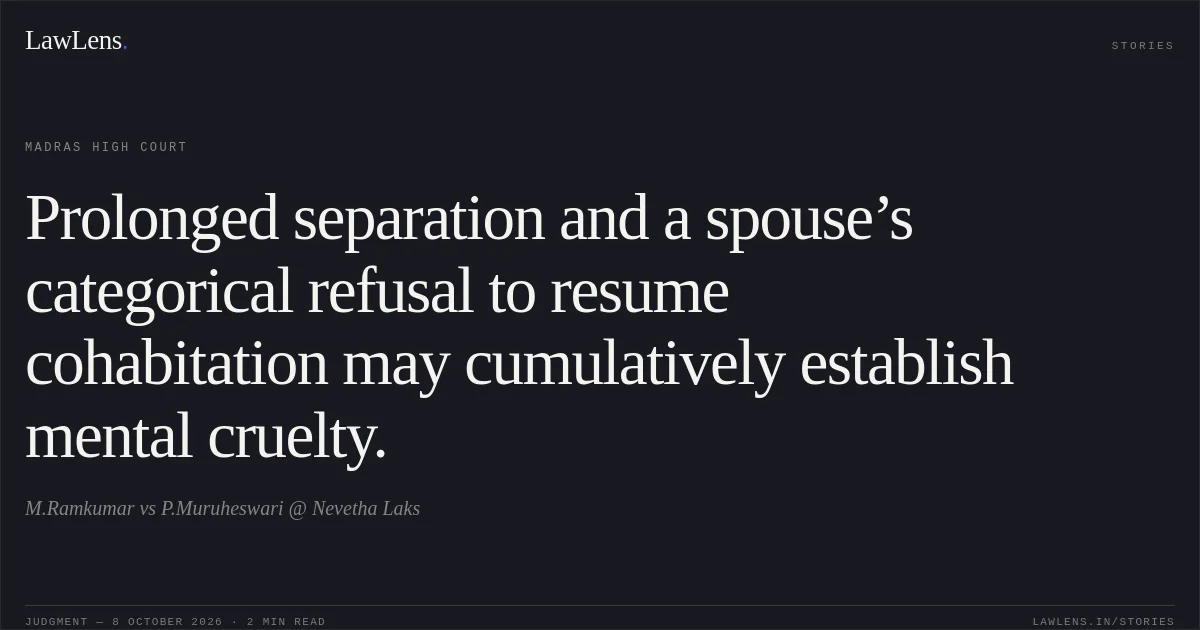
The Court held that the Family Court had treated the alleged incidents too separately and had not adequately considered their cumulative effect.
Source reference: paras. 29–38It relied particularly on the parties’ prolonged separation, continuing discord and the wife’s evidence that she was unwilling to live with the husband, except conditionally for the children’s welfare.
Source reference: paras. 29–38Those circumstances, taken together, established mental cruelty; the Court did not treat irretrievable breakdown alone as a ground for divorce.
Source reference: paras. 29–38On alimony, despite incomplete financial disclosures, the Court considered the available evidence, the duration of the marriage, the parties’ circumstances and the wife’s caregiving responsibilities, and fixed ₹25,00,000 as reasonable permanent alimony.
Source reference: paras. 41–49It declined to disturb the rejection of the jewellery claim because the wife had not sufficiently proved the quantity or continued possession of the articles, her claim conflicted with statements in Exs. P-4 and P-5, and the husband had not been specifically questioned on the alleged retention.
Source reference: paras. 51–53Holding
The appeal was partly allowed.
The Court set aside the dismissal of the divorce petition and dissolved the marriage on the ground of cruelty under Section 13(1)(ia).
Source reference: para. 54It set aside the dismissal of the wife’s alimony application and awarded her ₹25,00,000 under Section 25.
Source reference: para. 54The divorce decree was to come into force only upon deposit of that amount to the credit of the H.M.O.P. before the Family Court, Dindigul.
Source reference: para. 54The rejection of the jewellery claim was affirmed, and there was no order as to costs.
Source reference: para. 54Acts & Sections Cited
3 provisions across 2 statutes referred to in this judgment. Each provision opens on LawLens.
Family Courts Act, 19841
Hindu Marriage Act, 19552
Original Court PDF
M.RamkumarvsP.Muruheswari @ Nevetha Laks
Click to open original judgment
Original judgment, available to read, download and summarize on LawLens.in