Facts
The appellant-wife and respondent-husband were married on 7 May 2007 and had a male child born on 3 January 2009.
Source reference: p.2The wife alleged that the husband failed to take her to his place of residence, subjected her to verbal and mental cruelty, accused her of mental illness and immoral character, and ultimately left her at her parental home.
Source reference: pp.2–3She further alleged that the parties had lived separately since February 2013 and that the husband had failed to maintain her and their minor son.
Source reference: pp.2–3The wife instituted Matrimonial (Divorce) Case No. 20 of 2022 before the Principal Judge, Family Court, Lakhisarai.
Source reference: p.3Despite service, the husband did not appear, and the suit was dismissed ex parte on 15 June 2024 on the ground that the wife had not produced specific evidence of cruelty.
Source reference: p.3The wife preferred the present appeal.
Source reference: no citationThe High Court first condoned the delay under Section 5 of the Limitation Act and thereafter heard the appeal.
Source reference: p.1Issues
Whether the delay in filing the appeal was liable to be condoned under Section 5 of the Limitation Act.
Source reference: p.1Whether the husband’s prolonged separation, failure to resume matrimonial cohabitation, and unchallenged allegations of cruelty constituted matrimonial cruelty warranting dissolution of marriage.
Source reference: pp.3–5Whether a decree of divorce could be granted solely on the ground of irretrievable breakdown of marriage.
Source reference: p.4Law Applied
The Court applied Section 5 of the Limitation Act, under which delay may be condoned where the appellant establishes “sufficient cause” for not preferring the proceeding within the prescribed limitation period.
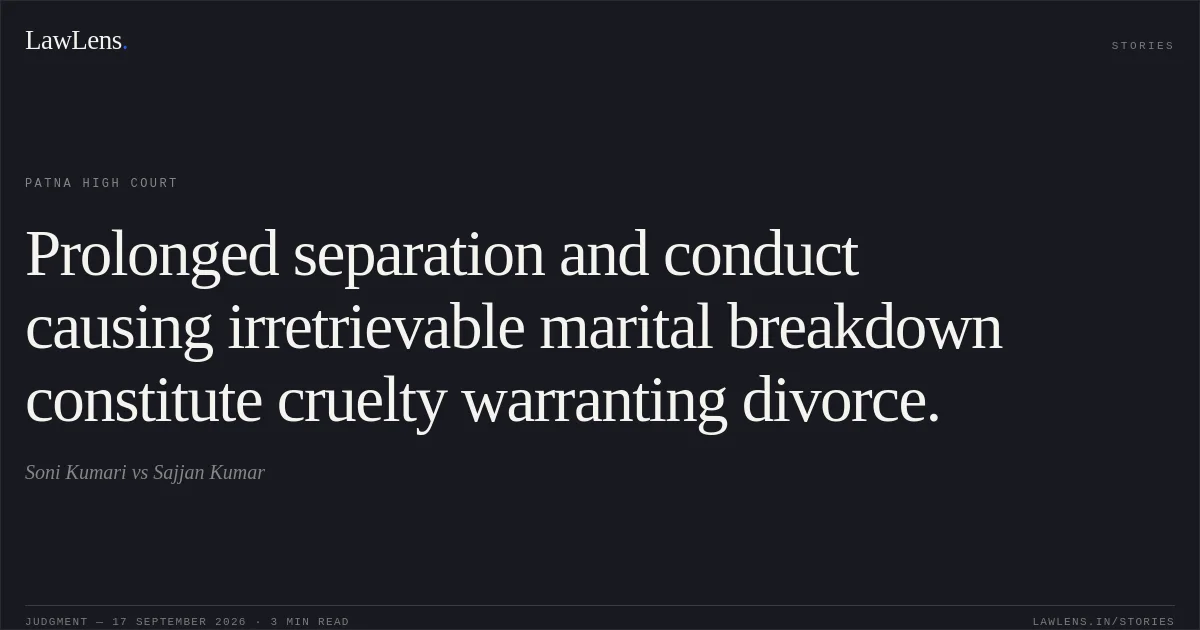
Source reference: p.1In matrimonial proceedings, the Court treated conduct resulting in the permanent and prolonged denial of matrimonial companionship, coupled with unchallenged allegations of abusive and humiliating treatment, as constituting mental cruelty.
Source reference: pp.4–5The Court also recognised that irretrievable breakdown of marriage, by itself, was not a ground on which it could directly grant divorce, but held that conduct causing such breakdown may constitute cruelty warranting dissolution of marriage.
Source reference: pp.4–5No specific statutory provision or precedent was expressly identified in the judgment.
Source reference: no citationReasoning
The Court was satisfied that the wife had shown sufficient cause for the delay and therefore allowed the limitation application.
Source reference: p.1On the merits, the husband had neither contested the divorce proceedings before the Family Court nor appeared before the High Court despite substituted service.
Source reference: pp.3–4His prolonged refusal to resume cohabitation, the parties’ separation for more than thirteen years, and his failure to challenge the wife’s allegations of abuse, humiliation, and abandonment demonstrated that the matrimonial relationship had effectively ceased.
Source reference: pp.4–5Although the Court held that it could not grant divorce solely on the basis of irretrievable breakdown, it regarded the husband’s conduct producing that breakdown and depriving the wife of a continuing matrimonial relationship as mental cruelty.
Source reference: pp.4–5The Family Court’s insistence on specific proof of cruelty, despite the uncontroverted pleadings and surrounding circumstances, was therefore held unsustainable.
Source reference: p.5Holding
The delay in filing the appeal was condoned under Section 5 of the Limitation Act.
The High Court held that the husband’s prolonged separation and unchallenged conduct amounted to cruelty and justified dissolution of the marriage, while clarifying that irretrievable breakdown alone could not independently support the decree.
Source reference: pp.4–5The Family Court’s judgment dated 15 June 2024 was set aside, the appeal was allowed, and the wife was granted a decree dissolving the marriage by divorce.
Source reference: p.5The Registry was directed to draw up the decree accordingly.
Source reference: p.5Acts & Sections Cited
1 provisions across 1 statute referred to in this judgment. Each provision opens on LawLens.
Limitation Act, 19631
Original Court PDF
Soni KumarivsSajjan Kumar
Click to open original judgment
Original judgment, available to read, download and summarize on LawLens.in