Facts
The petitioner, Rajinder Singh, was President of Agroha Gramo Udyog Mandal.
Source reference: p. 2The complainant alleged that the petitioner, in connivance with other office-bearers, fabricated resolutions authorising the opening and operation of a bank account in the name of the Mandal and used those resolutions before the Central Cooperative Bank, Agroha.
Source reference: pp. 2–5The petitioner was alleged to have misappropriated funds belonging to the Mandal, although the complainant could not establish the specific amount of misappropriation.
Source reference: pp. 2–5The trial Court framed charges under Sections 468 and 471 IPC and convicted the petitioner, sentencing him to one year’s simple imprisonment and fine of ₹2,000 for each offence.
Source reference: pp. 5–6The Additional Sessions Judge modified the conviction under Section 468 IPC to Section 465 IPC but maintained the conviction and sentence under Section 471 IPC.
Source reference: pp. 6–8The petitioner filed the present revision and ultimately confined his challenge to reduction of sentence, relying on his age, clean antecedents, first-offender status, and the approximately 19-year duration of the criminal proceedings.
Source reference: pp. 6–8The custody certificate showed that he had undergone four months and seventeen days in custody and that no other case was pending against him.
Source reference: p. 7Issues
Whether the concurrent findings convicting the petitioner for forgery and use of forged documents under Sections 468 and 471 IPC warranted interference in revisional jurisdiction.
Source reference: pp. 6–8Whether the conviction under Section 468 IPC was correctly converted by the appellate Court to Section 465 IPC, notwithstanding the finding that the forgery was committed with the intent that the forged documents be used for cheating.
Source reference: pp. 10–12Whether, considering the petitioner’s age, clean antecedents, first-offender status, period already undergone, and prolonged pendency of the proceedings, the sentence of one year’s imprisonment should be reduced to the period already undergone.
Source reference: pp. 8–14Law Applied
The Court applied Sections 463–465 IPC, which define forgery and prescribe punishment for forgery simpliciter, Section 468 IPC, which aggravates forgery committed with the intention that the forged document be used for cheating, and Section 471 IPC, which punishes the fraudulent or dishonest use of a forged document as genuine.
Source reference: pp. 10–12Relying on Shivaji Narayan Shinde v. State of Maharashtra, the Court held that actual commission of cheating is not necessary for Section 468 IPC; the relevant consideration is the intention or purpose behind the forgery.
Source reference: pp. 10–12Under M.S. Sheriff v. State of Madras, civil proceedings do not bar criminal proceedings, although a civil judgment may be relevant for limited purposes such as sentencing.
Source reference: pp. 8–9The Court further applied the proportionality and reformative principles recognised in Israfil @ Pappu @ Naimuddin Khan v. State of Madhya Pradesh, Satish v. State of U.P., and Sanwal Ram v. State of Haryana, under which sentencing must balance the seriousness of the offence with the offender’s role, incarceration, passage of time, antecedents, age, and prospects of reform.
Source reference: pp. 12–14Reasoning
The Court declined to interfere with the concurrent factual findings because the petitioner’s counsel did not press the revision on merits and the evidence established that the disputed resolutions had neither been passed nor entered in the Mandal’s records, yet were used for opening and operating the bank account.
Source reference: pp. 3–6, 8The civil suit concerning rendition of accounts did not adjudicate the alleged forgery and therefore did not preclude the criminal prosecution; however, it could be considered while determining sentence.
Source reference: pp. 8–9The Court held that the appellate Court had incorrectly reduced the conviction from Section 468 to Section 465 IPC because the record and the very use of the forged resolutions showed the requisite intent that they be used for cheating.
Source reference: pp. 10–13Nevertheless, since the State’s appeal for enhancement had already been dismissed, the petitioner’s sentence had not been challenged before the High Court, and counsel raised no objection to restoring the Section 468 conviction, the Court upheld the conviction under Sections 468 and 471 IPC while granting sentencing relief.
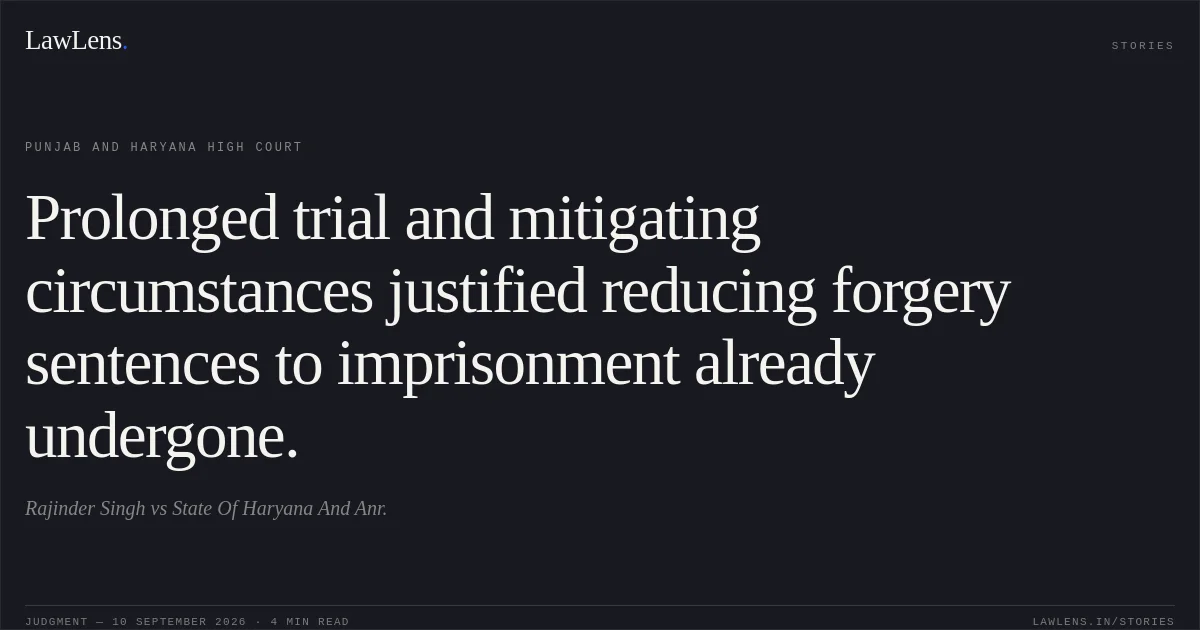
Source reference: pp. 10–13The petitioner’s age of approximately 70 years, first-offender status, absence of other criminal cases, four months and seventeen days of custody, and the 19-year pendency of the proceedings justified reducing the custodial sentence on proportionality and reformative grounds.
Source reference: pp. 7–8, 12–14Holding
The revision petition was disposed of with the conviction under Sections 468 and 471 IPC upheld.
The appellate Court’s alteration of the Section 468 conviction to Section 465 IPC was modified, and the petitioner’s imprisonment was reduced to the period already undergone.
Source reference: p. 14The fine imposed by the trial Court remained intact.
Source reference: p. 14Acts & Sections Cited
9 provisions across 2 statutes referred to in this judgment. Each provision opens on LawLens.
Indian Penal Code, 18608
Code of Criminal Procedure, 19731
Original Court PDF
Rajinder SinghvsState Of Haryana And Anr.
Click to open original judgment
Original judgment, available to read, download and summarize on LawLens.in