Facts
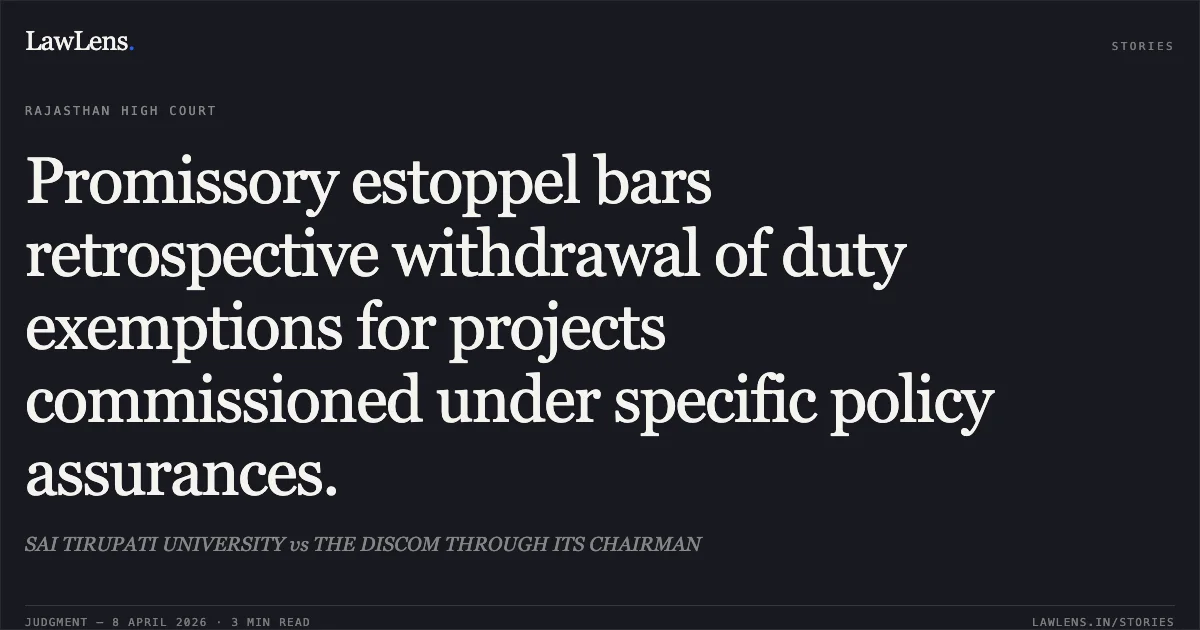
The State of Rajasthan notified the Solar Policy, 2019, which explicitly assured an exemption from the payment of electricity duty for a period of seven years from the Commercial Operation Date (COD) for captive solar power plants
Source reference: para 2, 5.14Relying on this sovereign representation, Petitioner No. 1 (UltraTech) altered its position by investing approximately ₹89 crores to establish captive solar power generation facilities in Rajasthan
Source reference: para 5.17, 9On 10.05.2022, the State issued an amendment to Clause 16.4 of the Policy, effectively withdrawing the blanket seven-year exemption and making such benefits subject to separate government notifications issued under the Rajasthan Electricity (Duty) Act, 1962
Source reference: para 5.18, 9.3Consequently, the respondents began raising electricity duty bills on the petitioners' plants
Source reference: para 5.19The petitioners challenged the amendment, seeking the enforcement of the original exemption on the grounds of promissory estoppel and legitimate expectation
Source reference: para 4Issues
1. Whether the policy assurances made by the State in the Solar Policy, 2019 regarding electricity duty exemptions are enforceable under the doctrines of promissory estoppel and legitimate expectation?
Source reference: para 12. Whether the State can retrospectively withdraw fiscal incentives to the detriment of investors who have already commissioned projects based on those incentives?
Source reference: para 20Law Applied
The court primarily applied Section 3(3) of the Rajasthan Electricity (Duty) Act, 1962, which grants the State the power to exempt consumers from electricity duty in the public interest
Source reference: para 9.1It relied on the equitable doctrine of Promissory Estoppel derived from Motilal Padampat Sugar Mills v. State of U.P., which holds the State accountable to promises that induce a party to act to their detriment
Source reference: para 14The court further applied the principle of Legitimate Expectation and the test of Non-arbitrariness under Article 14 of the Constitution, as discussed in State of Jharkhand v. Brahmputra Metallics Ltd. and State of Punjab v. Nestle India Ltd., asserting that executive policy changes must be fair and supported by overriding public interest if they negate prior assurances
Source reference: para 7, 14.1Reasoning
The State argued that the Solar Policy was a non-statutory executive guideline and that exemptions could only be granted via formal notification under the 1962 Act
Source reference: para 8(A)-(B)The Court rejected this, reasoning that the State cannot rely on its own failure to issue a statutory notification to defeat a concrete promise made in a formal policy intended to attract investment
Source reference: para 15The petitioners fulfilled all ingredients of promissory estoppel: a clear representation, intent to induce action, and substantial capital expenditure
Source reference: para 13, 16Regarding the State's claim of "public interest" based on financial constraints, the Court found this to be a "bald assertion" unsupported by evidence, especially given that the State's solar capacity targets had not yet been reached
Source reference: para 17The Court held that while the State has the flexibility to change economic policy, it cannot do so retrospectively to divest "accrued or vested rights"
Source reference: para 19Such an abrupt withdrawal without a transitional mechanism was deemed "manifestly arbitrary"
Source reference: para 19Holding
The High Court disposed of the petitions, holding that the impugned amendment dated 10.05.2022 cannot operate retrospectively and is only prospective in nature
The Court held that petitioners whose solar projects were commissioned prior to the amendment (10.05.2022) are entitled to the promised seven-year electricity duty exemption from their respective COD
Source reference: para 20, 21The Court directed the competent authorities to verify the exact COD of each project and pass independent orders granting the exemption for the limited seven-year period
Source reference: para 21, 29, 34Relief was similarly extended to individual members of petitioner associations and rooftop solar owners, subject to verification of their commissioning dates
Source reference: para 29, 34Acts & Sections Cited
3 provisions across 1 statute referred to in this judgment. Each provision opens on LawLens.
Original Court PDF
SAI TIRUPATI UNIVERSITYvsTHE DISCOM THROUGH ITS CHAIRMAN
Click to open original judgment
Original judgment, available to read, download and summarize on LawLens.in