Facts
The applicant, an Armament Mechanic at the 506 Army Base Workshop, challenged an order dated 25.09.2015
Source reference: p. 2He sought the first Assured Career Progression (ACP) benefit upon completing 12 years of service from 09.08.1999 and the second ACP after 24 years
Source reference: p. 4-5The respondents contended that the post of Armourer is a promotional post from Tradesman Mate (Semi-Skilled), and unlike other trades that included a "Skilled" grade, Armourers moved directly to "Highly Skilled Grade II"
Source reference: p. 5-7The respondents argued that this movement constituted a promotion, disqualifying the applicant from the first ACP benefit
Source reference: p. 8The applicant also alleged discrimination as other trades received the benefit
Source reference: p. 4Procedurally, the applicant filed this O.A. in 2015, whereas his representation had been effectively settled or ignored since 2004
Source reference: p. 8Issues
1. Whether the movement from Armourer Mate to Armourer (Highly Skilled Grade) constitutes a "promotion," thereby disentitling the employee to the first ACP benefit
Source reference: p. 72. Whether the Original Application is barred by the limitation period under the Administrative Tribunals Act, 1985
Source reference: p. 83. Whether the denial of ACP benefits to Armourers vis-à-vis other trades amounts to unlawful discrimination
Source reference: p. 10Law Applied
The court applied Section 21 of the Administrative Tribunals Act, 1985, which prescribes a one-year limitation period for filing applications.
Source reference: p. 9The principle from S.S. Rathore v. State of M.P., which establishes that repeated unsuccessful representations do not extend the limitation period
Source reference: p. 9The doctrine of equality in pay as interpreted in Associate Banks Officers Association v. State Bank of India, holding that parity is only applicable to similarly situated employees
Source reference: p. 10State of Uttar Pradesh v. Ramashyraya Yadav, which mandates that different functions or scales justify different treatment
Source reference: p. 10Reasoning
The cause of action arose in 2004 when the applicant’s initial representation went unaddressed or was rejected; filing in 2015 after a 11-year gap, supported only by "repeated representations," was held barred by Section 21 of the Act and the S.S. Rathore precedent
Source reference: p. 8-9The Tribunal noted that the Armourer trade enjoyed a higher entry-level pay scale (Rs. 330–480) compared to other trades (Rs. 260–400) and reached Highly Skilled status faster
Source reference: p. 5Following the precedent set in a similar case, Praveen Kumar Borkar v. Union of India (O.A. 120/2006), the Tribunal reasoned that since moving to the Armourer grade was a promotion from Tradesman Mate (Semi-Skilled), it offset the first ACP entitlement
Source reference: p. 10The Tribunal concluded that having enjoyed better prospects and pay scales historically, the applicant could not claim "discrimination" for being excluded from a scheme meant to alleviate stagnation in other cadres
Source reference: p. 11Holding
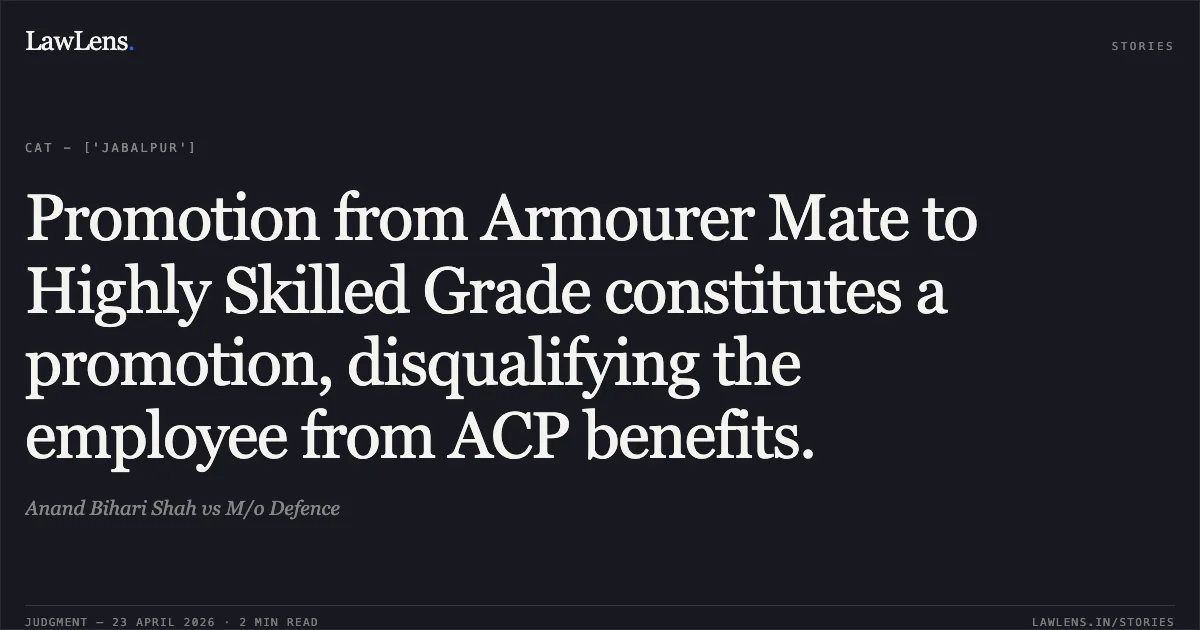
The Tribunal held that the post of Armourer is indeed a promotional post, and its occupants are not entitled to the first ACP benefit on the same terms as other trades
The Tribunal dismissed the Original Application for being hit by the bar of limitation as the applicant failed to approach the Tribunal within the statutory timeframe following the initial grievance
Source reference: p. 9, 11Acts & Sections Cited
2 provisions across 2 statutes referred to in this judgment. Each provision opens on LawLens.
Administrative Tribunals Act, 19851
Limitation Act, 19631
Original Court PDF
Anand Bihari ShahvsM/o Defence
Click to open original judgment
Original judgment, available to read, download and summarize on LawLens.in


