Facts
Respondent No. 1 provides business opportunities to army personnel under the name ‘Ardh Sainik Canteen’ since 2015, and Respondent No. 2 is the registered proprietor of the device mark bearing “Ardh Sainik Canteen” as its dominant feature
Source reference: p. 2, para. 6In June 2022, the Appellant’s father entered into a franchise agreement with the Respondents and paid a service charge, but later withdrew and received a refund
Source reference: p. 2, para. 6.1Subsequently, the Appellant began operating a similar business using the mark ‘Bhhotpurv Ardh Sainik Kalyan Canteen,’ which the Respondents alleged was deceptively similar
Source reference: p. 3, para. 6.2The Trial Court found in favor of the Respondents, granting a permanent injunction and awarding Rs. 3,00,000 in damages plus costs
Source reference: p. 3, para. 6.5The Appellant challenged this judgment on grounds of improper authorization of Respondent No. 1 and lack of evidence regarding actual consumer confusion
Source reference: p. 4–5Issues
1. Whether the lack of specific authorization for Respondent No. 1 to institute the suit warranted a dismissal of the entire plaint
Source reference: p. 4, para. 92. Whether an action for infringement can be sustained in the absence of evidence showing actual consumer confusion
Source reference: p. 5, para. 143. Whether the award of nominal damages was justified without proof of actual financial loss
Source reference: p. 7, para. 17Law Applied
The Court applied Section 13 of the Commercial Courts Act and Order XLI of the CPC regarding appellate procedure
Source reference: p. 1-2, para. 5Regarding procedural defects, it relied on United Bank of India v. Naresh Kumar, holding that lack of authorization in corporate suits is a curable defect
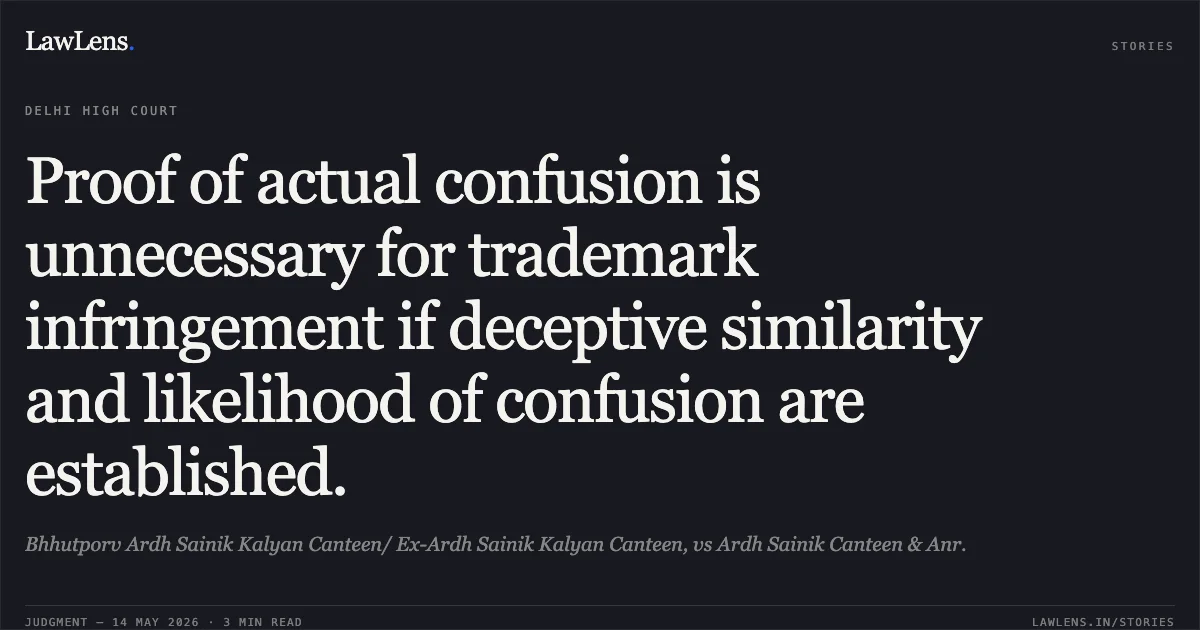
Source reference: p. 5, para. 13For trademark infringement, the Court applied the "likelihood of confusion" test from Renaissance Hotel Holdings Inc. v. B. Vijaya Sai, noting that proof of actual confusion is unnecessary
Source reference: p. 5-6, para. 15It further applied the principle that deceptive similarity is a matter of judicial perception rather than evidence when goods are identical, citing K.R. Chinna Krishna Chettiar v. Shri Ambal & Co.
Source reference: p. 6, para. 15Finally, regarding damages, it followed Kabushiki Kaisha Toshiba v. Tosiba Appliances, asserting that nominal damages may be awarded against a "willful infringer" despite a lack of proof of actual loss
Source reference: p. 7-8, para. 19Reasoning
The Court rejected the procedural objection regarding Respondent No. 1’s authorization, noting that Respondent No. 2 (the registered proprietor) had validly pursued the suit and that the objection was not raised in the written statement
Source reference: p. 4-5, para. 11-13On merits, the Court found the Appellant’s mark to be structurally and phonetically similar to the Respondents' mark, targeting the same consumer base through identical trade channels
Source reference: p. 6, para. 16The Court emphasized that since the Appellant’s father had previously signed a franchise agreement, the Appellant had "due notice" of the Respondents’ rights; therefore, the subsequent adoption of a similar mark was dishonest and intended to "ride upon the reputation" of the Respondents
Source reference: p. 7-8, para. 16, 20Although the Respondents failed to prove actual monetary loss, the Court reasoned that the Appellant’s status as a "willful infringer" who ignored a cease-and-desist notice justified the award of nominal damages
Source reference: p. 7-8, para. 19-20Holding
The High Court dismissed the appeal and upheld the Trial Court’s judgment
It held that: (i) the suit was maintainably instituted by the registered proprietor (Respondent No. 2); (ii) the Appellant’s mark was deceptively similar and caused a likelihood of confusion; and (iii) the award of Rs. 3,00,000 as nominal damages was fair and reasonable given the Appellant's dishonest conduct and prior knowledge of the Respondents' mark. The permanent injunction stands.
Source reference: p. 4, para. 12; p. 6, para. 16; p. 8, para. 20; p. 3, para. 6.5Acts & Sections Cited
1 provisions across 1 statute referred to in this judgment. Each provision opens on LawLens.
Commercial Courts Act, 20151
Original Court PDF
Bhhutporv Ardh Sainik Kalyan Canteen/ Ex-Ardh Sainik Kalyan Canteen,vsArdh Sainik Canteen & Anr.
Click to open original judgment
Original judgment, available to read, download and summarize on LawLens.in


