Facts
The appellant, a Malaria Inspector in the Municipal Corporation of Delhi (MCD), was accused of demanding and accepting a bribe of ₹500/- from PW4 (a dhaba owner) on 05.02.2003
Source reference: p. 1-2The bribe was allegedly intended to prevent the prosecution of PW4 for maintaining unhygienic conditions at his establishment
Source reference: p. 2Following a complaint (Ext. PW4/A), the CBI organized a trap where the appellant was apprehended after receiving chemically treated currency notes
Source reference: p. 9-10The appellant's hand wash subsequently turned pink, and an audio recording of the transaction was obtained
Source reference: p. 11The Trial Court convicted the appellant under Sections 7 and 13(2) read with 13(1)(d) of the Prevention of Corruption Act, 1988 (PC Act), sentencing him to rigorous imprisonment for three years
Source reference: p. 5The appellant challenged this conviction, contending that there was no prior demand and that the shadow witness's testimony was inconsistent with the transcript
Source reference: p. 6-7Issues
1. Whether the prosecution successfully established the foundational facts of demand and acceptance of illegal gratification to sustain a conviction under the PC Act
Source reference: p. 12-132. Whether the statutory presumption under Section 20 of the PC Act was attracted and if the appellant successfully rebutted said presumption
Source reference: p. 133. Whether the inconsistencies in witness testimonies and the defense evidence were sufficient to discredit the prosecution’s case
Source reference: p. 14Law Applied
The court primarily applied Section 7 of the PC Act regarding public servants taking gratification other than legal remuneration and Section 13(1)(d) read with 13(2) concerning criminal misconduct
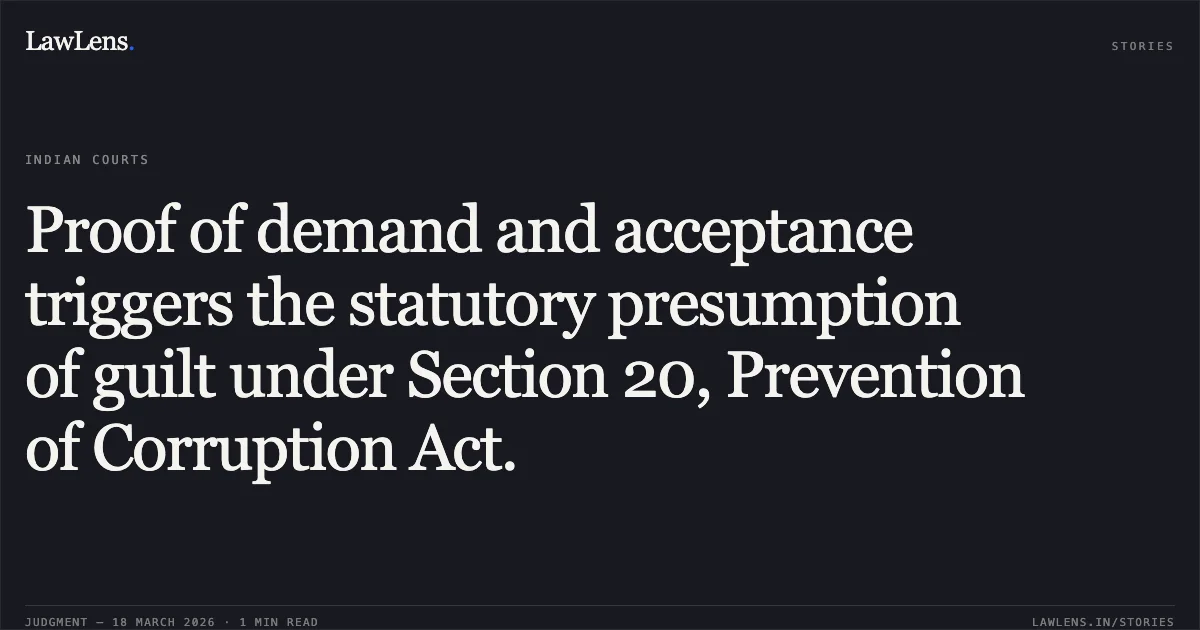
Source reference: p. 1-2It further relied on the mandatory presumption under Section 20 of the PC Act, which stipulates that once the acceptance of gratification is proved, it shall be presumed—unless the contrary is proved—that the gratification was accepted as a motive or reward for an official act
Source reference: p. 13The court also adhered to the appellate standards under Section 374 of the Cr.P.C.
Source reference: p. 1Reasoning
The Court found that the testimony of the complainant (PW4), corroborated by the shadow witness (PW2) and the recovery witness (PW3), clearly established the demand and acceptance of the bribe
Source reference: p. 11-13The scientific evidence from the CFSL (PW8) confirmed that the voice in the trap recording matched the appellant's specimen, further strengthening the prosecution's case
Source reference: p. 11Regarding the defense's argument that the transcript (Ext. PW2/G) did not explicitly show a demand, the Court held that the oral testimonies and the circumstances of the trap were sufficient to prove the "foundational facts"
Source reference: p. 13Once these facts were established, the burden shifted to the appellant under Section 20 of the PC Act to disprove the corrupt intent
Source reference: p. 13The Court noted that the defense witnesses (DW1 and DW2), who claimed the complainant tried to extort money from the appellant post-trap, actually reinforced the fact that the interaction took place, thereby substantiating rather than rebutting the prosecution's narrative
Source reference: p. 14Minor inconsistencies in testimonies were dismissed as immaterial to the core allegations
Source reference: p. 14Holding
The Court answered the issues in the affirmative for the prosecution, holding that the demand and acceptance were proved beyond reasonable doubt
The Court found no infirmity in the Trial Court’s judgment and held that the appellant failed to rebut the statutory presumption under Section 20 of the PC Act
Source reference: p. 14Consequently, the appeal was dismissed, and the conviction and sentence passed by the Trial Court were upheld
Source reference: p. 15Acts & Sections Cited
7 provisions across 2 statutes referred to in this judgment. Each provision opens on LawLens.
Code of Criminal Procedure, 19733
Prevention of Corruption Act, 19884
Original Court PDF
Mahender PrasadvsState (C.B.I)
Click to open original judgment
Original judgment, available to read, download and summarize on LawLens.in


![Subsequent exoneration does not retrospectively invalidate a finalized promotion select list.. UNNIKRISHNAN M vs M/o Environment And Forests. CAT - ['Ernakulam']. LawLens](/stories/thumbnails/subsequent-exoneration-does-not-retrospectively-invalidate-a-finalized-promotion-select-li-ce80a0e84f2f4887857271e8b4341c42.webp)