Facts
On January 5, 1995, Central Excise officials, including respondents A.K. Gaba and Alok Gupta, inspected M/s Amoli Ceraplast Ltd. and seized records without acknowledgment
Source reference: para. 2The complainant alleged that the Superintendent, R.K. Srivastava, demanded a bribe of ₹80,000 for the return of these documents
Source reference: para. 2A CBI trap was conducted on January 14, 1995, leading to the recovery of ₹60,000 from Srivastava’s bedroom and ₹20,000 from his brother’s jacket
Source reference: para. 3The Trial Court convicted the respondents under Section 120-B of the IPC read with Sections 7 and 13 of the Prevention of Corruption (P.C.) Act, 1988
Source reference: para. 4The High Court subsequently acquitted the respondents on May 27, 2019, citing a lack of evidence regarding demand and conspiracy
Source reference: para. 1, 5The State appealed this acquittal to the Supreme Court
Source reference: para. 6Issues
1. Whether the prosecution proved the foundational requirements of "demand" and "acceptance" of illegal gratification against the respondents to sustain a conviction under the P.C. Act
Source reference: para. 10, 112. Whether there was sufficient evidence to establish a criminal conspiracy under Section 120-B of the IPC among the respondents and the principal accused
Source reference: para. 19, 223. Whether the High Court’s order of acquittal warranted interference under the limited scope of Article 136 of the Constitution
Source reference: para. 33, 35Law Applied
The Court applied Section 7 and Section 13(1)(d) read with 13(2) of the P.C. Act, 1988, alongside Section 120-B of the IPC
Source reference: para. 3, 11It relied on the principle that "demand" for a bribe is a sine qua non for conviction, as established in B. Jayaraj v. State of A.P. and P. Satyanarayana Murthy v. District Inspector of Police
Source reference: para. 11, 15The Court invoked Section 20 of the P.C. Act, noting that the presumption of guilt only arises after the proof of demand
Source reference: para. 15Regarding conspiracy, it applied the "meeting of minds" doctrine from State (NCT of Delhi) v. Navjot Sandhu and Esher Singh v. State of A.P.
Source reference: para. 19, 20Furthermore, it applied Section 114 Illustration (g) of the Evidence Act to draw an adverse inference for withholding material evidence, citing Tomaso Bruno v. State of U.P.
Source reference: para. 26it followed the criteria for reversing acquittals set in Chandrappa v. State of Karnataka
Source reference: para. 30Reasoning
The Supreme Court observed that the prosecution failed to establish the indispensable element of "demand" against the respondents, as material witnesses, including the complainant, turned hostile
Source reference: para. 10, 18The Court noted that mere recovery of money is insufficient for conviction if divorced from proof of demand
Source reference: para. 12, 14On the charge of conspiracy, the Court found no evidence of a prior agreement or "meeting of minds"; the mere presence of the respondents at the scene was insufficient to prove they were part of a criminal partnership with the main accused, R.K. Srivastava
Source reference: para. 21-23The Court further criticized the prosecution for withholding a tape recorder allegedly containing the bribe demand, justifying an adverse inference against the State's case
Source reference: para. 25-27Since the Trial Court's conviction was based on "presumptions and conjectures" rather than cogent evidence, the High Court’s decision to grant the benefit of doubt was deemed a plausible and reasonable view
Source reference: para. 28, 34Holding
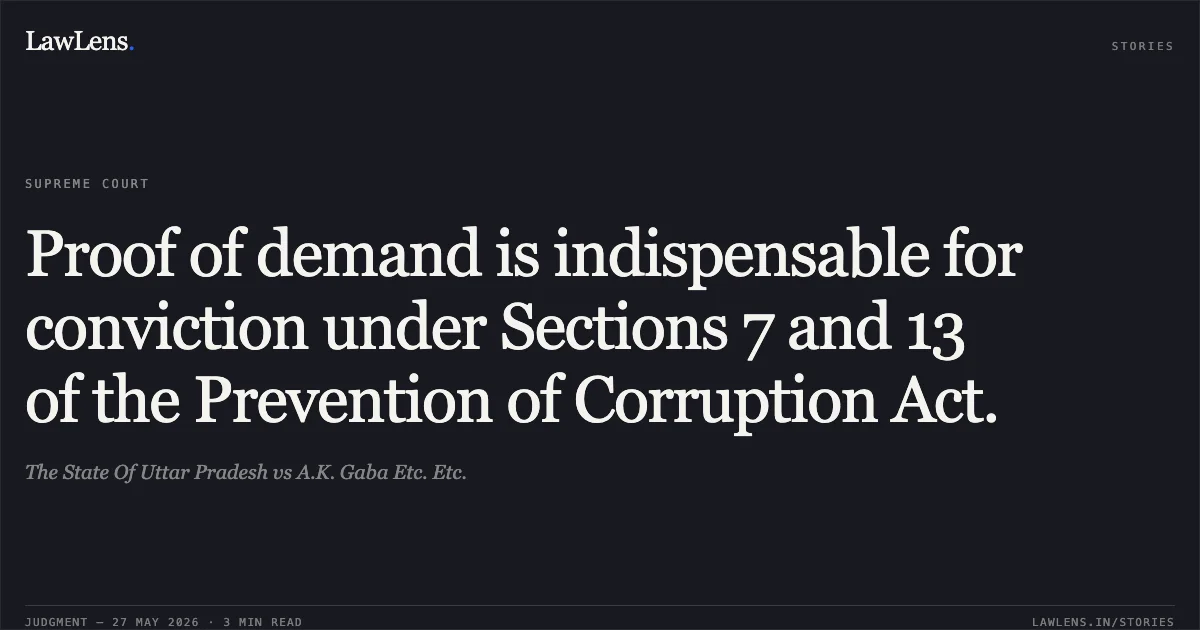
The Court held that the prosecution miserably failed to prove the essential ingredients of demand, acceptance, and conspiracy beyond reasonable doubt
It reaffirmed that an appellate court should not disturb an acquittal unless the findings are perverse or result in a miscarriage of justice
Source reference: para. 33, 35The Supreme Court concluded that the High Court’s judgment was meticulous and did not warrant interference under Article 136
Source reference: para. 34-37The appeals filed by the State of Uttar Pradesh were dismissed
Source reference: para. 38Acts & Sections Cited
7 provisions across 3 statutes referred to in this judgment. Each provision opens on LawLens.
Indian Penal Code, 18602
Prevention of Corruption Act, 19883
Code of Criminal Procedure, 19732
Original Court PDF
The State Of Uttar PradeshvsA.K. Gaba Etc. Etc.
Click to open original judgment
Original judgment, available to read, download and summarize on LawLens.in