Facts
The prosecution alleged that the deceased, married to the appellant in 2012, was subjected to cruelty over demands for a motorcycle and money.
Source reference: pp. 2, 4–5On 5 November 2014, she telephoned her brother, the informant, asking him to take her to her parental home and saying that otherwise she would be killed.
Source reference: pp. 2, 4–5The following morning, the informant found her dead on a cot at her matrimonial home.
Source reference: pp. 2, 4–5The post-mortem recorded a bruise on the neck and a fractured cervical spine, and the doctor attributed death to asphyxia caused by strangulation.
Source reference: pp. 2, 4–5The Sessions Court convicted the appellant under Sections 304B/34 IPC and sentenced him to life imprisonment; he appealed, challenging, among other matters, the proof of dowry demand and the prosecution evidence.
Source reference: pp. 1–2Issues
1. Whether the prosecution proved the essential elements of dowry death under Section 304B IPC, including dowry-related cruelty or harassment soon before the deceased’s death.
Source reference: pp. 4–7, paras. 11–172. Whether the circumstances of the death and the appellant’s failure to explain its cause supported the statutory presumptions under Sections 113B and 106 of the Evidence Act.
Source reference: pp. 7–9, paras. 18–193. Whether the appellant’s conviction and life sentence warranted interference on appeal.
Source reference: p. 9, para. 20Law Applied
Section 304B IPC applies where a woman dies from burns or bodily injury, or otherwise than under normal circumstances, within seven years of marriage, and was subjected soon before death to cruelty or harassment by her husband or his relative in connection with a dowry demand.
Source reference: pp. 4–5, paras. 10–11“Soon before” requires a proximate and live link between dowry-related cruelty and the death; it does not mean “immediately before,” and its application depends on the circumstances of the case.
Source reference: pp. 5–7, para. 16Under Section 113B of the Evidence Act, once the prosecution shows that the woman was subjected soon before death to such cruelty or harassment, the Court must presume that the accused caused the dowry death.
Source reference: pp. 7–9, para. 19Section 106 places on an accused the burden of explaining facts especially within his knowledge.
Source reference: pp. 7–8, para. 19Reasoning
The Court found that the death was unnatural and occurred within seven years of the marriage, relying on the post-mortem evidence and the evidence of the marriage date.
Source reference: pp. 4–5, paras. 12–13It accepted the evidence that the deceased had been subjected to cruelty over demands for a motorcycle and money, and treated her call to the informant on the evening before her death as evidence of a proximate connection between the cruelty and the death.
Source reference: pp. 5, 7, paras. 14–17Because the body was found inside the appellant’s house, the Court also considered the cause of death a matter requiring explanation by the appellant.
Source reference: pp. 7–9, paras. 18–19Finding that he had not discharged the relevant burden, the Court applied the presumption under Section 113B.
Source reference: pp. 7–9, paras. 18–19Holding
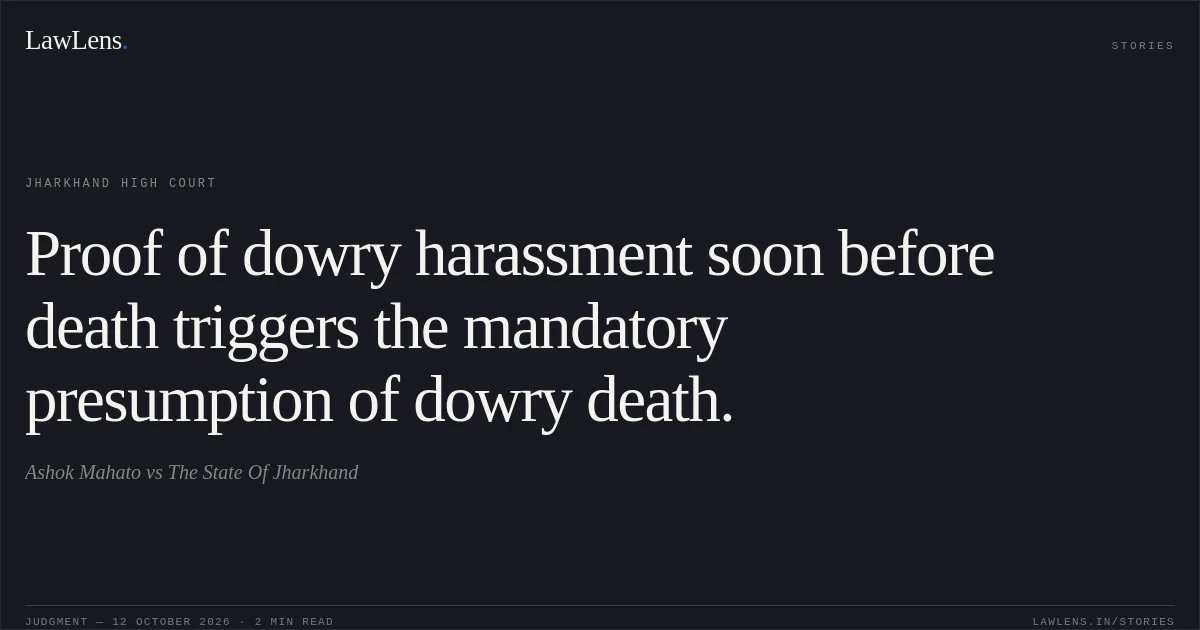
The High Court held that the prosecution had established the ingredients of Section 304B IPC and that the appellant had not rebutted the statutory presumption of dowry death.
It found no ground to interfere with the conviction or sentence and dismissed the appeal, directing that the trial-court record be returned.
Source reference: p. 9, paras. 20–21Acts & Sections Cited
3 provisions across 3 statutes referred to in this judgment. Each provision opens on LawLens.
Indian Penal Code, 18601
Code of Criminal Procedure, 19731
Dowry Prohibition Act, 19611
Original Court PDF
Ashok MahatovsThe State Of Jharkhand
Click to open original judgment
Original judgment, available to read, download and summarize on LawLens.in