Facts
Mahi Devi married the appellant, Dilip Kumar Mahto, on 01.07.2009. On 20.02.2012, she sustained extensive burn injuries and died during treatment on 24.02.2012, within seven years of the marriage.
Source reference: paras. 3–5Her father alleged that the appellant and his mother had subjected her to cruelty and demanded ₹1,00,000 as dowry. The demand was allegedly reiterated on 15.02.2012, shortly before the incident.
Source reference: paras. 3–4, 13–16An FIR was registered under Sections 304-B/34 IPC and Sections 3/4 of the Dowry Prohibition Act.
Source reference: para. 5The trial court acquitted the appellant’s mother but convicted the appellant under Section 304-B IPC and sentenced him to seven years’ simple imprisonment.
Source reference: para. 7The appellant challenged the conviction, principally alleging non-examination of the officer who prepared the inquest report, contradictions in the prosecution evidence, absence of direct evidence, and failure to prove the case beyond reasonable doubt.
Source reference: paras. 8–9Issues
Whether the prosecution established the essential ingredients of a dowry death under Section 304-B IPC, including cruelty or harassment for dowry “soon before” the deceased’s death.
Source reference: paras. 27–30, 39–42Whether the evidence established a proximate and live link between the dowry demand, the alleged cruelty, and the deceased’s burn-related death.
Source reference: paras. 31–38, 40–43Whether the alleged accidental-burning defence, the non-examination of the inquest officer, and the evidentiary inconsistencies were sufficient to rebut the statutory presumption under Section 113-B of the Evidence Act.
Source reference: paras. 8–10, 43–49Law Applied
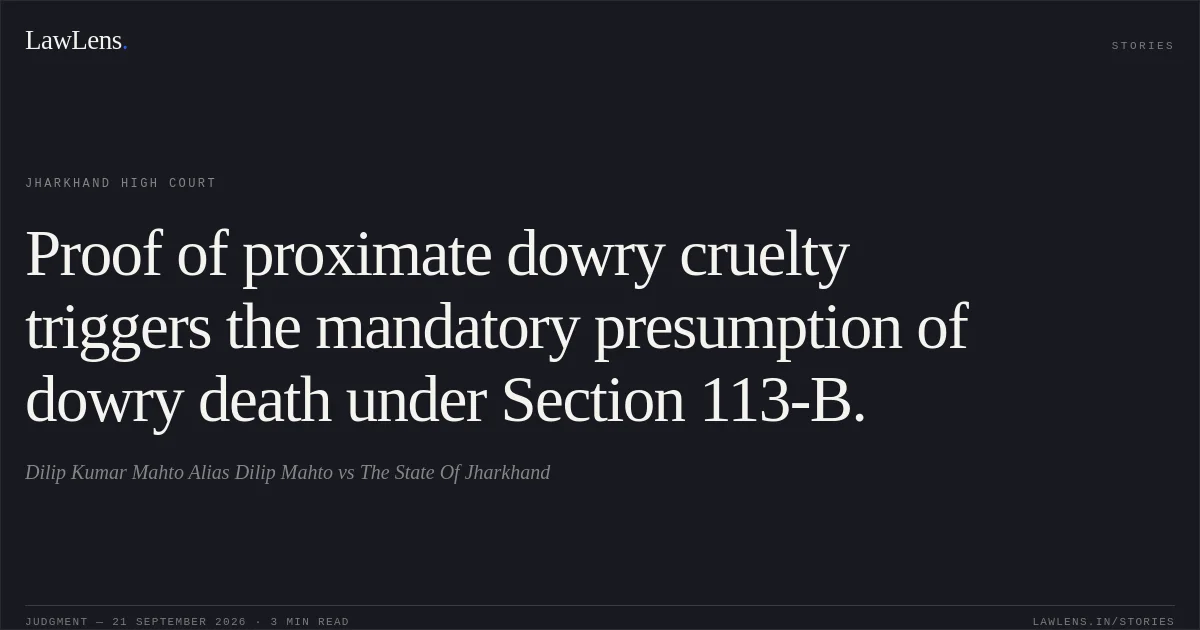
The Court applied Section 304-B IPC, under which a death constitutes dowry death where a woman dies by burns, bodily injury, or otherwise than under normal circumstances within seven years of marriage and is shown to have been subjected, soon before her death, to cruelty or harassment by her husband or his relative in connection with a dowry demand.
Source reference: paras. 27–30Section 113-B of the Indian Evidence Act, 1872 mandates a presumption that the accused caused the dowry death once these foundational facts are established.
Source reference: paras. 35–36Relying on Major Singh v. State of Punjab, (2015) 5 SCC 201, Satbir Singh v. State of Haryana, (2021) 6 SCC 1, Surinder Singh v. State of Haryana, (2014) 4 SCC 129, and State of M.P. v. Jogendra, (2022) 5 SCC 401, the Court held that “soon before” is a relative expression requiring a proximate and live link, not necessarily conduct immediately preceding death; Section 304-B also covers deaths that may be homicidal, suicidal, or accidental, provided the statutory ingredients are satisfied.
Source reference: paras. 31–38The accused bears the burden of rebutting the Section 113-B presumption once the prosecution establishes the foundational facts.
Source reference: paras. 35–38Reasoning
The Court found that the deceased died of approximately 80% ante-mortem burns and septicemia, thereby establishing death otherwise than under normal circumstances.
Source reference: para. 25Her marriage had taken place less than seven years before her death, satisfying the temporal requirement.
Source reference: para. 39The evidence of the deceased’s father, uncle, mother, aunt, and family acquaintance consistently supported the allegation that the appellant and his mother demanded ₹1,00,000 and that the demand was reiterated on 15.02.2012, when the deceased was allegedly physically mistreated.
Source reference: paras. 13–23, 40–42The Court treated this evidence as establishing the required proximate link between dowry-related cruelty and death.
Source reference: paras. 40–42It rejected the accidental-burning defence because the appellant’s version was unsupported by evidence, the burn injuries covered both the front and back of the body, and the Investigating Officer found smoke stains and a burnt portion of the bed in the room.
Source reference: paras. 43–47The appellant’s statement under Section 313 Cr.P.C. did not by itself establish the defence, and he failed to adduce evidence rebutting the statutory presumption.
Source reference: paras. 46–49The Court further held that non-examination of the officer who prepared the inquest report was not fatal in view of the remaining evidence supporting the conviction.
Source reference: paras. 8–10, 49Holding
The Court held that the prosecution proved all essential ingredients of Section 304-B IPC and that the presumption under Section 113-B of the Evidence Act operated against the appellant.
The appellant failed to rebut that presumption or establish that the deceased’s death was accidental.
Source reference: paras. 48–49The judgment of conviction dated 30.11.2016 and order of sentence dated 06.12.2016 were affirmed, and the criminal appeal was dismissed.
Source reference: paras. 49–52The appellant’s sentence of seven years’ simple imprisonment under Section 304-B IPC was consequently maintained.
Source reference: paras. 49–52Acts & Sections Cited
6 provisions across 3 statutes referred to in this judgment. Each provision opens on LawLens.
Indian Penal Code, 18602
Code of Criminal Procedure, 19731
Original Court PDF
Dilip Kumar Mahto Alias Dilip MahtovsThe State Of Jharkhand
Click to open original judgment
Original judgment, available to read, download and summarize on LawLens.in