Facts
The prosecution alleged that on 18 August 2013, a car driven rashly and negligently by the respondent collided with two motorcycles, causing injuries and a death.
Source reference: paras. 1–6, pp. 2–6The respondent was charged under Sections 279, 337 and 304-A of the Indian Penal Code.
Source reference: paras. 1–6, pp. 2–6The JMFC acquitted him, finding that the prosecution had not reliably established that he was driving the car.
Source reference: paras. 1–6, pp. 2–6The State appealed under Section 378 of the Code of Criminal Procedure.
Source reference: paras. 1–6, pp. 2–6On appeal, the High Court noted that the eyewitnesses described the collision but did not identify the respondent in court; PW1’s statement during cross-examination that the respondent was driving was treated as inconsistent with the witnesses’ other evidence.
Source reference: para. 12, pp. 8–10Issues
1. Whether the State established grounds to interfere with the acquittal, including that the respondent was driving the car involved in the accident.
Source reference: para. 9, p. 62. Whether the trial court’s acquittal was a possible view on the evidence or suffered from an error warranting appellate reversal.
Source reference: paras. 11, 14, pp. 6–8, 16Law Applied
Sections 279, 337 and 304-A IPC govern, respectively, rash driving on a public way, causing hurt by an act endangering life or personal safety, and causing death by a rash or negligent act; criminal liability required proof beyond reasonable doubt that the respondent committed the alleged acts, including that he was driving the car.
Source reference: para. 11, pp. 6–8Under Section 378 CrPC, an appellate court may reappraise the evidence in an appeal against acquittal, but the acquittal reinforces the presumption of innocence.
Source reference: para. 11, pp. 6–8Applying Constable 907 Surendra Singh v. State of Uttarakhand (2025) 5 SCC 433, Babu Sahebgouda Rudragoudar v. State of Karnataka (2024) 8 SCC 149, Chandrappa v. State of Karnataka (2007) 4 SCC 415 and H.D. Sundara v. State of Karnataka (2023) 9 SCC 581, the Court stated that an acquittal should not be reversed where the trial court’s view is reasonably possible; interference is warranted where the decision is perverse, overlooks or misreads material evidence, or guilt is the only reasonable conclusion.
Source reference: para. 11, pp. 6–8Reasoning
The Court accepted that the evidence supported the occurrence of the accident and the resulting injuries and death, but held that those facts alone did not establish the respondent’s guilt.
Source reference: paras. 12–14, pp. 8–16PW1–PW3 did not identify him in court, and PW1’s inconsistent statement on the driver’s identity was insufficient, without corroboration, to prove that the respondent was driving.
Source reference: paras. 12–14, pp. 8–16The other evidence, including the vehicle inspection and evidence of the car’s damage, did not cure that deficiency.
Source reference: paras. 12–14, pp. 8–16Given the unresolved doubt about the driver’s identity, the trial court’s acquittal was a possible view of the evidence and disclosed no basis for appellate interference.
Source reference: paras. 12–14, pp. 8–16Holding
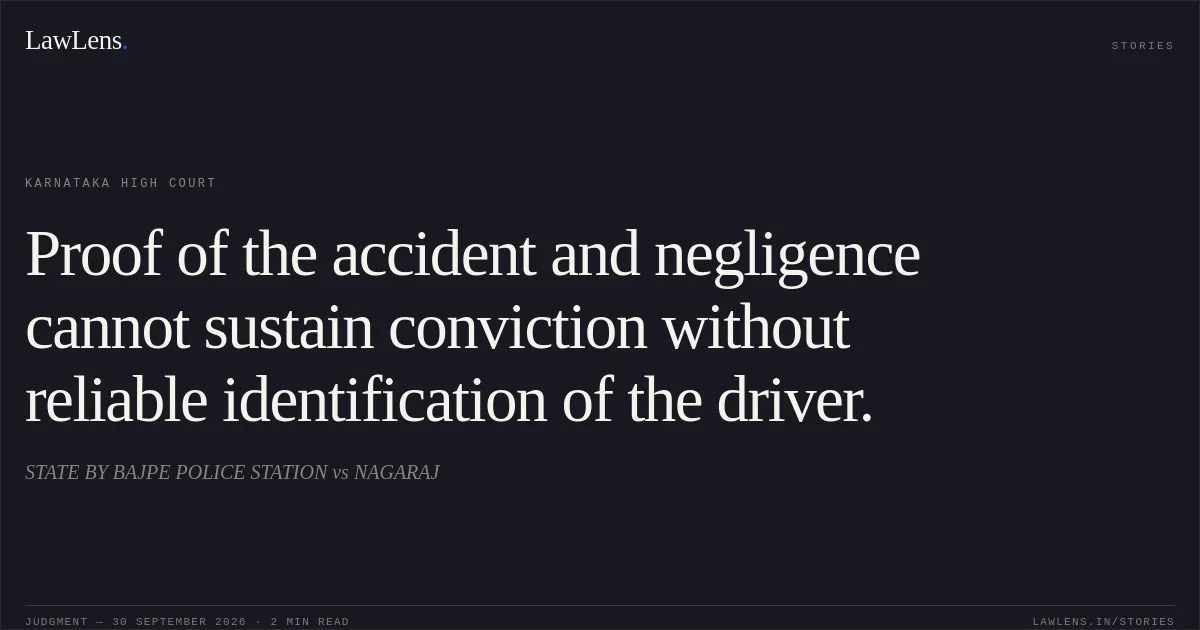
The High Court answered the State’s appeal point in the negative, holding that the prosecution had not proved beyond reasonable doubt that the respondent was driving the car.
Finding no legal or factual error in the trial court’s acquittal, it dismissed the appeal and left the acquittal undisturbed.
Source reference: paras. 10, 13–14, pp. 6, 15–16Acts & Sections Cited
6 provisions across 3 statutes referred to in this judgment. Each provision opens on LawLens.
Code of Criminal Procedure, 19732
Indian Penal Code, 18603
Motor Vehicles Act, 19881
Original Court PDF
STATE BY BAJPE POLICE STATIONvsNAGARAJ
Click to open original judgment
Original judgment, available to read, download and summarize on LawLens.in