Facts
The plaintiffs, daughters of defendant No. 1 Chinnaswamy, sought partition and separate possession of the suit property.
Source reference: p. 3–4The property had been purchased jointly in the names of Chinnaswamy and his nephew, defendant No. 4, Baluswamy.
Source reference: p. 3–4The plaintiffs contended that the purchase was funded by proceeds from the sale of family properties.
Source reference: p. 3–4The trial court dismissed the suit; the first appellate court reversed that decision and declared the plaintiffs entitled to a 1/10 share each.
Source reference: p. 8–9Defendant No. 5, a subsequent purchaser, appealed under Section 100 of the Code of Civil Procedure (CPC).
Source reference: p. 17The High Court admitted the appeal on a substantial question of law concerning whether the first appellate court had evidence to find that the purchase was funded by the proceeds of the earlier sale.
Source reference: p. 4Issues
Whether the first appellate court was justified in holding that the suit property was acquired from the sale proceeds of Ex. P1, allegedly without evidence
Source reference: p. 4Law Applied
Section 100 CPC confines a second appeal to a substantial question of law.
Source reference: p. 10In determining whether property was acquired from a joint-family nucleus, the court may consider the evidence concerning the family’s prior property, the sale proceeds available, the timing and value of the subsequent purchase, and relevant admissions.
Source reference: p. 17–20The court also applied the evidentiary principle that an adverse inference may be drawn where a party with relevant knowledge does not enter the witness box to support its case.
Source reference: p. 17–20Reasoning
The High Court found that Ex. P1 recorded the sale of family properties for Rs. 17,000 and that, within approximately 45 days, Chinnaswamy and Baluswamy jointly purchased the suit property for Rs. 20,000.
Source reference: p. 17–21It relied on Chinnaswamy’s admissions concerning the earlier properties and their sale, as well as the absence of evidence that Baluswamy had an independent source of funds.
Source reference: p. 17–21Baluswamy’s failure to testify supported an adverse inference.
Source reference: p. 17–21In those circumstances, the first appellate court was entitled to find that the purchase was funded by the available joint-family proceeds; the High Court therefore rejected the appellant’s assertion that the finding lacked evidentiary support.
Source reference: p. 17–21Holding
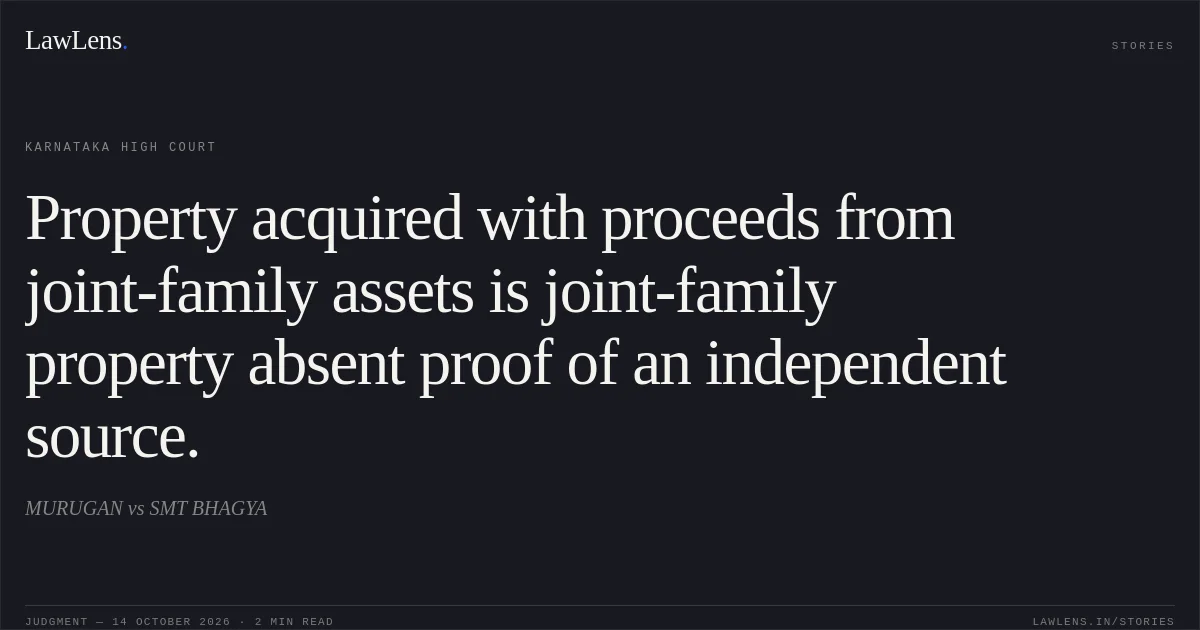
The High Court answered the substantial question of law against the appellant, holding that the first appellate court was justified in finding that the suit property had been acquired with proceeds from the sale of joint-family properties.
It dismissed the second appeal and left undisturbed the decree declaring the plaintiffs entitled to 1/10 share each.
Source reference: p. 21Acts & Sections Cited
1 provisions across 1 statute referred to in this judgment. Each provision opens on LawLens.
Code of Civil Procedure, 19081
Original Court PDF
MURUGANvsSMT BHAGYA
Click to open original judgment
Original judgment, available to read, download and summarize on LawLens.in


