Facts
The dispute concerns the inheritance of a residential property (Khasra No. 690/7) purchased in 1959 by Mattus Anthony (MA), a Christian, in the names of his two wives, Filomina and Shyam Bai
Source reference: p. 3, 6Filomina died in 1985, leaving three children (Plaintiffs). MA died in 1991. Shyam Bai died in 2000; her son John Anthony predeceased her, leaving behind his widow and children (Defendants 1-5).
Source reference: p. 3In 2002, the Defendants sold 888 sq. ft. (half share) to Defendant 6, leading Plaintiffs to challenge the sale
Source reference: p. 3The Trial Court decreed the suit, declaring the sale invalid; the First Appellate Court reversed this, holding each wife (and their heirs) entitled to half
Source reference: p. 3-4The High Court then modified the shares, granting the Plaintiffs 2/3rd as "lineal descendants" and the two widows 1/3rd collectively, applying Section 33 of the Indian Succession Act (ISA)
Source reference: p. 5Issues
1. Whether the High Court correctly applied the provisions of the Indian Succession Act, 1925, specifically Section 33, to property purchased in the names of the wives
Source reference: p. 5, para 72. Whether the property should be treated as the estate of the deceased husband (MA) or the separate estates of the two wives
Source reference: p. 6-7, para 10Law Applied
Section 35 of the Indian Succession Act, 1925, which grants a surviving husband the same rights over his deceased wife’s intestate property as a widow has over her husband’s
Source reference: p. 6Section 33 of the ISA, which mandates that if an intestate leaves a widow and lineal descendants, one-third of the property goes to the widow and two-thirds to the descendants
Source reference: p. 5Section 38 was cited regarding the distribution of property among grandchildren when no children survive the intestate
Source reference: p. 8The principles of benami transactions from Valliammal v. Subramaniam were noted, affirming that intention and source of funds define such transactions
Source reference: p. 8Reasoning
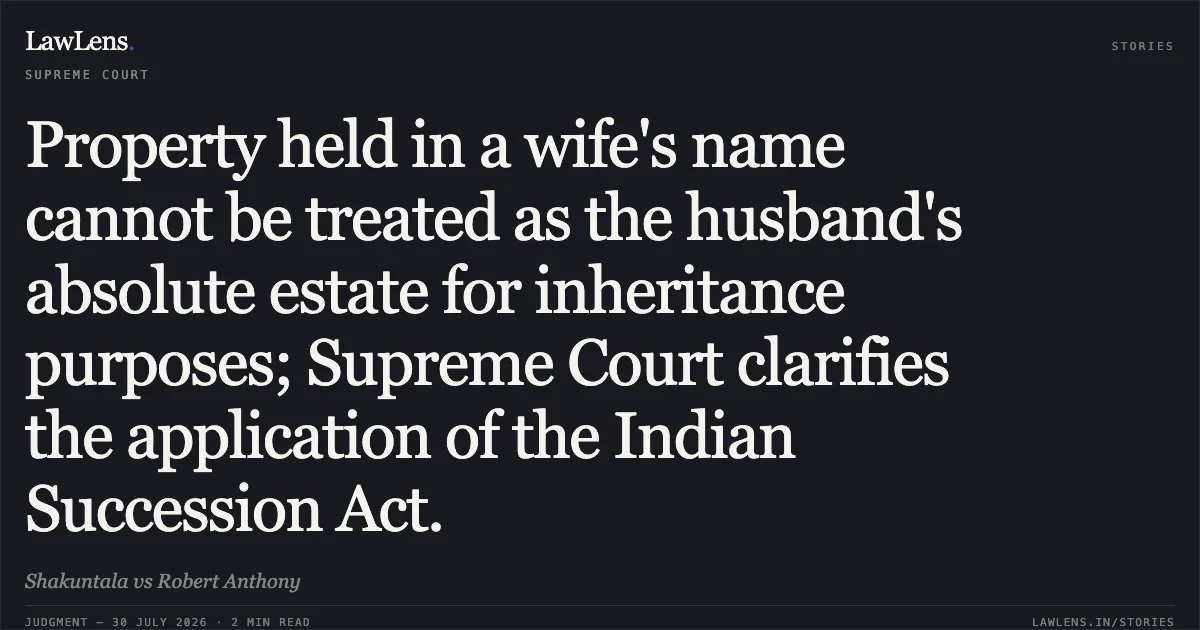
The Supreme Court found the High Court's application of Section 33 to the entire property was erroneous because MA never legally owned the whole property; he purchased it specifically in the names of his two wives
Source reference: p. 6, para 10Since the property was held as tenants-in-common by the wives, it must be treated as two separate estates. Upon Filomina’s death in 1985, Section 35 operated to give MA a 1/3rd share of her half, while 2/3rds of her half devolved to her children (Plaintiffs)
Source reference: p. 7When MA died in 1991, his 1/3rd portion (derived from Filomina) devolved among all his children from both wives as lineal descendants
Source reference: p. 7, para 11Regarding Shyam Bai’s original half-share, since she died intestate and her son John predeceased her, that specific half-share devolved to her grandchildren (the Defendants) under Section 38
Source reference: p. 7-8Holding
The Supreme Court set aside the High Court's judgment. It held that the property was not a single estate of MA but two separate halves belonging to Filomina and Shyam Bai.
The Plaintiffs are entitled to 2/3rds of Filomina's half, plus their proportionate share of the 1/3rd MA inherited from Filomina. The Defendants (heirs of Shyam Bai) are entitled to Shyam Bai's original half-share plus their proportionate share of the 1/3rd MA inherited from Filomina. The appeal was allowed with all consequences to follow
Source reference: p. 7-8, 9Original Court PDF
ShakuntalavsRobert Anthony
Click to open original judgment
Original judgment, available to read, download and summarize on LawLens.in


![Subsequent exoneration does not retrospectively invalidate a finalized promotion select list.. UNNIKRISHNAN M vs M/o Environment And Forests. CAT - ['Ernakulam']. LawLens](/stories/thumbnails/subsequent-exoneration-does-not-retrospectively-invalidate-a-finalized-promotion-select-li-ce80a0e84f2f4887857271e8b4341c42.webp)