Facts
The appellant challenged the judgment and decree dated 10.02.2026 of the Additional District Judge, Pokhran, which dismissed his civil suit under Order VII Rule 11 CPC.
Source reference: para. 1; p. 2The dispute concerned 75 bighas of agricultural land in Khasra No. 294/506, Village Jaimla, District Jaisalmer, originally allotted to the appellant’s grandfather, Chutra Ram, as a landless agriculturist.
Source reference: para. 1; p. 2The appellant claimed that the land was ancestral/coparcenary property and that, as the son of respondent No. 1, he had acquired an undivided 1/9th share by birth.
Source reference: para. 2; p. 2Chutra Ram died intestate on 24.04.2004, after which the land was recorded in the names of his three sons in equal shares.
Source reference: para. 2.1; p. 2Respondent Nos. 1 to 3 subsequently executed a registered sale deed dated 17.04.2025, followed by further alienations dated 26.09.2025 and 29.09.2025 in favour of other respondents.
Source reference: para. 2.1; p. 2The appellant sought declaration of his rights, cancellation of the sale deeds and permanent injunction.
Source reference: para. 2.2; p. 3During the suit, respondent No. 7 was impleaded and applied under Order VII Rule 11 CPC, contending that the appellant had no established khatedari right and that determination of such right fell within the jurisdiction of the revenue court.
Source reference: para. 2.2; p. 3The trial court allowed the application and dismissed the suit.
Source reference: para. 2.2; p. 3Issues
1. Whether the appellant had an existing coparcenary or proprietary interest in the suit property, so as to maintain a suit for partition and cancellation of the impugned sale deeds?
Source reference: para. 6; p. 52. Whether the appellant’s claim of khatedari rights and consequential challenge to the sale deeds was maintainable before the civil court without a prior declaration from the competent revenue court?
Source reference: paras. 7.2–7.5; pp. 14–153. Whether the trial court was justified in rejecting the plaint under Order VII Rule 11 CPC?
Source reference: para. 7.8; p. 16Law Applied
The Court applied Section 96 and Order VII Rule 11 CPC, concerning appellate jurisdiction and rejection of a plaint where it does not disclose a legally maintainable cause of action.
Source reference: no citationUnder Sections 4 and 8 read with the Schedule of the Hindu Succession Act, 1956, statutory succession prevails over inconsistent customary Hindu law, and the estate of a Hindu male dying intestate devolves upon his Class-I heirs.
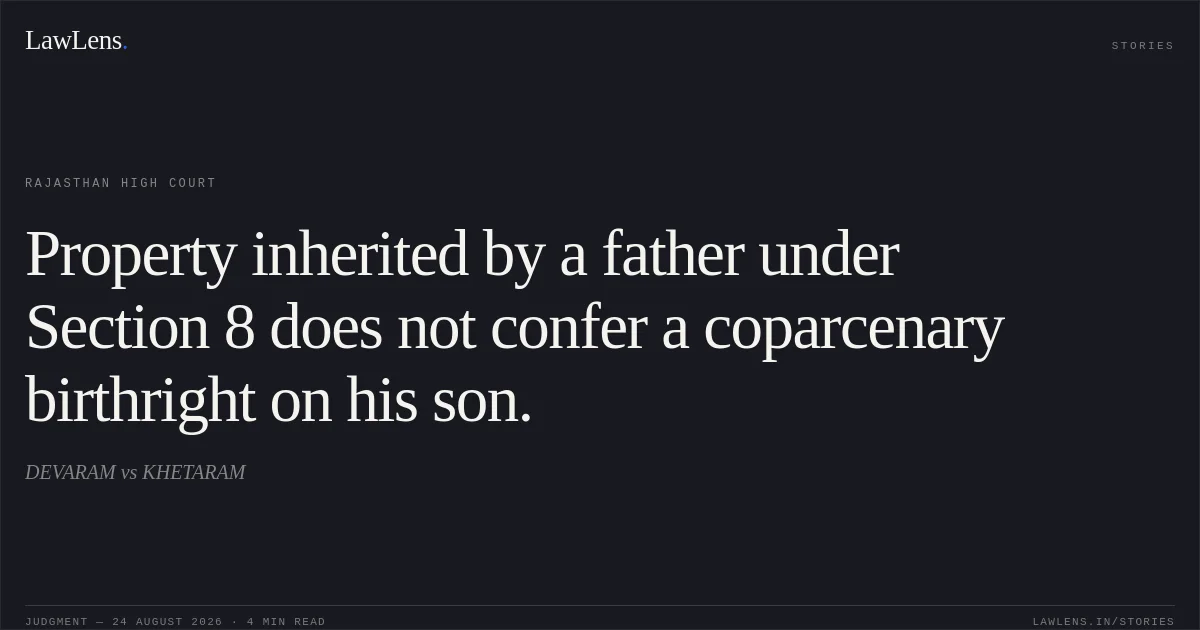
Source reference: paras. 6.7–6.12; pp. 7–11Relying on Uttam v. Saubhag Singh & Ors. (2016) 160 AIC 1, the Court held that property devolving upon heirs under Section 8 does not, merely because of the relationship between predecessor and successor, retain a coparcenary character conferring a birthright on the next generation.
Source reference: paras. 6.7–6.12; pp. 7–11The Court also relied on Pyarelal v. Shubhendra Pilania & Ors., (2019) 3 SCC 692, for the principle that a plaintiff claiming khatedari rights in agricultural land must first establish that foundational right before the competent revenue court.
Source reference: paras. 7.3–7.5; pp. 14–15Sections 88 and 207 of the Rajasthan Tenancy Act, 1955, respectively require declaration of khatedari rights before the revenue court and exclude civil-court jurisdiction over matters assigned to revenue courts.
Source reference: paras. 7.3–7.5; pp. 14–15Reasoning
The Court found that the plaint contained no specific plea that the land had been allotted to a Hindu Undivided Family, that Chutra Ram held it as karta, or that a subsisting HUF/coparcenary estate existed.
Source reference: paras. 6.1–6.4; pp. 5–7Since Chutra Ram died intestate, his three sons succeeded to the property under Section 8 of the Hindu Succession Act in equal shares.
Source reference: paras. 6.8–6.12; pp. 8–11The appellant, being the grandson and not a direct successor to Chutra Ram, could not claim a birthright merely from his relationship with the original allottee.
Source reference: paras. 6.8–6.12; pp. 8–11The Court further held that the appellant’s minority at the time of Chutra Ram’s death did not postpone or alter the statutory devolution.
Source reference: paras. 6.5 and 7; pp. 6, 13In the absence of foundational pleadings establishing the coparcenary character of the property, evidence could not be used to create a new case not pleaded.
Source reference: paras. 6.13–6.16; pp. 11–13Additionally, the appellant’s challenge to the sale deeds was consequential upon his alleged khatedari share.
Source reference: paras. 7.2–7.6; pp. 14–16Because he had neither obtained nor sought the requisite declaration from the competent revenue court, the civil court could not assume jurisdiction to adjudicate the underlying khatedari right or the consequential cancellation claim.
Source reference: paras. 7.2–7.6; pp. 14–16The suit therefore failed both for want of a legally sustainable coparcenary claim and for exclusion of civil-court jurisdiction.
Source reference: paras. 7.2–7.6; pp. 14–16Holding
The High Court held that the appellant had no presently enforceable coparcenary or proprietary interest in the one-third share inherited by his father.
The property devolved upon the appellant’s father individually under Section 8 of the Hindu Succession Act, and the appellant could not claim a 1/9th share by birth in the absence of specific pleadings and proof of a subsisting HUF/coparcenary estate.
Source reference: paras. 6.17 and 7.6; pp. 13, 16The Court further held that the appellant’s foundational khatedari claim was required to be determined by the competent revenue court under Sections 88 and 207 of the Rajasthan Tenancy Act before any consequential challenge to the sale deeds could be maintained in civil court.
Source reference: para. 7.5; p. 15The appeal was dismissed, the trial court’s judgment and decree dated 10.02.2026 were affirmed, and the stay petition and pending applications were disposed of.
Source reference: paras. 7.8, 8 and 8.1; pp. 16–17Acts & Sections Cited
6 provisions across 3 statutes referred to in this judgment. Each provision opens on LawLens.
Code of Civil Procedure, 19081
RAJASTHAN LAND REVENUE ACT, 19561
Hindu Succession Act, 19564
Original Court PDF
DEVARAMvsKHETARAM
Click to open original judgment
Original judgment, available to read, download and summarize on LawLens.in