Facts
The Petitioners, a senior citizen and her daughter (a doctor), were named in an application filed by Respondent No. 3 under Section 156(3) of the Code of Criminal Procedure (CrPC) before the Judicial Magistrate First Class (JMFC), Ponda.
Source reference: para. 2, 3(i)The JMFC dismissed the application on March 15, 2024.
Source reference: para. 3(i)Respondent No. 3 subsequently filed a Criminal Revision Application before the Additional Sessions Judge.
Source reference: para. 3(ii)On August 20, 2025, the Sessions Judge allowed the revision, set aside the JMFC’s order, and directed the police to register an FIR against the Petitioners without providing them an opportunity to be heard.
Source reference: para. 3(ii), 6Consequently, FIR No. 125/2025 was registered.
Source reference: para. 3(iii)the Petitioners approached the High Court seeking to quash the Sessions Judge's order and the FIR.
Source reference: para. 1Issues
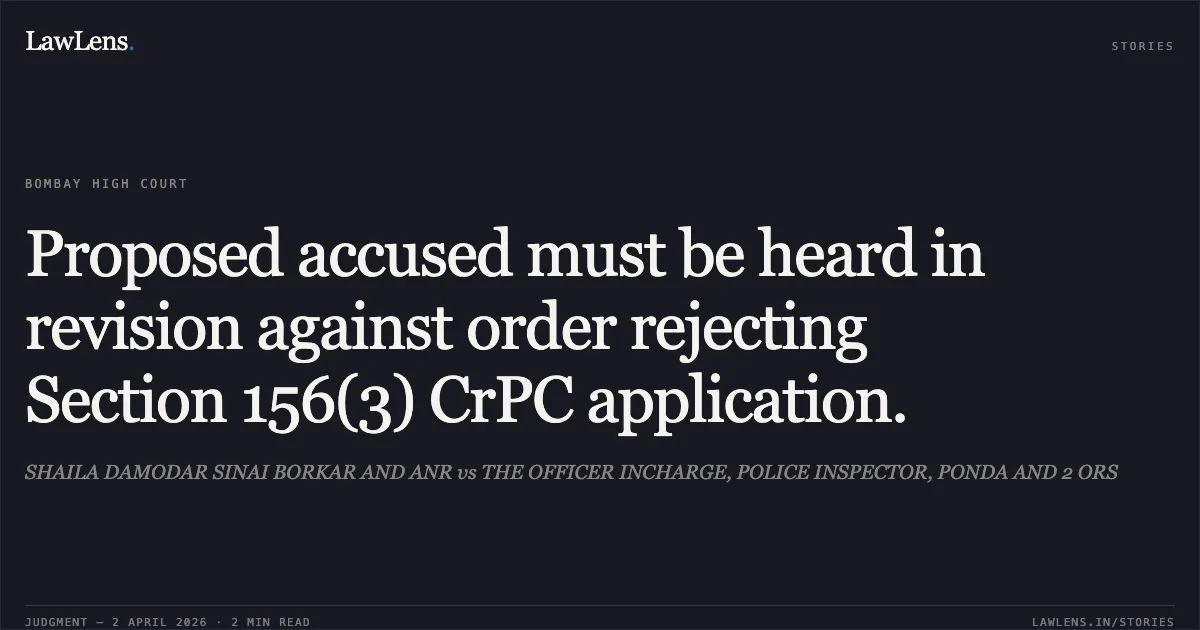
Whether a proposed accused is legally required to be heard by a Revisional Court in a revision filed by a complainant against the rejection of an application under Section 156(3) of the CrPC.
Source reference: para. 7Law Applied
Section 401(2) of the CrPC mandates that no order in revision shall be made to the prejudice of the accused or "other person" unless they have had an opportunity of being heard in their own defence.
Source reference: para. 8, 10Section 399(2) of the CrPC extends the powers and procedural requirements of the High Court’s revisionary jurisdiction to the Sessions Judge.
Source reference: para. 9The Supreme Court precedents of Manharibhai Muljibhai Kakadia v. Shaileshbhai Mohanbhai Patel (2012) and Santhakumari v. State of Tamil Nadu (2023) established that the right of hearing in a Revisional Court exists for a suspect regardless of whether the stage is pre-process or post-process.
Source reference: para. 14, 15Reasoning
The court examined the statutory framework of Sections 397, 399, and 401 of the CrPC, concluding that the mandate to hear a party before passing an order to their prejudice is absolute in revisionary proceedings.
Source reference: para. 9-10The court rejected the Respondent's contention that a hearing was unnecessary because the Magistrate’s order was "pre-cognizance".
Source reference: para. 13Referring to the Full Bench decision in Jagannath Verma v. State of UP, the court reasoned that while a prospective accused has no right to be heard during the original Section 156(3) proceedings before a Magistrate, they acquire a substantive right to defend a favorable order when it is challenged in a higher forum.
Source reference: para. 16The court found that the Sessions Judge’s order directing the registration of an FIR significantly prejudiced the Petitioners without granting them the statutory hearing required under Section 401(2).
Source reference: para. 18Thus, the order was procedurally and legally flawed.
Source reference: para. 18-19Holding
The High Court allowed the petition, holding that the failure to hear the proposed accused in a revision against a Section 156(3) dismissal violates the mandatory provisions of the CrPC.
The court quashed the Sessions Judge's order dated August 20, 2025, and the resulting FIR No. 125/2025.
Source reference: para. 20(i), (v)The matter was remanded to the Additional Sessions Judge, Merces (sitting at Ponda), with directions to add the Petitioners as respondents and decide the revision afresh after giving them an opportunity to be heard.
Source reference: para. 20(ii), (iii)Acts & Sections Cited
22 provisions across 2 statutes referred to in this judgment. Each provision opens on LawLens.
Indian Penal Code, 18605
Original Court PDF
SHAILA DAMODAR SINAI BORKAR AND ANRvsTHE OFFICER INCHARGE, POLICE INSPECTOR, PONDA AND 2 ORS
Click to open original judgment
Original judgment, available to read, download and summarize on LawLens.in