Facts
The dispute involves a claim over properties originally belonging to Bhika Gouda, who died in 1951
Source reference: p. 3The Plaintiff (Golapi) claimed title over 'A' and 'B' schedule properties through two gift deeds executed in 1980 by Bhika’s widow, Jasoda, and a subsequent sale deed from Sakuntala (Bhika’s daughter)
Source reference: p. 3Defendant No. 1 (Bhagirathi), the husband of Bhika’s deceased daughter Radhika, contested the suit, claiming he was an illatom son-in-law and that Jasoda, being old, illiterate, and of unsound mind, was incompetent to execute the gift deeds
Source reference: p. 4, 6The Trial Court held the gift deeds were not proved to be validly executed as Jasoda was a pardanashin and illiterate lady who lacked independent legal advice
Source reference: p. 6However, the Trial Court decreed the suit in part based on the Hindu Succession Act
Source reference: p. 7The First Appellate Court, despite the Plaintiff not filing a cross-appeal, invoked Order XLI Rule 33 of the CPC to reverse the finding on the gift deeds, validating them and declaring the Plaintiff's title over the entire property
Source reference: p. 7-8Issues
1. Whether, in the absence of an appeal or cross-objection by the Plaintiff, the First Appellate Court could legally reopen and reverse the Trial Court's finding that the gift deeds (Ext. 1) were invalid
Source reference: p. 8, para. 102. Whether the First Appellate Court erred in validating the gift deeds of an illiterate/pardanashin lady without disturbing the Trial Court's finding regarding the lack of conscious execution
Source reference: p. 8, para. 10Law Applied
The Court applied Order XLI Rule 33 of the CPC, which empowers an appellate court to pass any decree or order to do complete justice, even in favor of a party who has not filed an appeal or cross-objection
Source reference: p. 11It relied on Bihar Supply Syndicate v. Asiatic Navigation [(1993) 2 SCC 639] and Koksingh v. Deokabai [(1976) 1 SCC 383] to confirm this wide discretionary power
Source reference: p. 11-12Regarding the execution of documents by vulnerable persons, the Court applied the principles from Meena Pradhan v. Kamla Pradhan [(2023) 9 SCC 734], which places the burden on the propounder to remove all suspicious circumstances surrounding the execution of a document
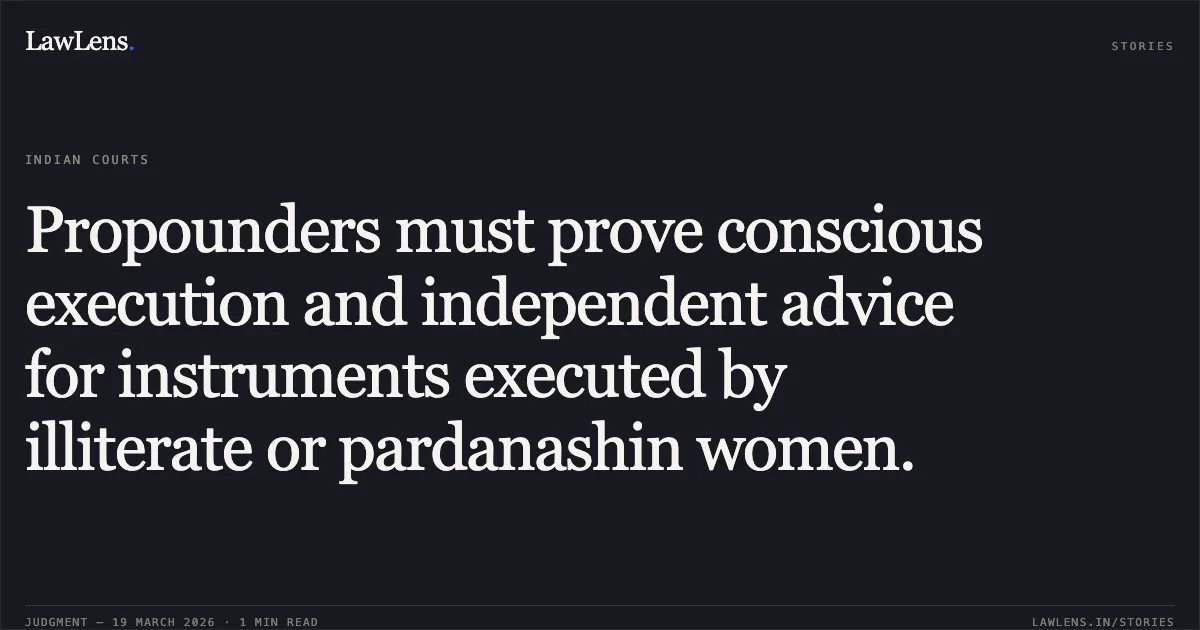
Source reference: p. 15-18Furthermore, it applied the doctrine from Kharbuja Kuer v. Jangbahadur Rai [AIR 1963 SC 1203] and Narayan Mishra v. Champa Dibya [AIR 1968 Ori 53], establishing that for documents executed by pardanashin or illiterate ladies, the propounder must affirmatively prove that the executant had independent legal advice and fully understood the nature and effect of the transaction
Source reference: p. 19-20Reasoning
The Court first addressed the procedural issue, holding that the First Appellate Court was legally permitted under Order XLI Rule 33 CPC to re-examine the validity of the gift deeds despite the lack of a cross-appeal, as the issue was central to the dispute
Source reference: p. 12, para. 17However, on the merits of the execution, the Court found the First Appellate Court's reasoning flawed. The High Court emphasized that because Jasoda was an old, illiterate, pardanashin lady, the burden rested heavily on the Plaintiff to prove "conscious execution" and "intelligent understanding"
Source reference: p. 13, para. 18; p. 20, para. 24The Trial Court had correctly noted the absence of evidence showing Jasoda had independent legal advice or business capacity
Source reference: p. 13, para. 18The High Court rejected the First Appellate Court's view that a specific plea of "fraud" was necessary in the written statement to challenge the deeds; suspicious circumstances (age, illiteracy, ill health) alone were sufficient to shift the burden back to the propounder to dispel doubts
Source reference: p. 21-22, para. 27-28Since the Plaintiff failed to provide a cogent explanation to dispel these suspicions, the Trial Court’s finding of invalidity was legally sound
Source reference: p. 20, para. 25Holding
The Court answered the substantial questions of law by holding that while the First Appellate Court had the power to hear the issue under Order XLI Rule 33 CPC, it erred in validating the gift deeds without sufficient proof of conscious execution by the pardanashin lady
The High Court allowed the appeal and set aside the judgment of the First Appellate Court, thereby restoring the Trial Court's decision which had invalidated the gift deeds
Source reference: p. 22, para. 31Acts & Sections Cited
1 provisions across 1 statute referred to in this judgment. Each provision opens on LawLens.
Indian Succession Act, 19251
Original Court PDF
BHAGIRATHIvsGOLAPI
Click to open original judgment
Original judgment, available to read, download and summarize on LawLens.in