Facts
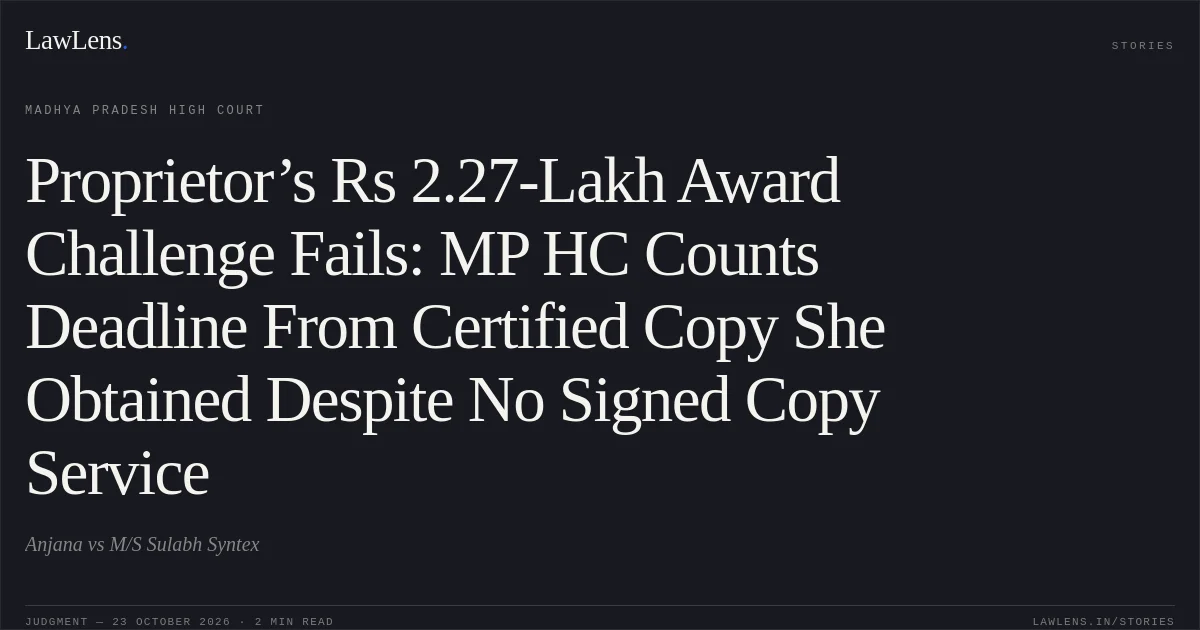
M/s. Sulabh Syntex obtained an ex parte arbitral award against Anjana on 11 December 2018.
Source reference: para. 2Although the record contained no proof that the Tribunal had delivered the signed award to her, Anjana obtained a certified copy from the Tribunal’s Secretariat on 18 March 2019.
Source reference: para. 2She subsequently applied under Section 34 of the Arbitration and Conciliation Act, 1996, to set aside the award.
Source reference: para. 3The District Court dismissed the application as time-barred, calculating limitation from the date she obtained the certified copy. Anjana appealed, contending that limitation could begin only upon delivery of the signed copy under Section 31(5).
Source reference: para. 4Issues
Whether limitation under Section 34(3) begins when a party obtains a certified copy of the award from the Arbitral Tribunal, despite the absence of proof that the Tribunal delivered the signed copy under Section 31(5)
Source reference: para. 18Whether the Section 34 application, filed more than three months after receipt of the certified copy and outside the further 30-day period, was time-barred
Source reference: para. 17Law Applied
Sections 31(1) and 31(5) of the Arbitration and Conciliation Act require an arbitral award to be in writing, signed, and delivered to each party; Section 34(3) provides a three-month limitation period from receipt of the award, extendable for sufficient cause by no more than 30 days; and Section 36 governs enforcement after the time to apply under Section 34 has expired.
Source reference: para. 19Section 3(1) sets out when written communications are deemed received.
Source reference: para. 21The Court relied on Union of India v. Tecco Trichy Engineers and Contractors, State of Maharashtra v. ARK Builders Pvt. Ltd., Anilkumar Jinabhai Patel v. Pravinchandra Jinabhai Patel and Dakshin Haryana Bijli Vitran Nigam Ltd. v. Navigent Technologies Pvt. Ltd. for the principle that delivery and receipt of the signed award ordinarily trigger limitation.
Source reference: para. 24It also considered Rahul S/o Omprakash Gandhi v. The Akola Janta Commercial Co-operative Bank Ltd. and Union of India v. Bhola Prasad Agrawal, which treated a party’s receipt of a certified copy as sufficient to commence limitation.
Source reference: para. 13Reasoning
The Court accepted that the Tribunal had not proved dispatch or delivery of the signed award, so receipt could not be presumed on that basis.
Source reference: para. 22However, it distinguished the ordinary Section 31(5) rule from the circumstances before it: Anjana herself obtained the certified copy from the Tribunal, thereby acquiring the award and knowledge of its contents sufficient to pursue a Section 34 challenge.
Source reference: para. 25The Court held that allowing limitation to remain open indefinitely after that point would defeat the statutory scheme.
Source reference: para. 26Limitation therefore began on 18 March 2019, and the application filed about 183 days later fell outside both the three-month period and the maximum additional 30 days.
Source reference: para. 28Holding
The High Court held that, in these circumstances, receipt of the certified copy by the party started limitation under Section 34(3), notwithstanding the absence of proved delivery of the signed copy under Section 31(5).
As the application was filed beyond the permitted period, the appeal was dismissed and the District Court’s order affirmed, with no order as to costs.
Source reference: para. 29Acts & Sections Cited
10 provisions across 2 statutes referred to in this judgment. Each provision opens on LawLens.
Arbitration and Conciliation Act, 1996
General Clauses Act, 18971
Original Court PDF
AnjanavsM/S Sulabh Syntex
Click to open original judgment
Original judgment, available to read, download and summarize on LawLens.in