Facts
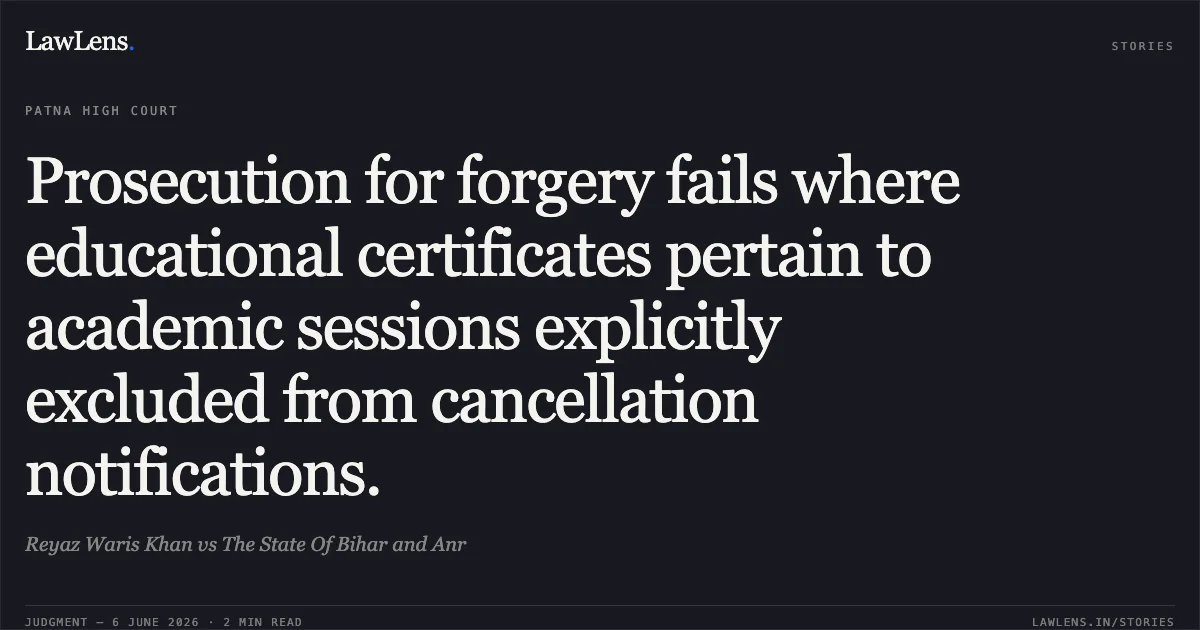
The petitioner, a Panchayat Teacher, was accused of obtaining employment using a forged B.Ed. certificate from a college whose recognition was allegedly cancelled.
Source reference: p.1An FIR was lodged (Sahpur P.S. Case No. 154 of 2016), and the A.C.J.M., Bhojpur, took cognizance of the offences on 20.01.2017.
Source reference: p.1The petitioner claimed he attended the 1994-95 session, during which the college held valid provisional affiliation.
Source reference: p.2The prosecution's foundational document—a University notification dated 29.02.2000—disclosed that only results for the 1997-98 session were cancelled, not the 1994-95 session.
Source reference: p.2The petitioner moved the High Court to quash the cognizance order under Section 528 of the BNSS (formerly Section 482 CrPC).
Source reference: no citationIssues
1. Whether the criminal proceedings against the petitioner constitute an abuse of the process of law when the prosecution's own records contradict the foundational allegations of forgery and fraud?
Source reference: p.2-32. Whether the ingredients of Sections 467, 468, 471, 409, and 420 of the IPC are made out against the petitioner?
Source reference: p.3-4Law Applied
The Court primarily applied the inherent powers under Section 528 of the Bharatiya Nagarik Suraksha Sanhita, 2023 (BNSS), which allows for the quashing of proceedings to prevent abuse of the process of any Court.
Source reference: p.2It interpreted the definitions of "forgery" under Sections 467, 468, and 471 of the IPC, noting that a document cannot be considered forged if it was issued during a period of valid affiliation.
Source reference: p.3Regarding Section 420 IPC, the court applied the principle of "dishonest inducement," and for Section 409, it held that employment through a regular selection process does not constitute "entrustment" or "criminal breach of trust".
Source reference: p.4Reasoning
The Court observed that while it generally does not adjudicate disputed facts in quashing petitions, it must intervene when the prosecution's own material (the 2000 University notification) invalidates the basis of the FIR.
Source reference: p.2-3The court found that because the petitioner's B.Ed. session (1994-95) fell within the college's period of valid affiliation, the certificate was not a "forged document," thereby nullifying charges under Sections 467, 468, and 471.
Source reference: p.3Since no false representation was made regarding the certificate's validity, the ingredient of deception for Section 420 IPC was absent.
Source reference: p.4Furthermore, the court reasoned that salary or employment gained via a selection process does not qualify as "property entrusted" to a public servant to attract Section 409 IPC.
Source reference: p.4Holding
The Court held that the continuance of the criminal proceedings would amount to an abuse of the process of the court as none of the alleged offences were made out, even on the prosecution's own case.
The application was allowed, and the order of cognizance dated 20.01.2017 passed by the A.C.J.M., Bhojpur in Sahpur P.S. Case No. 154 of 2016 was quashed in relation to the petitioner.
Source reference: p.5Acts & Sections Cited
6 provisions across 2 statutes referred to in this judgment. Each provision opens on LawLens.
Indian Penal Code, 18605
Bharatiya Nagarik Suraksha Sanhita, 20231
Original Court PDF
Reyaz Waris KhanvsThe State Of Bihar and Anr
Click to open original judgment
Original judgment, available to read, download and summarize on LawLens.in