Facts
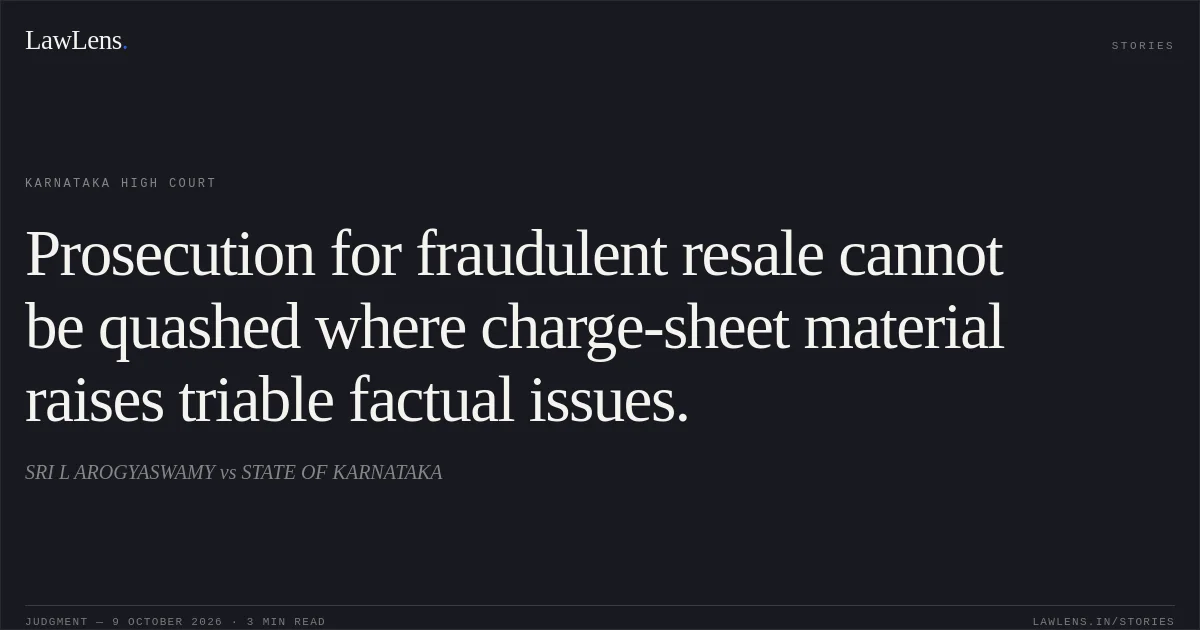
The petitioners, arrayed as accused Nos. 3 and 4, sought to quash proceedings in C.C. No. 50208/2019 arising from Crime No. 358/2017, for alleged offences under Sections 418, 419, 420, 468, 471, 447, 448, 120B and 34 IPC.
Source reference: para. 2The complainant alleged that the petitioners’ mother had executed a GPA and sale agreement in favour of Ramathilak, who sold Site No. 15 to the complainant in 1990; the petitioners later joined their mother in executing a sale deed in favour of Sagayaraju in 2003, allegedly concerning property already conveyed to the complainant.
Source reference: paras. 3, 5, 7–8The petitioners denied criminal involvement, relying on the cancellation of the GPA, the civil nature of the dispute and their alleged lack of knowledge of the earlier transaction.
Source reference: paras. 4, 8–9After investigation, the police filed a charge sheet against them.
Source reference: paras. 3, 6Issues
Whether the criminal proceedings against the petitioners should be quashed under Section 482 Cr.P.C. on the ground that the dispute was civil in nature and the allegations did not disclose their involvement in the alleged offences.
Source reference: paras. 7–10Whether the petitioners’ disputed defences concerning the GPA, their knowledge of the earlier sale and their role in the later transaction could be determined in a petition under Section 482 Cr.P.C.
Source reference: paras. 8–9Law Applied
Section 482 Cr.P.C. empowers the High Court to prevent abuse of process and secure the ends of justice, but disputed factual defences are ordinarily matters for trial.
Source reference: paras. 4, 10The court applied the principle in State of Haryana v. Bhajan Lal, 1992 Supp (1) SCC 335, that criminal proceedings may be quashed in appropriate cases, including where they are brought to wreak personal vengeance.
Source reference: paras. 4, 10It also relied on Dineshbhai Chandubhai Patel v. State of Gujarat, (2018) 3 SCC 104, for the principle that the investigating officer’s duty is to investigate and unearth the truth.
Source reference: para. 8The petitioners’ reliance on Anukul Singh v. State of Uttar Pradesh, 2025 LiveLaw (SC) 948, concerning a dispute of purely civil character, was distinguished on the facts.
Source reference: paras. 4, 9The alleged conduct was charged under Sections 418, 419, 420, 468, 471, 447, 448, 120B and 34 IPC.
Source reference: para. 2Reasoning
The court found that the charge-sheet material disclosed an earlier sale to the complainant, executed by the GPA holder before the GPA was cancelled, followed by a later sale deed executed by the petitioners and their mother in favour of Sagayaraju.
Source reference: paras. 7–8The alleged later transaction and subsequent dealings in the property provided a basis for the investigating officer to include the petitioners in the charge sheet; their participation in the later sale deed was not disputed.
Source reference: paras. 8, 10Whether the petitioners knew of the earlier sale, and whether the property descriptions and transactions established fraud, involved disputed facts unsuitable for resolution under Section 482 Cr.P.C.
Source reference: paras. 8–9The court therefore distinguished Anukul Singh and found that the case could not, at that stage, be treated as merely civil or as prosecution motivated by personal vengeance.
Source reference: paras. 9–10Holding
The High Court answered the issues against the petitioners and dismissed the petition to quash the proceedings.
It left the petitioners’ defences to be raised before the trial court and directed that the trial court not be influenced by the High Court’s observations when deciding the case on its merits.
Source reference: para. 11Acts & Sections Cited
13 provisions across 2 statutes referred to in this judgment. Each provision opens on LawLens.
Code of Criminal Procedure, 19732
Original Court PDF
SRI L AROGYASWAMYvsSTATE OF KARNATAKA
Click to open original judgment
Original judgment, available to read, download and summarize on LawLens.in