Facts
The complainant, Budhram, belonging to the Gond community, alleged that on 10 October 2020 the respondents, armed with lathis, abused him by caste name, assaulted him with hands, fists and lathis, and restrained him near a tree.
Source reference: p.2, para. 3An FIR was registered for offences under Sections 148/149, 294, 506 and 323/149 of the IPC and Section 3(1)(s) of the Scheduled Castes and Scheduled Tribes (Prevention of Atrocities) Act, 1989 (“SC/ST Act”).
Source reference: p.2, para. 3The complainant was medically examined and was found to have simple injuries allegedly caused by a hard and blunt object.
Source reference: p.4, paras. 7, 10The prosecution examined eight witnesses and relied upon documents including a temporary caste certificate issued by the Tahsildar on 7 November 2020, nearly one month after the incident.
Source reference: p.3, para. 4; p.9, para. 21The Special Judge acquitted all respondents by judgment dated 24 December 2022, principally finding that the prosecution had failed to establish the charges beyond reasonable doubt.
Source reference: p.4, para. 9The State preferred an appeal against acquittal under Section 14-A(1) of the SC/ST Act.
Source reference: no citationIssues
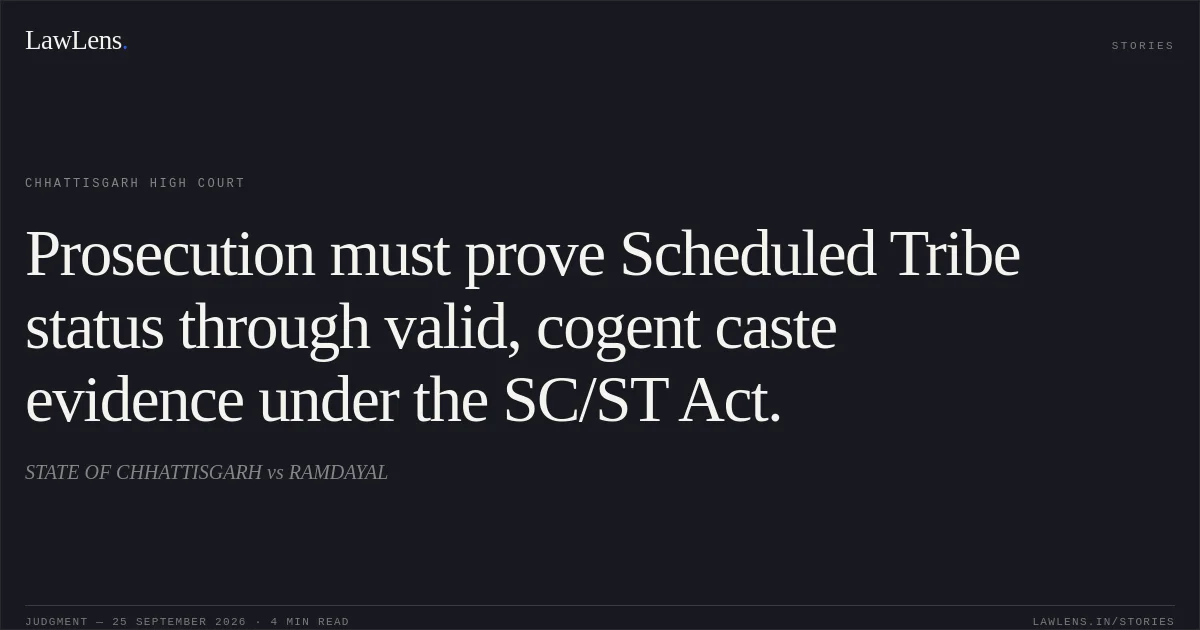
Whether the temporary caste certificate issued after the incident was sufficient to establish that the complainant belonged to a notified Scheduled Tribe for the purposes of Section 3(1)(s) of the SC/ST Act?
Source reference: p.7, para. 15; pp.9–10, paras. 21–22Whether the prosecution proved beyond reasonable doubt the offences under Sections 148/149, 294 and 323/149 of the IPC against the respondents?
Source reference: p.7, para. 15; pp.12–17, paras. 27–34Whether the prosecution established the essential ingredients of criminal intimidation under Section 506(2) of the IPC?
Source reference: pp.10–12, paras. 23–26Law Applied
The Court applied Section 3(1)(s) of the SC/ST Act, which criminalises intentionally insulting or intimidating a member of a Scheduled Caste or Scheduled Tribe by caste name in a place within public view, read with the definitions of Scheduled Castes and Scheduled Tribes under Article 366(24)–(25) and the constitutional scheme under Articles 341 and 342.
Source reference: pp.7–9, paras. 17–20It held that the prosecution must establish, through reliable evidence, that the victim belongs to a notified Scheduled Caste or Scheduled Tribe.
Source reference: no citationFor Section 506 IPC, the Court relied on Sections 503 and 506 IPC and Parminder Kaur v. State of Punjab, 2020 (8) SCC 811, and Sharif Ahmed v. State of U.P., 2024 (14) SCC 122, for the rule that a mere utterance or abusive expression is insufficient unless the threat was intended to cause alarm or compel the victim to act or abstain from acting.
Source reference: pp.10–12, paras. 23–25Regarding unlawful assembly and vicarious liability, the Court relied on Nitya Nand v. State of Uttar Pradesh, (2024) 9 SCC 314, and the principles under Section 149 IPC that every member of an unlawful assembly may be liable for an offence committed in prosecution of the common object, even without personally inflicting an injury.
Source reference: pp.14–16, para. 33For Section 294 IPC, the Court applied the requirement of an obscene act or obscene words in or near a public place and relied on Director General, Doordarshan v. Anand Patwardhan, (2006) 8 SCC 433, and Apoorva Arora v. State (NCT of Delhi), (2024) 6 SCC 181, concerning the distinction between obscenity and mere vulgarity or profanity.
Source reference: pp.12–14, paras. 28–30Reasoning
The Court held that the temporary caste certificate issued on 7 November 2020 was issued after the incident, was valid only for six months, and had expired before the complainant’s evidence was recorded on 6 April 2022.
Source reference: pp.9–10, paras. 21–22Since no other reliable document established the complainant’s status as a member of a notified Scheduled Tribe on the date of occurrence, the essential caste-related requirement of Section 3(1)(s) of the SC/ST Act was not proved.
Source reference: pp.9–10, paras. 21–22The Court nevertheless found that the oral and medical evidence established that the complainant had been assaulted and had sustained simple injuries.
Source reference: pp.12, 14–17, paras. 27, 32–34It held that the prosecution evidence, including the testimony of the complainant and supporting witnesses, proved the respondents’ participation as members of an unlawful assembly, attracting Sections 148/149 and 323/149 IPC.
Source reference: pp.12, 14–17, paras. 27, 32–34The Court further accepted the evidence that the respondents used filthy language in the presence of others and treated it as sufficient to establish the offence under Section 294 IPC.
Source reference: pp.13–14, paras. 28–31Conversely, the evidence did not establish that the alleged threats were accompanied by the requisite intention to cause alarm or compel the complainant to act or abstain from acting.
Source reference: pp.10–12, paras. 23–26Holding
The appeal was partly allowed.
The High Court set aside the respondents’ acquittal for offences under Sections 148/149, 323/149 and 294 of the IPC, thereby holding them liable for those offences.
Source reference: p.17, para. 34The acquittal for offences under Section 3(1)(s) of the SC/ST Act and Section 506(2) of the IPC was affirmed because the complainant’s Scheduled Tribe status and the ingredients of criminal intimidation were not proved beyond reasonable doubt.
Source reference: pp.10–12, 17, paras. 22, 26, 34The matter was directed to be listed for hearing on sentence on 13 October 2026.
Source reference: p.17, paras. 34–36Acts & Sections Cited
10 provisions across 4 statutes referred to in this judgment. Each provision opens on LawLens.
Scheduled Castes and the Scheduled Tribes (Prevention of Atrocities) Act, 19891
Indian Penal Code, 18607
Code of Criminal Procedure, 19731
Information Technology Act, 20001
Original Court PDF
STATE OF CHHATTISGARHvsRAMDAYAL
Click to open original judgment
Original judgment, available to read, download and summarize on LawLens.in