01Facts
The petitioners, serving or retired CRPF personnel, were involved in a cordon-and-search operation at Bhaderwah during the intervening night of 30/31 December 1994 after information regarding militant infiltration.
pp. 3–4 · ¶ 3–4During the operation, a CRPF constable and two alleged militants were killed; Bilal Ahmed Butt, the owner of the house where the encounter occurred, also died.
pp. 3–4 · ¶ 3–4An FIR arising from the death of the CRPF constable was registered as FIR No. 201/1994, and the police final report stated that Bilal Ahmed Butt had died in the crossfire.
pp. 3–4 · ¶ 3–4Subsequently, on the complaint of Bilal Ahmed Butt’s mother, FIR No. 67/1995 was registered on 1 June 1995 alleging that the petitioners had dragged Bilal Ahmed out of his house and killed him.
pp. 4–5 · ¶ 5–6Although an initial report closed the proceedings, the Sub-Judge, Bhaderwah directed further investigation, which resulted in chargesheet No. 30/2006 for offences under Sections 302, 452, 148, 149 and 382 RPC.
pp. 4–5 · ¶ 5–6The petitioners invoked the inherent jurisdiction of the High Court under Section 561-A of the J&K CrPC, seeking quashing of the chargesheet and proceedings.
pp. 5–8 · ¶ 7–1002Issues
i.Whether the chargesheet was liable to be quashed on the ground that FIR No. 67/1995 constituted an impermissible second FIR concerning the same incident or occurrence as FIR No. 201/1994.
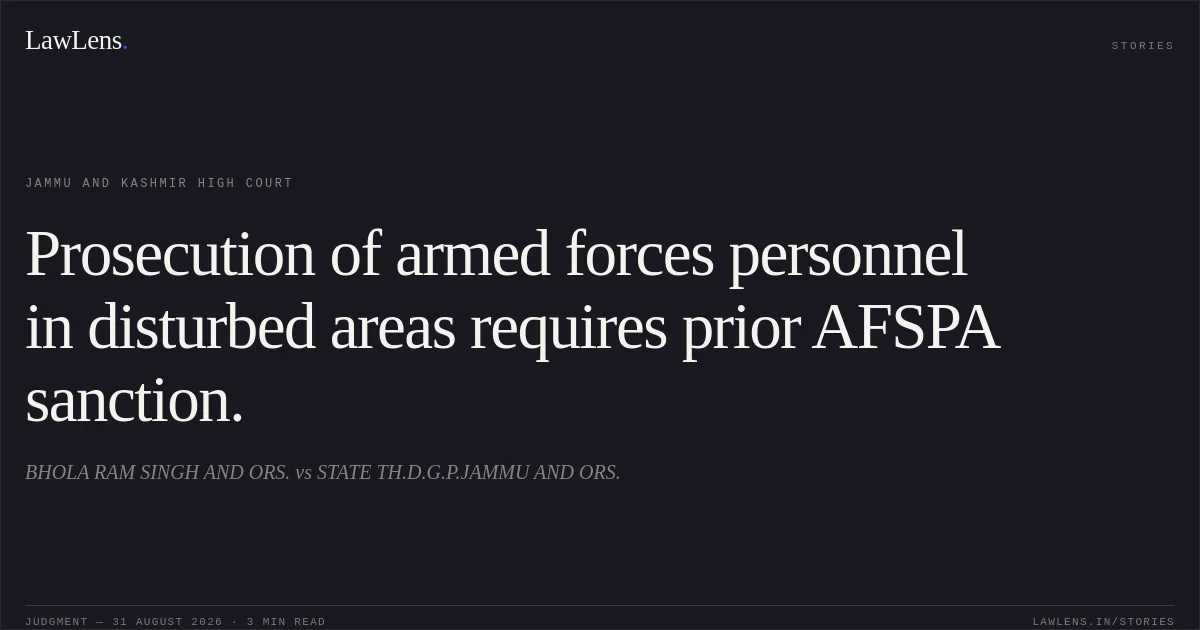
pp. 5–9 · ¶ 7, 9, 15ii.Whether prosecution of the petitioners, who were CRPF personnel operating in a declared disturbed area, required prior sanction under Section 7 of the Armed Forces (Jammu & Kashmir) Special Powers Act, 1990, and whether absence of such sanction justified quashing the proceedings at the pre-trial stage.
pp. 5, 9–10 · ¶ 7, 10, 16–1803Law Applied
The Court exercised its inherent jurisdiction under Section 561-A of the J&K CrPC to prevent abuse of process, while reiterating that such jurisdiction cannot ordinarily be used to conduct a mini-trial or determine disputed questions of fact.
p. 9 · ¶ 15Section 7 of the Armed Forces (Jammu & Kashmir) Special Powers Act, 1990 requires prior sanction of the Central Government before cognizance is taken of an offence allegedly committed by a member of the armed forces while acting or purporting to act in the discharge of official duty in a disturbed area.
pp. 9–10 · ¶ 16Relying on Rabina Ghale & Anr. v. Union of India & Ors. and Anjali Gupta v. Union of India & Ors., the Court applied the principle that proceedings may remain closed or may proceed only subject to the grant of the requisite sanction; if sanction is granted at any stage, the proceedings may continue in accordance with law.
p. 10 · ¶ 17Provisions in the judgment · 4 · Linked ones open on LawLens
Bharatiya Nagarik Suraksha Sanhita, 2023 Section 528
Arms Act, 1959 Section 3Section 25
Armed Forces (Jammu and Kashmir) Special Powers Act, 1990 Section 7
04Reasoning
The Court rejected the challenge based on the alleged second FIR because the prosecution version in FIR No. 67/1995 was that Bilal Ahmed had been removed from his house and killed after the encounter, whereas the earlier FIR and final report treated his death as having occurred during crossfire.
p. 9 · ¶ 15Whether both FIRs related to the same occurrence, or whether they concerned distinct acts forming separate offences, involved disputed factual questions that could not be resolved in proceedings under Section 561-A without effectively conducting a mini-trial.
p. 9 · ¶ 15On the sanction issue, the Court noted that Doda was a declared disturbed area at the relevant time and that the petitioners were members of the CRPF, thereby attracting the protection contemplated under Section 7 of AFSPA.
pp. 9–10 · ¶ 16However, following the principles in Rabina Ghale and Anjali Gupta, the Court held that the absence of sanction at that stage did not warrant outright quashing of the chargesheet.
p. 10 · ¶ 17–19The appropriate course was to require the trial court to consider the issue of sanction at the stage of charge/discharge and to proceed only subject to production of sanction from the competent authority.
p. 10 · ¶ 17–1905Holding
The High Court dismissed the petition at that stage and declined to quash chargesheet No. 30/2006 or the proceedings arising from FIR No. 67/1995.
pp. 10–11 · ¶ 18–21It held that the question concerning the legality of the second FIR involved disputed facts unsuitable for determination under inherent jurisdiction.
pp. 10–11 · ¶ 18–21It further directed the trial court to proceed with the matter at the stage of charge/discharge subject to production of the requisite prior sanction under Section 7 of the AFSPA from the competent authority.
pp. 10–11 · ¶ 18–21A copy of the judgment was directed to be forwarded to the Principal Sessions Judge, Bhaderwah, for information and compliance.
p. 11 · ¶ 20Original Court PDF
BHOLA RAM SINGH AND ORS.vsSTATE TH.D.G.P.JAMMU AND ORS.
Click to open original judgment
Original judgment, available to read, download and summarize on LawLens.in