Facts
The applicant, Dina Nath Jauhar, served as Vice-Chancellor of Dr. Bhim Rao Ambedkar University, Agra, from 11 January 2011 and resigned on 18 May 2013.
Source reference: para. 3The Vigilance Department initiated an open inquiry in 2014 concerning alleged financial irregularities and, pursuant to the State Government’s recommendation dated 18 June 2018, an FIR was registered on 4 September 2018 under Sections 409, 406, 420 and 120-B IPC and Sections 13(1)(d) and 13(2) of the Prevention of Corruption Act, 1988.
Source reference: para. 4After investigation, a supplementary charge-sheet was filed against the applicant on 23 July 2025 under Sections 166 and 120-B IPC and Section 7 of the Prevention of Corruption Act, 1988, as amended in 2018.
Source reference: paras. 5–6The Special Judge took cognizance on 28 August 2025 and summoned the applicant.
Source reference: para. 6Although prosecution sanction had been sought, the Governor/Chancellor declined it on 9 October 2024 on the ground that the applicant had already resigned and was no longer a public servant.
Source reference: para. 10The applicant challenged the cognizance order and the subsequent order dated 17 October 2025 under Section 528 BNSS, contending that sanction under Section 19 of the Prevention of Corruption Act was mandatory even for a former public servant after the 2018 amendment.
Source reference: paras. 2, 7Issues
Whether previous sanction under Section 19 of the Prevention of Corruption Act, 1988, as amended by Act No. 16 of 2018, was mandatory before taking cognizance against the applicant who had resigned from public service before registration of the FIR and cognizance?
Source reference: para. 12Whether the Special Court could take cognizance when the competent authority had declined sanction solely on the ground that the applicant was no longer a public servant?
Source reference: paras. 10, 14, 17Law Applied
Section 19(1) of the Prevention of Corruption Act, 1988, as amended by Act No. 16 of 2018, prohibits a court from taking cognizance of offences under Sections 7, 11, 13 and 15 against a public servant without previous sanction from the competent authority; the amended provision applies to a person who is employed, or was employed at the time of commission of the alleged offence.
Source reference: para. 13The Court held that, after the 2018 amendment, previous sanction is mandatory even where the accused has subsequently retired or resigned, provided cognizance is taken after the amendment came into force.
Source reference: para. 14It relied on State of Mizoram v. Dr. C. Sangnghina, 2019 (13) SCC 335, concerning whether an error or irregularity in sanction resulted in failure of justice.
Source reference: para. 15State of Telangana v. Managipet @ Mangipet Sarveshwar, AIR Online 2019 SC 1686, following K. Kalimuthu v. State of D.S.P., 2005 (4) SCC 512, on the question of sanction being capable of consideration at the appropriate stage of trial.
Source reference: para. 16Reasoning
The alleged offences related to the applicant’s tenure as Vice-Chancellor, when he was a public servant, whereas the FIR was registered on 4 September 2018 and cognizance was taken after the Prevention of Corruption Act was amended on 26 July 2018.
Source reference: para. 14The Court treated the amended Section 19 as prospective and applicable to the act of taking cognizance after its commencement.
Source reference: para. 14Since the applicant was employed at the time of the alleged offences, his subsequent resignation did not eliminate the statutory requirement of previous sanction.
Source reference: para. 14The competent authority’s refusal to grant sanction was based solely on the erroneous view that sanction was unnecessary because the applicant had resigned.
Source reference: para. 17Consequently, the Special Court acted without the mandatory statutory safeguard and took cognizance in a casual and cursory manner, resulting in failure of justice.
Source reference: paras. 14, 17Holding
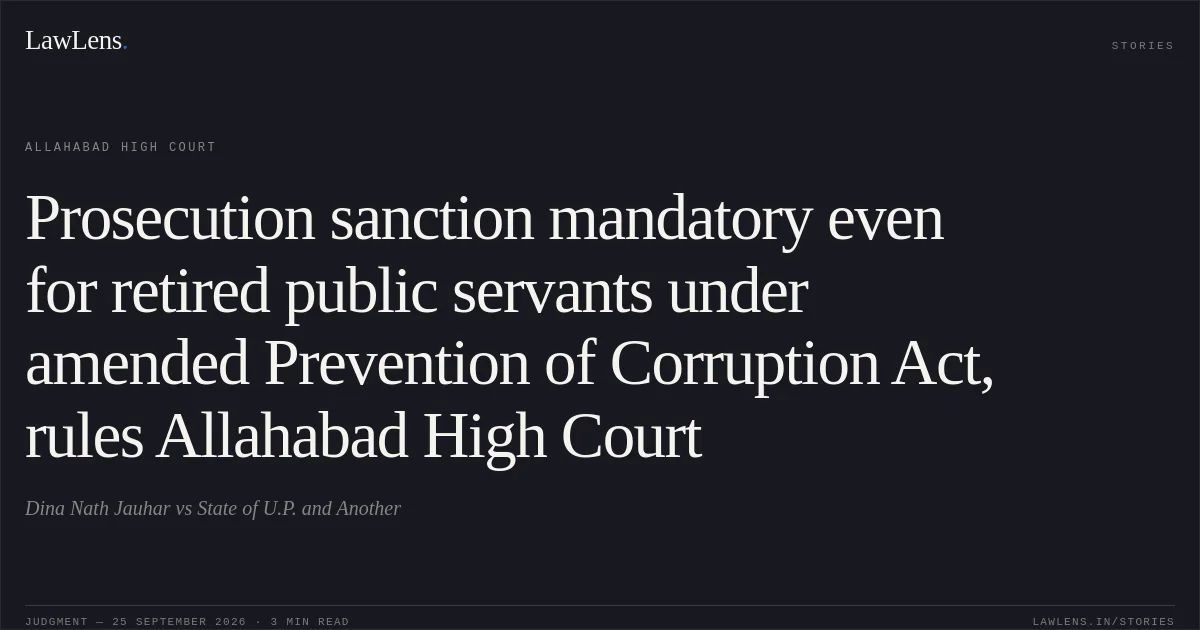
The Court held that previous sanction under Section 19 of the Prevention of Corruption Act, 1988, was mandatory before taking cognizance against the applicant, notwithstanding his resignation in 2013.
The cognizance order dated 28 August 2025 and the order dated 17 October 2025 were set aside.
Source reference: para. 18The matter was remitted to the prosecution/competent authority to take necessary steps for obtaining fresh sanction within six weeks, after which the Trial Court was directed to pass a fresh cognizance order in accordance with law and proceed expeditiously, subject to there being no other legal impediment.
Source reference: para. 18The application under Section 528 BNSS was accordingly allowed.
Source reference: para. 19Acts & Sections Cited
10 provisions across 3 statutes referred to in this judgment. Each provision opens on LawLens.
Bharatiya Nagarik Suraksha Sanhita, 20231
Indian Penal Code, 18604
Prevention of Corruption Act, 19885
Original Court PDF
Dina Nath JauharvsState of U.P. and Another
Click to open original judgment
Original judgment, available to read, download and summarize on LawLens.in