Facts
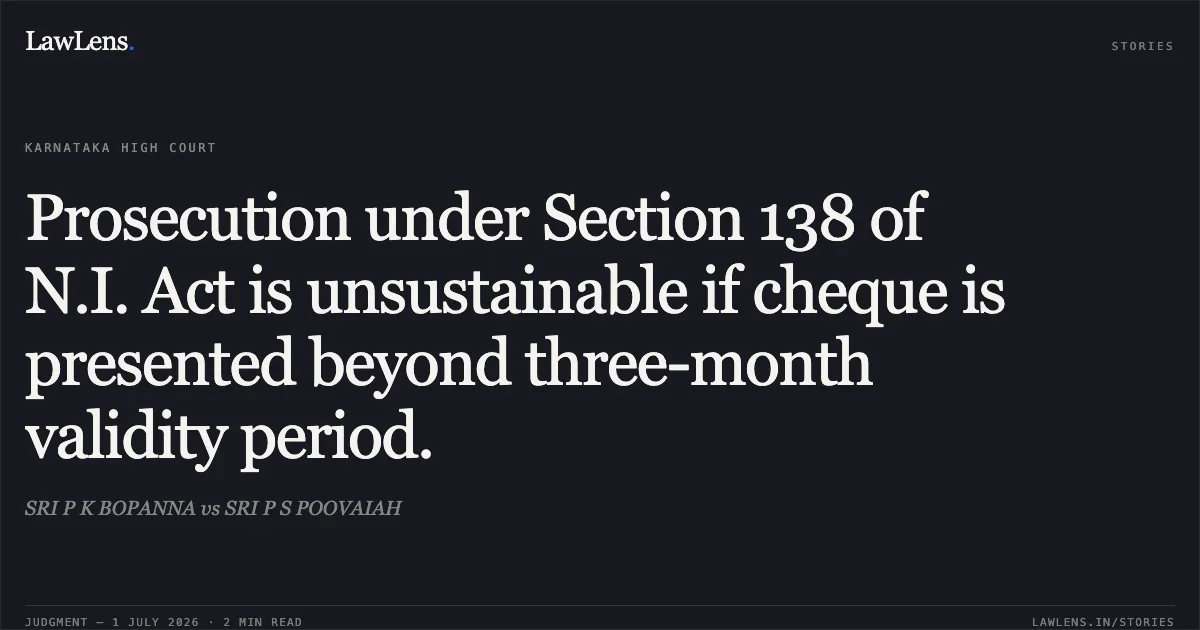
The complainant alleged that the petitioner borrowed ₹1,50,000/- for financial assistance and issued a post-dated cheque dated 13.06.2018 to facilitate repayment.
Source reference: p. 2-3 / para. 3While the cheque was dated in June, the complainant did not present it until 05.12.2018, at which point it was returned for insufficient funds.
Source reference: p. 3 / para. 3Following a failed demand notice, the Trial Court in C.C.No.444/2019 convicted the petitioner under Section 138 of the Negotiable Instruments Act, a decision later upheld by the Appellate Court in Crl.A.No.62/2023.
Source reference: p. 3 / para. 4The petitioner approached the High Court in revision, arguing that the cheque was presented beyond its legal validity period.
Source reference: p. 4 / para. 6-7Issues
1. Whether a prosecution under Section 138 of the N.I. Act is maintainable if the subject cheque is presented to the bank after the expiry of the three-month validity period prescribed by the Reserve Bank of India.
Source reference: p. 4 / para. 72. Whether the concurrent findings of the lower courts were sustainable given the timing of the instrument’s presentation.
Source reference: p. 6 / para. 9Law Applied
Section 138 of the Negotiable Instruments Act, which requires a cheque to be presented within six months or its period of validity, whichever is earlier.
Source reference: p. 6 / para. 10Section 35A of the Banking Regulation Act, 1949, under which the Reserve Bank of India issued a directive (dated 04.11.2011) reducing the validity of cheques from six months to three months effective from 01.04.2012.
Source reference: p. 5 / para. 7Shri Ishar Alloy Steels Ltd. v. Jayaswals Neco Ltd. (2001) regarding the necessity of presentation within the statutory period.
Source reference: p. 5 / para. 8Reasoning
The Court noted that the cheque in question was dated 13.06.2018 but was only presented to the bank on 05.12.2018, which is approximately five months and twenty-two days later.
Source reference: p. 4 / para. 7; p. 6 / para. 9Although the bank returned the cheque for "funds insufficient" rather than "instrument expired," the Court held that the legal validity of the instrument had already lapsed under the RBI-mandated three-month rule.
Source reference: p. 6-7 / para. 11The court reasoned that since the statutory prerequisite for Section 138—presentation within the validity period—was not met, the underlying criminal proceedings were fundamentally flawed.
Source reference: p. 7 / para. 11The Court found that both the Trial and Appellate courts failed to properly evaluate this jurisdictional fact despite it being raised during the appellate stage.
Source reference: p. 7 / para. 11Holding
The court held that no proceedings under Section 138 of the N.I. Act could be maintained as the cheque was presented after its three-month validity period; consequently, the petitioner was acquitted.
The High Court allowed the revision petition and set aside the judgments of conviction and sentence passed by the Trial Court and the Appellate Court.
Source reference: p. 7-8 / para. 12Acts & Sections Cited
1 provisions across 1 statute referred to in this judgment. Each provision opens on LawLens.
Negotiable Instruments Act, 18811
Original Court PDF
SRI P K BOPANNAvsSRI P S POOVAIAH
Click to open original judgment
Original judgment, available to read, download and summarize on LawLens.in