Facts
The National Investigation Agency registered RC-29/2021/NIA/DLI concerning alleged conspiracy and terrorist activities involving proscribed organisations under Sections 120B, 121A, 122 and 123 IPC and Sections 18, 18A, 18B, 20, 38 and 39 UAPA. Bilal Mir was arrested on 12 October 2021 and was subsequently charge-sheeted as Accused No. 3 for offences including Sections 120B and 121A IPC and Sections 18, 20, 38 and 39 UAPA.
Source reference: paras. 4–6, 53On 8 April 2022, the Special Court allowed the NIA’s application under Section 44 UAPA read with Section 17 NIA Act and declared several witnesses as protected, directing that their statements be supplied after redaction of their identities.
Source reference: paras. 7–10, 54–55A further order dated 20 March 2023 granted protected status to additional witnesses.
Source reference: paras. 7–10, 54–55The orders did not record individual reasons regarding threat perception or the measures necessary for protecting each witness.
Source reference: paras. 18–20, 79After charges were framed and protected witnesses X-5 and X-11 were scheduled to testify, Mir sought their complete unredacted and de-anonymised statements to enable effective cross-examination. The Special Court rejected the request on 24 July 2025, holding that it effectively sought review of the earlier protection orders.
Source reference: paras. 15–17, 56Mir challenged both the original protection orders and the refusal to disclose the witnesses’ identities before the High Court under Section 528 BNSS and Article 227 of the Constitution.
Source reference: paras. 2, 34Issues
Whether the orders dated 8 April 2022 and 20 March 2023 declaring several prosecution witnesses as protected witnesses were passed in accordance with the procedure and safeguards prescribed under Section 44 UAPA and Section 17 NIA Act.
Source reference: para. 57(i)Whether, at the stage of recording evidence, the accused was entitled to the unredacted statements and disclosure of the name, address and identity of protected witnesses X-5 and X-11 to ensure a fair and effective cross-examination.
Source reference: paras. 57(ii), 85, 89Law Applied
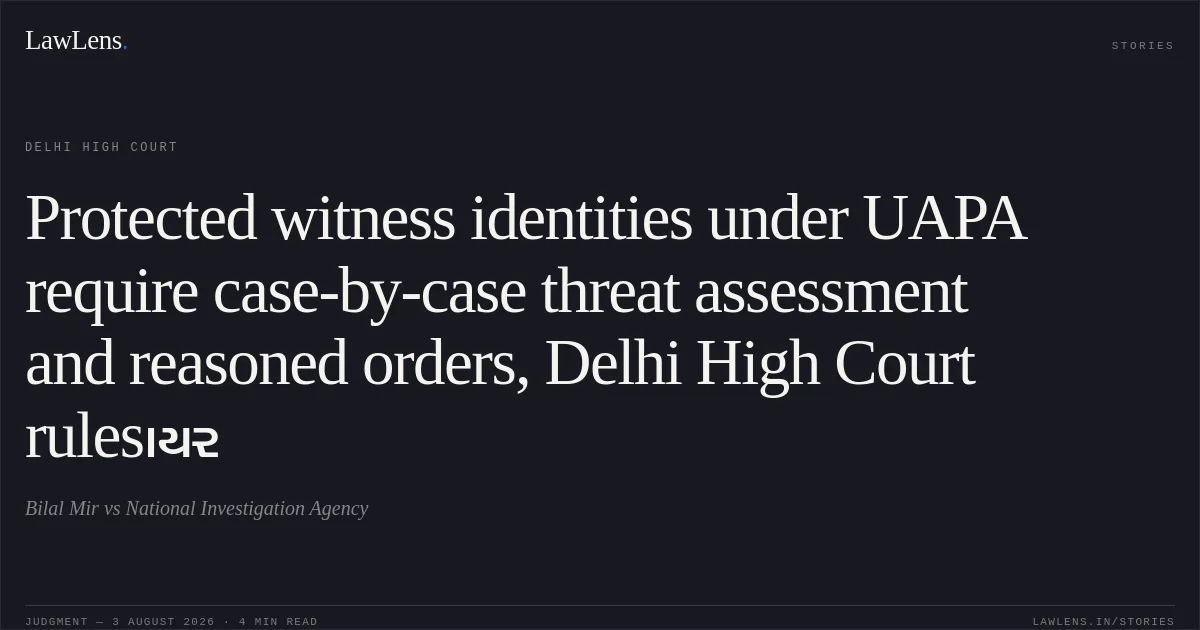
Section 44(2)–(3) UAPA and Section 17 NIA Act permit the Special Court, upon being satisfied that a witness’s life is in danger, to protect the witness’s identity and address, but require reasons to be recorded in writing and do not authorise blanket or mechanical protection orders.
Source reference: paras. 62–68The court relied on A.K. Roy v. Union of India, which recognised that witness anonymity is an exceptional judicial measure; Mohammed Asarudeen v. Union of India, 2025 INSC 746, which requires witness-specific satisfaction, consideration of appropriate protective measures and recorded reasons; and Kartar Singh v. State of Punjab, (1994) 3 SCC 569, which held that cross-examination is a fundamental safeguard but may be restricted in exceptional cases involving threats to witnesses.
Source reference: paras. 69, 73–78, 100–104People’s Union for Civil Liberties v. Union of India, (2004) 9 SCC 580, further requires a balance between witness safety, the public interest in prosecuting serious offences and the accused’s right to a fair trial.
Source reference: paras. 105–108The court also applied the constitutional guarantee of a meaningful and impartial opportunity to defend oneself, and held that the Special Court must reassess disclosure at the stage of witness examination, with due regard to the witness’s significance, the alleged threat and the potential prejudice to cross-examination.
Source reference: paras. 90–98, 111–112Reasoning
The High Court found that the original protection orders appeared deficient because they were omnibus orders and did not record individual satisfaction regarding the threat to each witness or the specific protective measures required, contrary to Mohammed Asarudeen.
Source reference: paras. 73–79Nevertheless, Mir had not challenged the protected status of X-5 and X-11 for more than three years, despite the proceedings having progressed substantially and the trial being monitored by the Supreme Court. His challenge was brought only when the witnesses were to be examined and after the Special Court referred to the finality of the earlier orders.
Source reference: paras. 80–84Accordingly, the challenge to the original orders was rejected as highly belated.
Source reference: paras. 80–84However, the earlier orders did not conclusively determine whether the witnesses’ identities could be disclosed at the later stage of cross-examination.
Source reference: paras. 86–89, 111The Special Court was required to make a fresh, witness-specific assessment of whether disclosure would endanger the witnesses, whether safeguards could ensure their safety, and whether non-disclosure would materially impair the accused’s ability to cross-examine.
Source reference: paras. 86–89, 111By treating the application for disclosure as an impermissible review of the earlier protection orders, the Special Court failed to undertake this required balancing exercise.
Source reference: paras. 56, 113Holding
CRL.M.C. 5129/2025 was dismissed. Although the High Court observed that the orders dated 8 April 2022 and 20 March 2023 did not fully reflect the procedure required under Section 44 UAPA and Section 17 NIA Act, it declined to interfere because the challenge was raised belatedly and the petitioner had not previously questioned the protected status of the witnesses.
CRL.M.C. 5130/2025 was allowed, and the Special Court’s order dated 24 July 2025 was set aside.
Source reference: para. 113The matter was remanded to the Special Court to determine, before recording the testimony of X-5 and X-11, whether disclosure of their names, addresses and identities would threaten their lives or whether disclosure could be made subject to appropriate safety measures. The Special Court was directed to record specific reasons for either protecting or disclosing the particulars, and the parties were directed to appear before it on 10 August 2026.
Source reference: paras. 113–114Original Court PDF
Bilal MirvsNational Investigation Agency
Click to open original judgment
Original judgment, available to read, download and summarize on LawLens.in