Facts
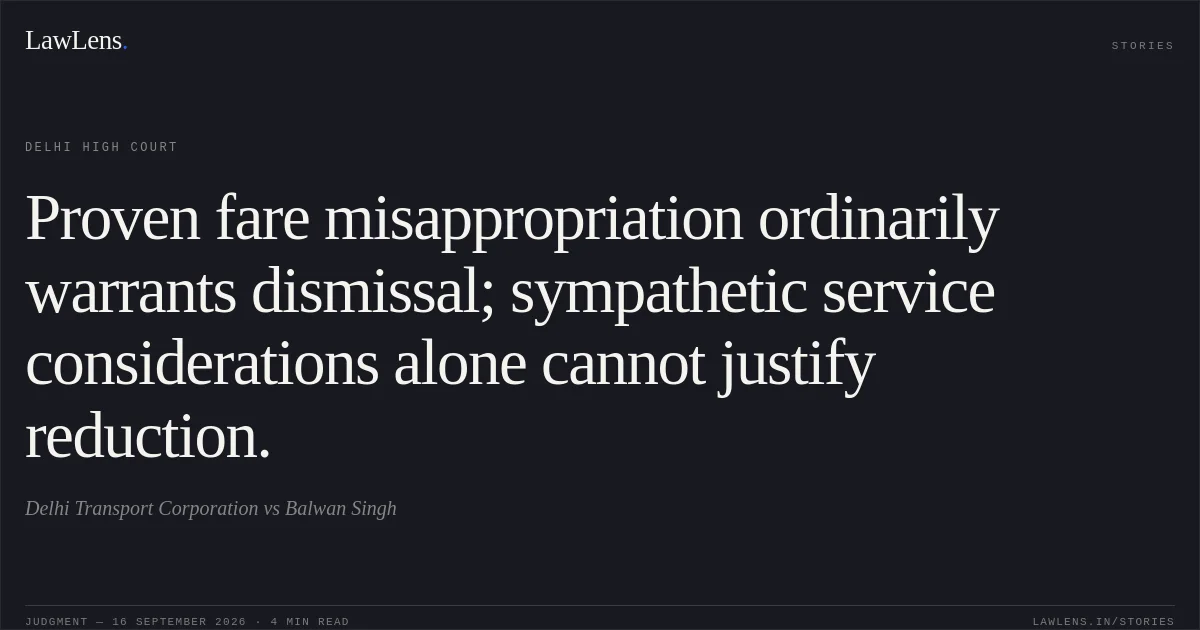
The respondent, a conductor employed by the Delhi Transport Corporation (DTC) since 1978, was found during a bus inspection on 14 February 1993 to have collected fares from seven passengers without issuing tickets. The passengers had allegedly paid an aggregate fare of ₹66.
Source reference: pp. 2–4, paras. 2–7A chargesheet was issued on 26 February 1993, and following a domestic enquiry, the respondent was removed from service on 26 September 1994. The enquiry proceedings were upheld in the approval proceedings dated 18 July 1995.
Source reference: pp. 2–4, paras. 2–7The respondent’s earlier writ petition was withdrawn in 2007 with liberty to approach the Labour Court. The Labour Court subsequently held that the enquiry was consistent with natural justice and that the misconduct was proved, but modified the punishment from removal to deemed retirement with effect from 26 September 1994, granting retiral and consequential benefits in view of the respondent’s 16 years of service and clean record.
Source reference: pp. 2–4, paras. 2–7DTC challenged the modification of punishment under Article 226 of the Constitution.
Source reference: pp. 4–5, paras. 8–13Issues
1. Whether the domestic enquiry and finding of misconduct were vitiated because the passengers allegedly found travelling without tickets were not examined.
Source reference: pp. 6–9, paras. 16–192. Whether, after upholding the misconduct, the Labour Court was justified under Section 11A of the Industrial Disputes Act, 1947, in modifying the punishment of removal from service to deemed retirement on sympathetic or mitigating grounds.
Source reference: pp. 9–13, paras. 20–273. Whether the High Court, in exercise of its supervisory jurisdiction under Article 226, should interfere with the Labour Court’s modification of punishment.
Source reference: pp. 5–6, 13–14, paras. 14–15, 28–31Law Applied
The High Court applied the supervisory, non-appellate scope of Article 226, under which a writ court should not reappreciate evidence or substitute its own view for that of the Labour Court unless the decision is perverse, arbitrary, or unsupported by evidence.
Source reference: p. 5, paras. 14–15In domestic enquiries, strict rules of evidence do not apply; misconduct may be established on a preponderance of probabilities, provided there is some relevant and credible evidence. Relying on State of Haryana v. Rattan Singh, (1977) 2 SCC 491, the Court held that non-examination of passengers does not invalidate an enquiry where the evidence of checking officials provides a sufficient evidentiary basis.
Source reference: pp. 7–9, paras. 17–19Section 11A of the Industrial Disputes Act, 1947 empowers the Labour Court to award a lesser punishment where discharge or dismissal is not justified, but that discretion must be exercised only where the punishment is disproportionate to the misconduct, as recognised in LIC of India v. R. Dhandapani, (2006) 13 SCC 613.
Source reference: p. 10, para. 22The Court further relied on Depot Manager, A.P. SRTC v. B. Swamy, (2007) 12 SCC 40, and U.P. SRTC v. Suresh Chand Sharma, (2010) 6 SCC 555, for the principle that misappropriation or non-issuance of tickets by a transport-conductor constitutes serious misconduct and that sympathy or a clean past record ordinarily cannot justify interference with dismissal.
Source reference: pp. 11–13, paras. 25–26Reasoning
The Court found that the respondent had received the chargesheet and relevant documents, participated in the enquiry, and cross-examined the checking staff. The evidence of the Traffic Inspector and other checking officials, together with the passengers’ statements and the respondent’s signatures on the relevant documents, constituted “some evidence” sufficient to establish misconduct on a preponderance of probabilities. Thus, the absence of passenger testimony did not render the enquiry defective.
Source reference: pp. 6–9, paras. 17–19On punishment, the Court held that the Labour Court’s reliance on the respondent’s long service and absence of previous adverse entries amounted to an impermissible sympathetic consideration, particularly where the misconduct involved collecting fares without issuing tickets. Although Section 11A permits reduction of punishment, that power must be exercised on grounds of disproportionality and not merely on the basis of the employee’s clean record.
Source reference: pp. 9–13, paras. 20–27Nevertheless, considering that the deemed-retirement order had already operated for nearly a decade and that only retiral or pensionary benefits had been granted, the Court declined to withdraw those benefits at that stage.
Source reference: pp. 13–14, para. 28Holding
The High Court held that the enquiry was valid, the misconduct was proved, and the Labour Court ought not to have modified the punishment from removal to deemed retirement merely on sympathetic or mitigating considerations.
However, it refrained from setting aside the pensionary relief because of the passage of time and the peculiar circumstances of the case.
Source reference: p. 14, paras. 28–31The impugned award was partially modified by limiting the respondent’s total pensionary relief to ₹5,00,000.
Source reference: p. 14, paras. 28–31The ₹5,00,000 deposited by DTC with the Registrar General pursuant to the interim order dated 21 February 2017 was directed to be released to the respondent within four weeks, and the pending application was disposed of.
Source reference: p. 14, paras. 28–31Acts & Sections Cited
1 provisions across 1 statute referred to in this judgment. Linked provisions open on LawLens.
Industrial Disputes Act, 19471
Original Court PDF
Delhi Transport CorporationvsBalwan Singh
Click to open original judgment
Original judgment, available to read, download and summarize on LawLens.in