01Facts
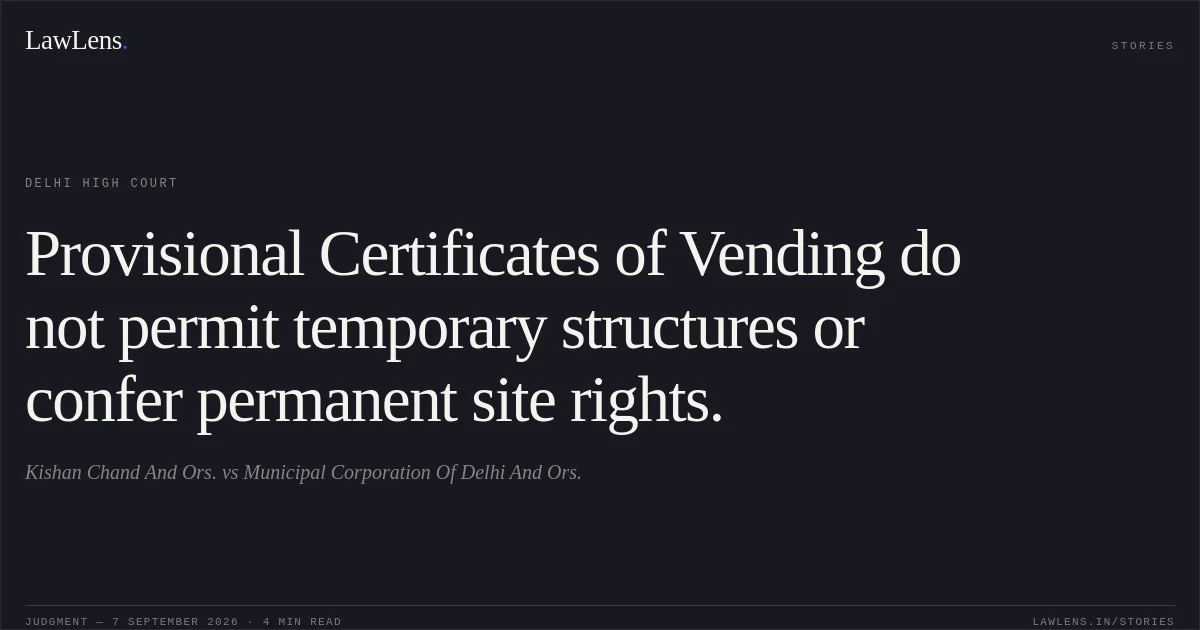
The 45 petitioners were street vendors holding provisional Certificates of Vending (CoVs), predominantly in the category of “Others,” with two petitioners authorised for “Food/Snack with Gas Cylinder/Fire” in South Zone, Ward S-79.
pp. 1–3They claimed to have operated for several years from semi-permanent structures at Sheetla Mata Market, Madangir, and relied on property-tax payments and demand notices issued by the MCD.
p. 4Their vending structures were demolished on 30 July 2024, following which they sought restoration of the structures, permission to continue vending from their fixed locations, and correction of their vending category to “Stationary Street Vendor”.
pp. 4–5The MCD contended that property-tax payment did not confer title or any right over the public road and that allotment of permanent vending sites and determination of vending categories fell within the domain of the Town Vending Committee-II (TVC-II), which had not yet been constituted.
pp. 5–602Issues
i.Whether the petitioners, as provisional CoV holders, were entitled to re-establish or maintain semi-permanent or temporary vending structures at their claimed fixed locations on the basis of past vending and payment of property tax.
pp. 4–8ii.Whether the petitioners could claim a right to vend from a fixed site notwithstanding the condition in their provisional CoVs requiring mobile vending and prohibiting temporary or permanent construction.
pp. 6–8iii.Whether the petitioners were entitled to correction of their vending category to “Stationary Street Vendor.”
pp. 4–5, 10–11iv.What directions, if any, were warranted for petitioners vending food or snacks with a gas cylinder/fire.
pp. 9–1003Law Applied
The Court applied the Street Vendors (Protection of Livelihood and Regulation of Street Vending) Act, 2014, particularly Section 18(3) concerning relocation or eviction and Section 21 concerning the street vending plan to be formulated by the competent Town Vending Committee.
p. 4, 10The Court treated the terms of the provisional CoVs as binding, including the requirements that mobile vendors comply with prescribed vending periods and zones, refrain from obstructing pedestrian or vehicular movement, and not construct any permanent or temporary structure.
pp. 6–8It held that payment or acceptance of municipal tax does not confer title, ownership, or a vested right in the property, relying on State of A.P. v. M/s. Star Bone Mill & Fertiliser Co., (2013) 9 SCC 319, and Vadiyala Prabhakar Rao v. Government of Andhra Pradesh, 2026 INSC 450.
pp. 8–9It also relied on Ramrakh Chhipa v. Municipal Council, 2026 RJ-JP 29890, for the principle that municipal-tax receipts may evidence a fiscal transaction or possession but do not create any proprietary interest.
p. 9Provisions in the judgment · 3 · Linked ones open on LawLens
Street Vendors (Protection of Livelihood and Regulation of Street Vending) Act, 2014 Section 18Section 6Section 21
04Reasoning
The Court held that the petitioners’ provisional CoVs did not authorise stationary vending or the erection of semi-permanent structures.
pp. 6–8Condition No. 11 required the petitioners, other than the two food vendors, to operate as mobile vendors, while Condition No. 14 expressly prohibited permanent or temporary structures.
pp. 6–8Their prior use of semi-permanent structures could not create a vested right because it was contrary to the CoV conditions.
pp. 6–8Similarly, payment of property tax on a self-assessment basis neither converted the public road into private property nor altered the legal character of the vending activity.
pp. 5, 8–9The Court therefore declined to order restoration of the demolished structures or grant fixed-site rights.
pp. 8–9However, recognising the special operational requirements of the two food vendors permitted to use gas cylinders, the Court granted them a limited exception from the mobile-vending condition, subject to strict safeguards concerning space, pedestrian and vehicular movement, hygiene, gas-cylinder size, non-transferability, and prohibition of construction.
pp. 9–10The question of changing the vending category was left to TVC-II because that committee had the statutory and administrative domain to determine vending categories and prepare the applicable street vending plan.
pp. 5–6, 1005Holding
The Court dismissed the claim to re-establish semi-permanent or temporary vending structures and held that the petitioners could not derive any fixed-site or proprietary right from their provisional CoVs or payment of property tax.
pp. 8–9Petitioners 13 and 31, who sold food/snacks using gas cylinders, were permitted to operate from a restricted space notwithstanding Condition No. 11, provided they complied with the specified safety, hygiene, obstruction, non-transferability, and no-construction conditions.
pp. 9–10The remaining petitioners were required to operate in accordance with their provisional CoVs, maintain cleanliness, refrain from creating third-party rights, and not erect temporary or permanent structures.
p. 10All directions were made subject to any future plan prepared by TVC-II, with no vested rights being created.
p. 10After constitution of TVC-II, the petitioners were given liberty to seek correction of their vending categories, which TVC-II was directed to consider and decide in accordance with law within three months of its constitution.
p. 11The writ petition and pending applications were accordingly disposed of.
p. 11Original Court PDF
Kishan Chand And Ors.vsMunicipal Corporation Of Delhi And Ors.
Click to open original judgment
Original judgment, available to read, download and summarize on LawLens.in