Facts
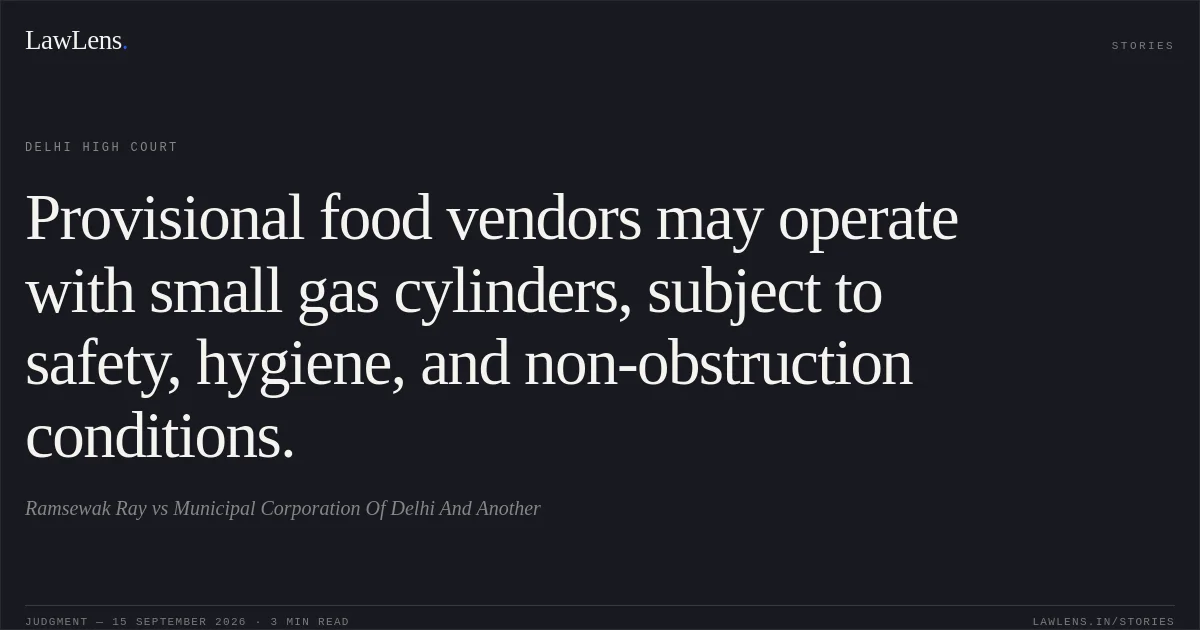
The Petitioner, a street vendor, approached the Delhi High Court under Article 226 seeking protection to vend at Major Sudesh Marg Road, adjacent to the DESU Office, J-Block Bus Stand No. 2, Rajouri Garden, Delhi.
Source reference: p.1, para. 2He had been issued a provisional Certificate of Vending (CoV), bearing URI No. 1512535, under the category “Food snack with gas cylinder/fire”.
Source reference: p.1, para. 3The Petitioner operated a mobile stall mounted on a tricycle and alleged that officials of the Municipal Corporation of Delhi and the Delhi Police were unnecessarily harassing and obstructing him.
Source reference: p.2, paras. 4–5The Court considered similar orders passed in favour of vendors operating under the same category.
Source reference: p.2, para. 7Issues
1. Whether the Petitioner, holding a provisional CoV for vending food/snacks using a gas cylinder, should be permitted to continue vending at the specified site subject to compliance with the applicable conditions.
Source reference: p.2, paras. 2–3, 7–82. Whether the Petitioner’s vending activities should be protected from disturbance, subject to restrictions concerning public safety, hygiene, pedestrian movement, traffic, and the terms of the provisional CoV.
Source reference: pp. 3–5, paras. 8–103. Whether the protection granted should remain subject to any vending plan formulated by the Town Vending Committee under Section 21 of the Street Vendors (Protection of Livelihood and Regulation of Street Vending) Act, 2014.
Source reference: p.5, para. 9Law Applied
The Court exercised its jurisdiction under Article 226 of the Constitution to protect the Petitioner’s livelihood while ensuring compliance with statutory and regulatory conditions governing street vending.
Source reference: p.1, para. 2It applied the Street Vendors (Protection of Livelihood and Regulation of Street Vending) Act, 2014, particularly the framework concerning plans prepared by the Town Vending Committee under Section 21.
Source reference: p.5, para. 9The Court also relied on the Delhi Street Vendors (Protection of Livelihood and Regulation of Street Vending) Scheme, 2019 and the conditions contained in the Petitioner’s provisional CoV, including requirements relating to hygiene, public health, non-obstruction of pedestrians and vehicles, prohibition on permanent or temporary structures, and compliance with the prescribed vending zone and other regulatory requirements.
Source reference: pp. 3–4, para. 8(a)The Court followed its earlier orders in Rajendra Singh v. Commissioner of Police & Ors., W.P.(C) 15082/2025, order dated 2 February 2026; Mohd. Badruddin v. Municipal Corporation of Delhi & Ors., W.P.(C) 19391/2025, order dated 8 January 2026; and Rihana v. MCD & Ors., W.P.(C) 1609/2026, order dated 5 February 2026, concerning similarly situated food and snack vendors using gas cylinders.
Source reference: p.2, para. 7Reasoning
The Court balanced the Petitioner’s livelihood interest against the need to regulate vending in the interests of public safety, hygiene, pedestrian movement, and traffic.
Source reference: no citationSince the Petitioner possessed a provisional CoV for the relevant category, the Court permitted him to operate his mobile vend, but required him to comply with all conditions of the CoV, except that Condition No. 11—limiting mobile vendors to 30 minutes or the time prescribed by the Town Vending Committee—would not apply, subject to the stated directions.
Source reference: pp. 3–5, para. 8(e)The Court specifically restricted the Petitioner to a particular space, prohibited obstruction to pedestrians and vehicular traffic, required the use of only a small gas cylinder, and mandated cleanliness and the presence of a dustbin.
Source reference: p.4, paras. 8(b)–(d)It further prohibited construction, sub-letting, transfer, or creation of any third-party interest in the provisional CoV.
Source reference: p.5, paras. 8(f)–(g)The protection was expressly made subject to any future plan framed by the Town Vending Committee under Section 21 of the 2014 Act, and no vested right was recognised.
Source reference: p.5, para. 9Holding
The petition was disposed of with directions permitting the Petitioner to continue vending from the specified site, subject to adherence to the provisional CoV and the additional safeguards imposed by the Court.
The Petitioner was required to use only a small gas cylinder, avoid obstruction and traffic congestion, maintain hygiene and cleanliness, keep a dustbin, refrain from constructing any structure, and not transfer or sub-let the CoV.
Source reference: pp. 4–5, para. 8Subject to compliance, the Petitioner’s vending activities were not to be disturbed.
Source reference: p.5, paras. 10–11The directions remained subject to any plan subsequently formulated by the Town Vending Committee under Section 21 of the 2014 Act, without creation of any vested right.
Source reference: p.5, paras. 9–11Acts & Sections Cited
1 provisions across 1 statute referred to in this judgment. Each provision opens on LawLens.
Street Vendors (Protection of Livelihood and Regulation of Street Vending) Act, 20141
Original Court PDF
Ramsewak RayvsMunicipal Corporation Of Delhi And Another
Click to open original judgment
Original judgment, available to read, download and summarize on LawLens.in