Facts
The applicant sought quashing of FIR being C.R. No. I-11210067250295 of 2025 registered at Saroli Police Station, Surat, concerning the suicide of Sukhpreet Kaur.
Source reference: p.1, paras. 2–3The prosecution alleged that accused Mahendra Rajput had harassed, assaulted and blackmailed the deceased by threatening to circulate her private videos.
Source reference: p.4, para. 4.2Shortly before the incident, the deceased allegedly contacted the applicant for financial assistance to meet Mahendra’s demand.
Source reference: pp.4, 8–9, paras. 4.2, 7–8During a conference call arranged through witness Babli on the night of 01 May 2025, the applicant allegedly used abusive language, threatened the deceased, and stated that he would come to her house with Mahendra and demonstrate his power.
Source reference: pp.4, 8–9, paras. 4.2, 7–8The deceased was found hanging in a room at her residence on 02 May 2025.
Source reference: p.5, para. 5(d)Her earlier written complaint dated 03 April 2025 named Mahendra and referred to blackmail, confinement, assault and threats, but did not mention the applicant; the post-mortem report corroborated injuries allegedly caused by Mahendra.
Source reference: pp.6–8, paras. 5(e)–7The applicant contended that he was not named in the FIR or the written complaint and that abusive language, without more, did not constitute instigation to suicide.
Source reference: pp.2–4, para. 4.1The State opposed quashing on the basis of the call-detail records, the witness statement and the recorded conversation.
Source reference: p.4, para. 4.2Issues
1. Whether the allegations and material collected during investigation prima facie disclosed abetment of suicide by the applicant under Sections 306 and 107 of the IPC.
Source reference: pp.17–19, paras. 12–142. Whether the applicant’s non-mention in the FIR and the deceased’s earlier written complaint justified quashing of the criminal proceedings in the exercise of the High Court’s inherent jurisdiction.
Source reference: pp.7, 18–19, paras. 7, 12–143. Whether the alleged abusive and threatening conference call constituted instigation having a proximate nexus with the deceased’s suicide.
Source reference: pp.8–9, 17–19, paras. 8, 12–13Law Applied
The Court applied Sections 306 and 107 IPC, under which abetment of suicide requires proof of instigation, intentional aid or conspiracy, and relied on the principle that instigation may be inferred from the accused’s acts, omissions or continued conduct creating circumstances in which the deceased feels compelled to commit suicide.
Source reference: pp.10–13, paras. 9–11Relying on Praveen Pradhan v. State of Uttaranchal, (2012) 9 SCC 734, the Court held that no straitjacket formula determines instigation and that the circumstances and their effect on the deceased must be assessed.
Source reference: p.10, para. 9Amit Kapoor v. Ramesh Chander, (2012) 9 SCC 460, and Mahendra K.C. v. State of Karnataka, (2022) 2 SCC 129, were applied for the rule that, at the quashing stage, the Court must determine only whether the allegations, taken at face value, prima facie constitute an offence and must not conduct a mini-trial or assess evidentiary sufficiency.
Source reference: pp.11–16, paras. 10–11The Court also relied on Chitresh Kumar Chopra, Ramesh Kumar and Amalendu Pal for the requirement of intentional and proximate conduct capable of provoking or compelling suicide.
Source reference: pp.12–13, para. 11The applicant’s reliance on Sanju v. State of Madhya Pradesh, 2002 LawSuit (SC) 559, was distinguished on facts.
Source reference: p.19, para. 14Reasoning
The Court found that the applicant’s role was not based merely on a solitary allegation of abusive language.
Source reference: pp.7–9, 17–18, paras. 7–8, 12The call-detail records corroborated the conference call, while witness Babli’s statement and the recorded conversation indicated that the applicant threatened to visit the deceased with Mahendra, who had previously assaulted and injured her.
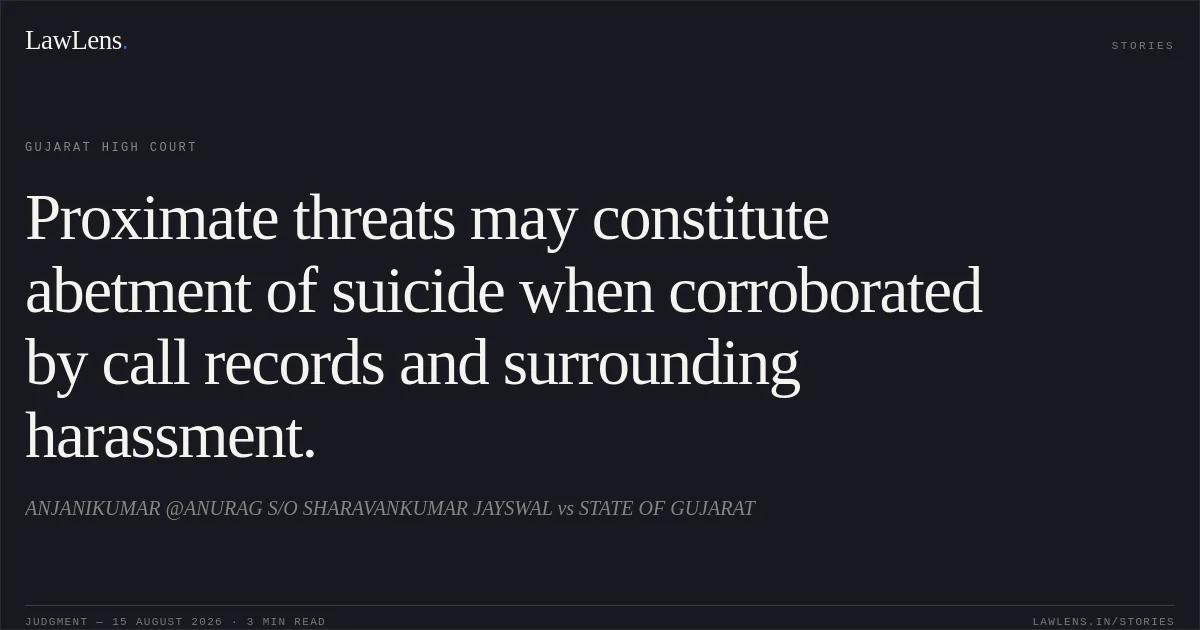
Source reference: pp.7–9, 17–18, paras. 7–8, 12Considering the pre-existing fear created by Mahendra’s blackmail and physical assault, the Court held that the applicant’s immediate threats could prima facie have caused the deceased to feel frustrated and unable to continue living.
Source reference: pp.17–19, paras. 12–13The proximity between the threatening call on the night of 01 May 2025 and the suicide on 02 May 2025 supplied the requisite nexus at the preliminary stage.
Source reference: pp.17–19, paras. 12–13The earlier complaint’s failure to name the applicant did not exonerate him because it preceded the alleged conference call by approximately one month and did not negate the later material collected during investigation.
Source reference: p.18, para. 12Applying the limited scope of quashing jurisdiction, the Court declined to evaluate the credibility or sufficiency of the evidence.
Source reference: pp.11–16, paras. 10–11Holding
The Court held that the prosecution material prima facie disclosed that the applicant’s threatening conduct, considered in the context of Mahendra’s prior assault and blackmail, could amount to instigation and abetment of suicide under Sections 306 and 107 IPC.
The applicant’s failure to be named in the earlier written complaint or FIR was not sufficient to warrant quashing.
Source reference: pp.18–19, paras. 13–14The application for quashing the FIR was therefore rejected; the Rule was discharged.
Source reference: p.20, para. 15Acts & Sections Cited
4 provisions across 2 statutes referred to in this judgment. Each provision opens on LawLens.
Code of Criminal Procedure, 19732
Indian Penal Code, 18602
Original Court PDF
ANJANIKUMAR @ANURAG S/O SHARAVANKUMAR JAYSWALvsSTATE OF GUJARAT
Click to open original judgment
Original judgment, available to read, download and summarize on LawLens.in