Facts
The applicant, an OBC candidate (Roll No. 0849375), challenged an impugned communication dated 03.10.2023 which presumably denied her benefit under the Other Backward Classes (OBC) Non-Creamy Layer category
Source reference: para 1, 8.1She sought a direction for the respondents to treat her as a Non-Creamy Layer OBC candidate, include her in the service allocation list based on her merit rank, and provide consequential benefits
Source reference: para 8.1The applicant contended that her case was squarely covered by a recent Supreme Court judgment regarding the criteria for determining the "creamy layer" status
Source reference: para 2Issues
Whether the applicant is entitled to be treated as an OBC (Non-Creamy Layer) candidate and allocated service based on the legal principles established in Union of India & Ors. v. Rohith Nathan & Ors.
Source reference: para 2, 5Law Applied
The Tribunal primarily relied on the precedent established by the Hon’ble Supreme Court in Union of India & Ors. v. Rohith Nathan & Ors. (Civil Appeal No. 2827-2829/2018, decided 11.03.2026)
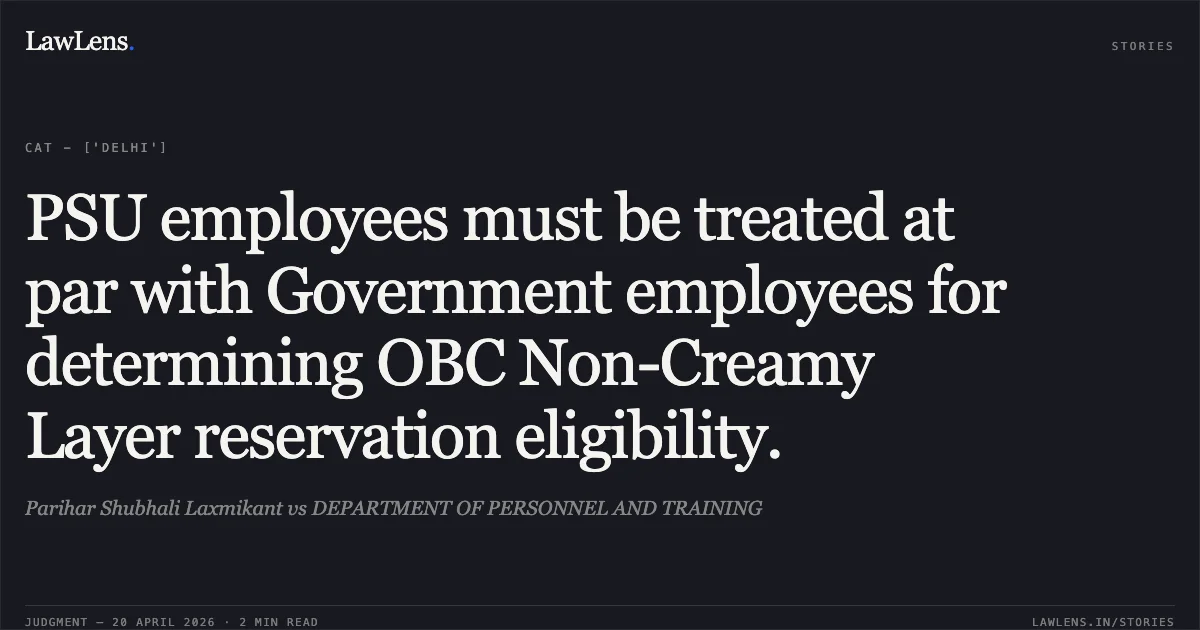
Source reference: para 2The core principle derived is that treating similarly placed employees of Public Sector Undertakings (PSUs) and private entities differently from Government employees when determining "creamy layer" status for reservation purposes constitutes "hostile discrimination" and violates the cornerstone of equality
Source reference: para 40The Supreme Court further mandated the creation of supernumerary posts to accommodate eligible candidates who meet the clarified non-creamy layer criteria
Source reference: para 43Reasoning
The applicant argued that the legal controversy regarding her OBC status was identical to the issues resolved in the Rohith Nathan case
Source reference: para 2The Tribunal examined paragraphs 40 to 44 of the Apex Court’s judgment, noting that the Supreme Court had rejected interpretations that disadvantaged segments of the same backward class without rational justification
Source reference: para 3, 40The Tribunal observed that the Supreme Court had specifically directed the government to consider the claims of all similarly situated candidates and intervenors within a fixed timeline
Source reference: para 3, 44Consequently, without adjudicating the specific factual merits or the respondents' counter-claims, the Tribunal determined that the respondents must evaluate the applicant's eligibility through the lens of the Supreme Court’s clarified criteria
Source reference: para 5Holding
The Tribunal disposed of the Original Application by directing the respondents to consider the applicant’s claim in accordance with the ratio laid down in Union of India v. Rohith Nathan
The respondents were ordered to complete this exercise and take appropriate steps within six months from the date of receipt of the certified copy of the order
Source reference: para 6No order was made as to costs
Source reference: para 7Acts & Sections Cited
1 provisions across 1 statute referred to in this judgment. Each provision opens on LawLens.
Administrative Tribunals Act, 19851
Original Court PDF
Parihar Shubhali LaxmikantvsDEPARTMENT OF PERSONNEL AND TRAINING
Click to open original judgment
Original judgment, available to read, download and summarize on LawLens.in


