Facts
The subject land, measuring three acres, was granted to the appellants’ predecessor in 1971.
Source reference: para. 2The appellants sold it to respondent No. 3 by registered sale deed dated 6 March 1995.
Source reference: paras. 2–3In 2017, the appellants sought resumption and restoration under the Karnataka Scheduled Caste and Scheduled Tribes (Prohibition of Transfer of Certain Lands) Act, 1978 (PTCL Act).
Source reference: para. 3The Assistant Commissioner dismissed the application in 2019 for inordinate delay; the Deputy Commissioner reversed that decision in 2024, relying on the 2023 amendment to Section 5 of the PTCL Act.
Source reference: paras. 3–4The Single Judge set aside the Deputy Commissioner’s order and restored the Assistant Commissioner’s decision. The appellants challenged that order in this appeal.
Source reference: paras. 1, 5Issues
Whether the 2023 amendment to Section 5 of the PTCL Act displaced the requirement that proceedings for restoration be initiated within a reasonable time.
Source reference: paras. 6–8Whether the appellants’ restoration claim, initiated approximately 23 years after the sale and without an explanation for the delay, could be entertained.
Source reference: paras. 9–11Law Applied
Sections 4 and 5 of the PTCL Act govern prohibited transfers of granted land and proceedings for annulment, resumption, and restoration.
Source reference: no citationAlthough the Act prescribes no limitation period, Nekkanti Rama Lakshmi v. State of Karnataka and Vivek M. Hinduja v. M. Aswatha establish that such proceedings must be initiated within a reasonable time and cannot be entertained after an inordinate delay.
Source reference: para. 7The Court, following Smt. Gouramma @ Gangamma v. The Deputy Commissioner, held that the 2023 insertion of clauses (c) and (d) into Section 5—providing that there is no limitation period and applying that provision to pending cases—did not displace the separate equitable doctrine of delay and laches.
Source reference: para. 7Laches requires consideration of the length of delay and the circumstances, including conduct and prejudice.
Source reference: para. 7Reasoning
The sale occurred in 1995, but the appellants did not seek restoration until 2017, and they offered no explanation for the approximately 23-year delay.
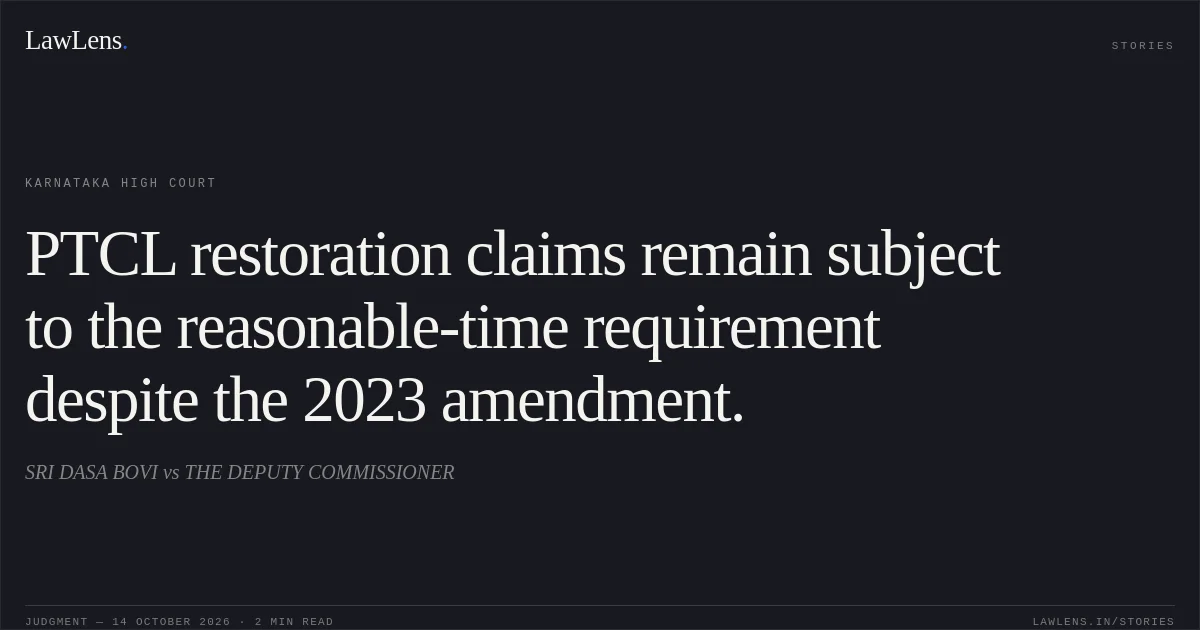
Source reference: para. 9Applying Nekkanti Rama Lakshmi and the interpretation of the 2023 amendment in Gouramma, the Court held that the amendment’s removal of any limitation bar did not eliminate the requirement to act within a reasonable time.
Source reference: paras. 7, 11Nor did the alleged absence of prior Government permission under Section 4(2), by itself, revive a claim that had not been pursued within a reasonable time.
Source reference: para. 10The Deputy Commissioner therefore erred in treating the amendment as curing the delay.
Source reference: para. 11Holding
The Court answered the issues against the appellants, found no error in the Single Judge’s decision, and dismissed the appeal.
The Assistant Commissioner’s order dismissing the restoration application for inordinate delay accordingly remained in force.
Source reference: paras. 11–12Acts & Sections Cited
3 provisions across 2 statutes referred to in this judgment. Each provision opens on LawLens.
KARNATAKA HIGH COURT ACT, 19611
Original Court PDF
SRI DASA BOVIvsTHE DEPUTY COMMISSIONER
Click to open original judgment
Original judgment, available to read, download and summarize on LawLens.in


