Facts
The Petitioner, the Supreme Court of India, filed a writ petition seeking to quash an order dated 14.11.2025 passed by its own Registrar-cum-First Appellate Authority (FAA) under the Right to Information Act, 2005 ("RTI Act")
Source reference: para. 1The FAA’s order directed the disclosure of examination-related records, including evaluated answer scripts and moderation data
Source reference: para. 1The Petitioner approached the High Court directly without exhausting the statutory remedy of a Second Appeal before the Central Information Commission (CIC) under Section 19(3) of the RTI Act
Source reference: para. 2The Petitioner argued that a "public authority" is excluded from the definition of "any person" in Section 19(1), and therefore, it lacked the standing to file a statutory appeal
Source reference: para. 3Issues
1. Whether the expression "any person" as used in Section 19 of the RTI Act excludes a "public authority," thereby precluding it from filing a statutory appeal
Source reference: para. 3, 52. Whether the Petitioner must exhaust the alternative statutory remedy under Section 19(3) of the RTI Act before approaching the High Court under Article 226
Source reference: para. 18Law Applied
The Court interpreted Section 19(1) and 19(3) of the RTI Act, which provides a right of appeal to "any person" aggrieved by a decision of an information officer
Source reference: para. 4It relied on Section 3(42) of the General Clauses Act, 1897, which defines "person" to include any company, association, or body of individuals, whether incorporated or not
Source reference: para. 12The Court further applied the principle that the right of appeal is a legal right available to every aggrieved party unless explicitly curtailed by statute
Source reference: para. 8It also emphasized the independent quasi-judicial status of the Public Information Officer (PIO), who functions separately from the public authority itself
Source reference: para. 6, 9Reasoning
The Court rejected the Petitioner’s contention, stating that the argument lacked merit
Source reference: para. 4It reasoned that the term "person" under Section 19(1) is intentionally broad and is not limited to natural persons or information seekers
Source reference: para. 13, 16The Court observed that under the scheme of the RTI Act, the PIO is an independent authority whose actions are not automatically attributed to the public authority; thus, the public authority can be "aggrieved" by a decision of its own FAA
Source reference: para. 6-7Referring to the General Clauses Act and various legal commentaries, the Court held that a "public authority" is a juristic entity and fits within the definition of a "person"
Source reference: para. 8, 12, 14Furthermore, the Court noted that if public authorities were barred from the statutory appellate hierarchy, they would be forced to challenge every original decision via writ petitions, which would be an "unfathomable" and unintended procedural result
Source reference: para. 17Holding
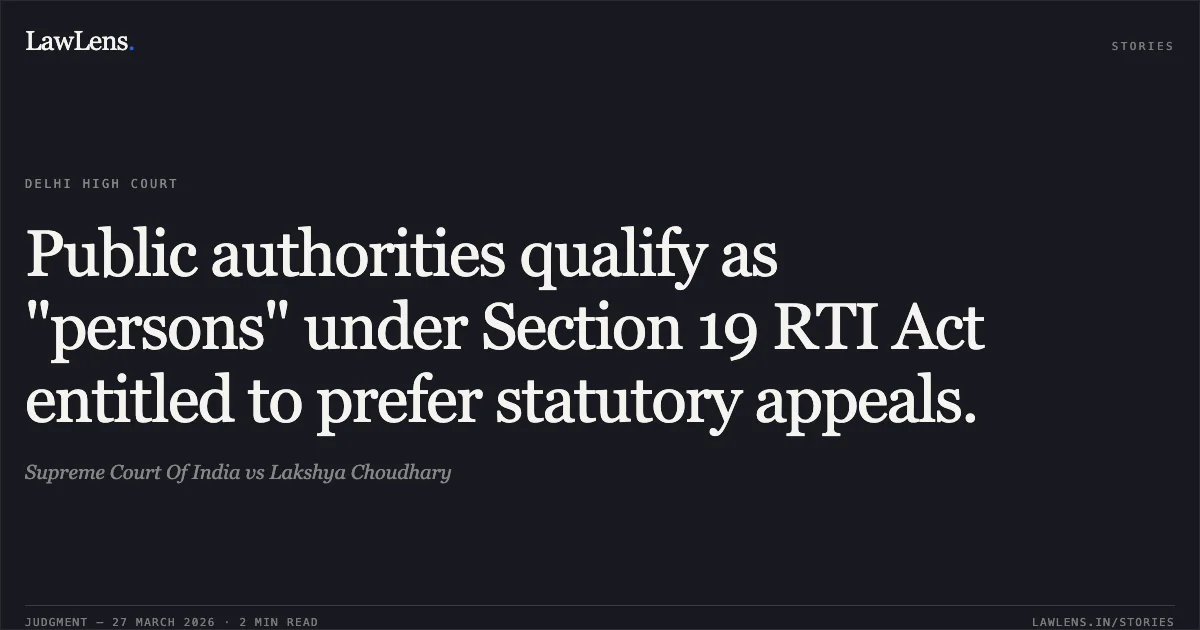
The Court held that a "public authority" under Section 2(h) is a "person" within the meaning of Section 19 of the RTI Act and is entitled to prefer an appeal
The Court concluded that the Petitioner has an efficacious alternative remedy under Section 19(3) of the RTI Act
Source reference: para. 18Consequently, the writ petition was dismissed, granting the Petitioner liberty to file a Second Appeal before the CIC
Source reference: para. 19To protect the Petitioner's rights, the Court ordered that the time spent in the present writ proceedings be excluded for the purpose of limitation when filing the statutory appeal
Source reference: para. 19Acts & Sections Cited
5 provisions across 2 statutes referred to in this judgment. Each provision opens on LawLens.
Right to Information Act, 20054
General Clauses Act, 18971
Original Court PDF
Supreme Court Of IndiavsLakshya Choudhary
Click to open original judgment
Original judgment, available to read, download and summarize on LawLens.in