Facts
The petitioner sought, under an RTI application dated 24 June 2024, an employee’s LTC records, travel and settlement details, CGHS benefits and medical bills concerning his dependants, and family declaration forms.
Source reference: pp. 1–5, paras. 2–6The DGCA CPIO refused disclosure on the ground that the information was exempt; the First Appellate Authority and the Central Information Commission upheld that refusal under Section 8(1)(j) of the RTI Act.
Source reference: pp. 1–5, paras. 2–6The petitioner’s writ petition contended that public expenditure and the pursuit of vigilance complaints justified disclosure.
Source reference: pp. 1–5, paras. 2–6The respondents also pointed to matrimonial disputes between the petitioner and the employee’s family
Source reference: pp. 1–5, paras. 11–12Issues
1. Whether the requested LTC, medical-benefit and family-declaration records constituted third-party personal information exempt from disclosure under Section 8(1)(j) of the RTI Act
Source reference: pp. 3–4, paras. 7–92. Whether the involvement of public funds or the petitioner’s stated intention to pursue vigilance complaints established a larger public interest warranting disclosure
Source reference: pp. 2–5, paras. 6, 10–11Law Applied
Section 8(1)(j) of the Right to Information Act, 2005, as applied in the judgment, exempts personal information where disclosure has no relationship to public activity or interest, or would cause an unwarranted invasion of privacy, unless the competent authority is satisfied that larger public interest justifies disclosure
Source reference: p. 3, para. 7The judgment cites no judicial precedents.
Source reference: no citationReasoning
The Court found that the application sought more than aggregate information about DGCA expenditure: it sought identifiable dependants’ travel, medical treatment and expenses, as well as the employee’s family declarations.
Source reference: pp. 3–5, paras. 8–13These details concerned the private affairs of the employee and, particularly, family members who were third parties.
Source reference: pp. 3–5, paras. 8–13Reimbursement from public funds did not, by itself, convert those personal particulars into disclosable information.
Source reference: pp. 3–5, paras. 8–13The petitioner showed no overriding larger public interest; neither the assertion of public expenditure nor the intention to pursue vigilance complaints displaced the exemption.
Source reference: pp. 3–5, paras. 8–13The Court also considered the matrimonial-dispute context and observed that RTI could not be used to settle personal scores
Source reference: pp. 3–5, paras. 8–13Holding
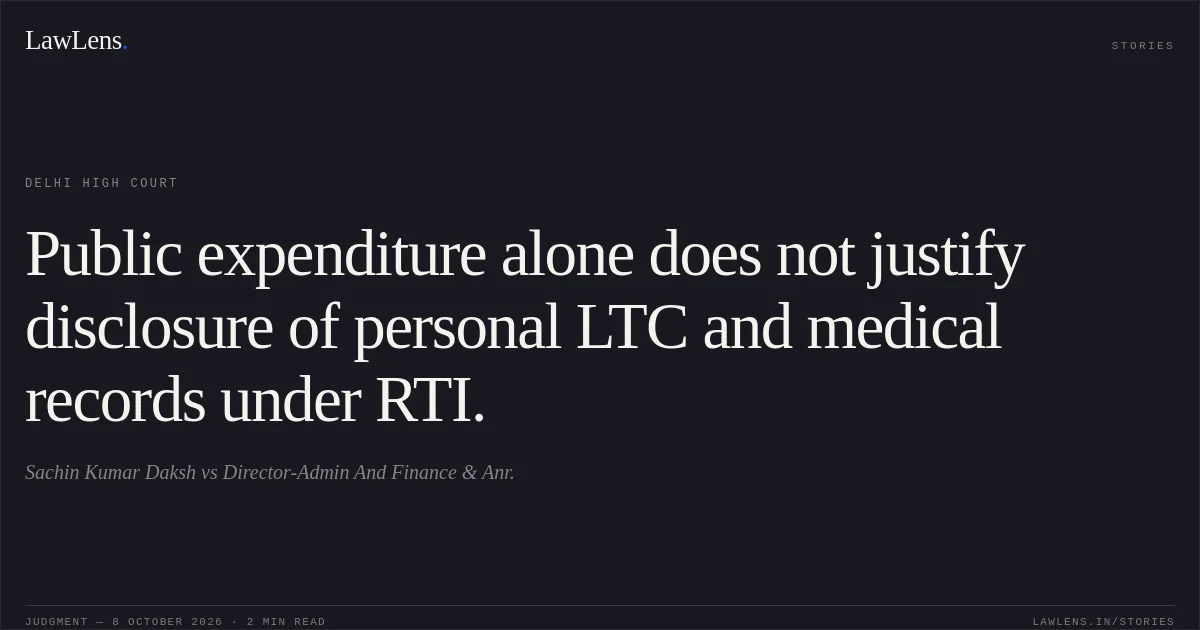
The Court held that the requested records were exempt third-party personal information and that no larger public interest justified disclosure.
It dismissed the writ petition and disposed of any pending applications.
Source reference: p. 5, paras. 14–15Acts & Sections Cited
1 provisions across 1 statute referred to in this judgment. Each provision opens on LawLens.
Right to Information Act, 20051
Original Court PDF
Sachin Kumar DakshvsDirector-Admin And Finance & Anr.
Click to open original judgment
Original judgment, available to read, download and summarize on LawLens.in