Facts
The respondent applied for the post of Constable in the Delhi Police pursuant to an advertisement dated September 1, 2023
Source reference: para. 5After qualifying for the first tier of the selection process, he was scheduled to appear for the Physical Endurance and Measurement Test (PE&MT) on January 14, 2024
Source reference: para. 3, 6The respondent failed to appear, citing ill health (cold, fever, and dizziness), and submitted three representations on January 13, 14, and 25, 2024, seeking to reschedule the test
Source reference: para. 3, 6The appellants marked him as "absent."
Source reference: para. 3The Central Administrative Tribunal (CAT) directed the appellants to allow the respondent to participate in the PE&MT with the next batch, a direction subsequently upheld by the High Court of Delhi
Source reference: para. 3The appellants challenged these orders, arguing that the advertisement explicitly stated the schedule was final
Source reference: para. 5Issues
Whether the respondent possessed an enforceable right to seek rescheduling of the PE&MT despite a specific prohibitory stipulation in the recruitment advertisement
Source reference: para. 8Whether judicial discretion in matters of public employment can be exercised on the grounds of compassion or backward community status to override established selection procedures
Source reference: para. 11Law Applied
The Court applied the principle that the terms and conditions specified in a recruitment advertisement, particularly regarding the finality of examination schedules, are binding on the candidates
Source reference: para. 5, 8It further emphasized the doctrine of a "fair level playing field" in public employment, asserting that judicial discretion must be exercised within strictly defined legal boundaries
Source reference: para. 11The Court held that "grace, charity or compassion" should not influence adjudicatory outcomes in public recruitment if they compromise the integrity and uniformity of the selection process
Source reference: para. 11Reasoning
The Court reasoned that the advertisement’s clear stipulation—that the PE&MT schedule could not be altered under any circumstances—left no room for the respondent to demand a reschedule
Source reference: para. 5, 8The Court noted that the respondent’s ailment was not so debilitating as to prevent him from moving, as evidenced by his own admission of reporting to the recruitment office on January 13; his failure to appear on January 14 to request an accommodation in person demonstrated a lack of "drive and initiative"
Source reference: para. 7, 9The Court found no evidence that the respondent’s representations were officially received or acknowledged, and even if they were, the appellants’ silence did not create a legal right to a second chance
Source reference: para. 6, 8The Court rejected the lower forums' reliance on the respondent’s backward community status, stating that such factors cannot be used to tilt the scales of justice against established rules of recruitment
Source reference: para. 11Holding
The Supreme Court allowed the appeal and set aside the judgments of the Central Administrative Tribunal and the Delhi High Court
The Court held that the respondent was rightly marked "absent" and that the Tribunal erred in disrupting the recruitment process by granting an unauthorized rescheduling
Source reference: para. 7, 8No costs were awarded
Source reference: para. 14Original Court PDF
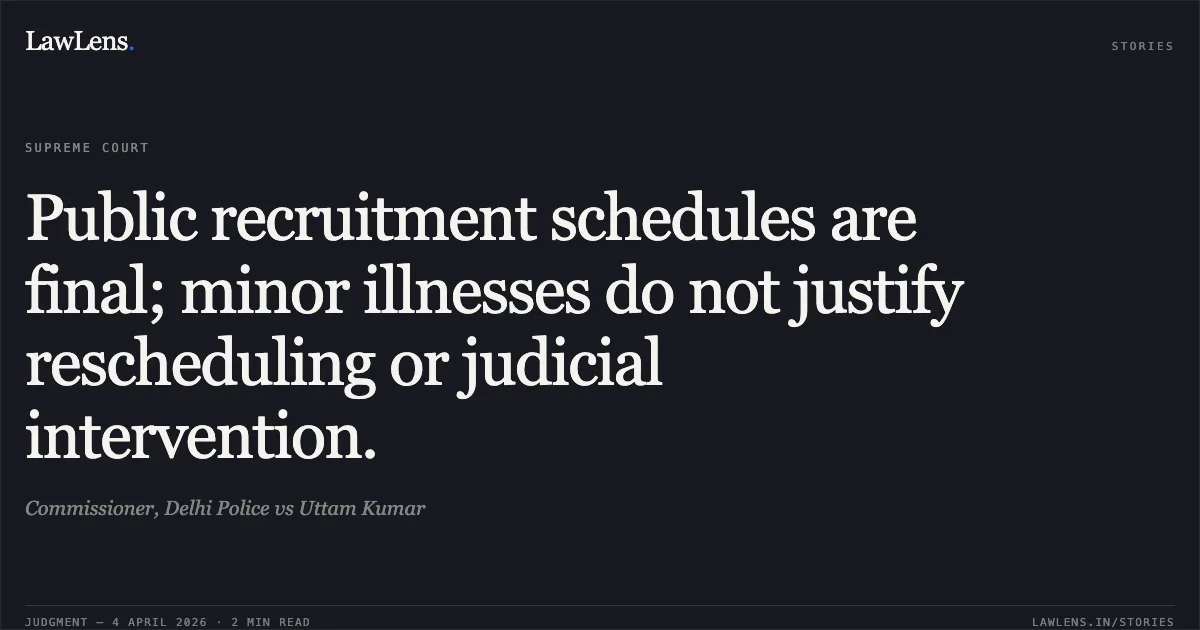
Commissioner, Delhi PolicevsUttam Kumar
Click to open original judgment
Original judgment, available to read, download and summarize on LawLens.in


![Authorities must decide pensionary and retiral-benefit claims through a reasoned order within eight weeks.. Habibullah khan vs HOME DEPARTMENT. CAT - ['Srinagar']. LawLens](/stories/thumbnails/authorities-must-decide-pensionary-and-retiral-benefit-claims-through-a-reasoned-order-wit-d0cbe8a8119c48fbabe7df9f2d353488.webp)