Facts
On 11th February 2011, a pedestrian named Mahavir was struck and killed by a Delhi Transport Corporation (DTC) bus driven by Respondent No. 3.
Source reference: p. 2The Motor Accident Claims Tribunal (MACT) awarded Rs. 9,22,000 to the claimants but denied the Appellant Insurance Company recovery rights against the DTC (Respondent No. 4), despite finding the driver's license was fake.
Source reference: p. 1-2The DTC contended it exercised due diligence by conducting a driving test and attempting to verify the license via mail.
Source reference: p. 6The licensing authority in Mathura confirmed the license number belonged to a different individual.
Source reference: p. 9The Insurance Company appealed, seeking recovery rights against the DTC for breach of policy terms.
Source reference: p. 2Issues
1. Whether the owner of a vehicle (DTC) is entitled to protection from liability if they conduct a driving test but fail to verify the authenticity of a driver’s license that is ex-facie suspicious.
Source reference: p. 10 / para. 182. Whether the standard of "due diligence" for verifying a driving license differs between a private individual and a public transport undertaking/commercial fleet operator.
Source reference: p. 16-17 / para. 32-33Law Applied
Section 149(2)(a)(ii) of the Motor Vehicles Act, 1988, which permits insurers to defend claims on the ground that the driver was not duly licensed.
Source reference: p. 11Principles from United India Insurance Co. Ltd. v. Lehru, National Insurance Co. Ltd. v. Swaran Singh, and National Insurance Co. Ltd. v. Geeta Bhatt which establish that an insurer can recover from the insured if a "wilful breach" or lack of reasonable care in verifying the license is proven.
Source reference: p. 11, 12, 13The distinction between public and private employers established in DTC v. United India Insurance Co. Ltd. (2017), holding that public undertakings have a higher administrative duty of care.
Source reference: p. 18Reasoning
The Court found that the driver's license was "ex-facie" fake because the validity dates (2007–2010) were inconsistent with the issuance date (2003), an irregularity the DTC merged or ignored.
Source reference: p. 10The Court reasoned that a public authority like the DTC, which operates a massive fleet and possesses significant administrative machinery, cannot satisfy its duty of "due diligence" merely by conducting an internal driving test, as such tests have no statutory weight under the Motor Vehicles Act.
Source reference: p. 11, 20-21While private owners are given leeway due to the difficulty of physical verification pre-2015, the DTC's failure to follow up on a verification letter sent to the Mathura RTO constituted a fundamental dereliction of duty.
Source reference: p. 17, 22The Court concluded that the Insurance Company successfully discharged its burden of proving a breach of policy terms by highlighting the DTC’s failure to ensure statutory authorization.
Source reference: p. 22Holding
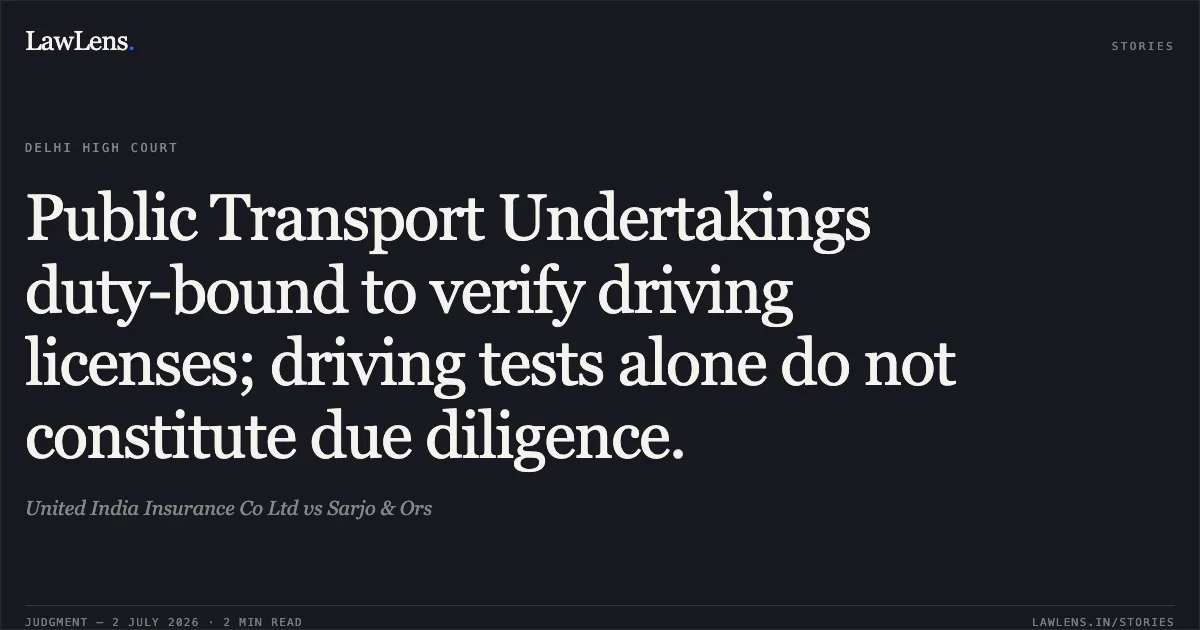
The Court answered that a public transport undertaking must exercise a higher degree of care than a private individual and must verify the authenticity of licenses before employment.
The Court set aside the MACT’s denial of recovery rights, holding that the DTC was "completely amiss" in its duties. The appeal was allowed, and the Appellant Insurance Company was granted recovery rights against the Delhi Transport Corporation.
Source reference: p. 22-23 / para. 48Acts & Sections Cited
1 provisions across 1 statute referred to in this judgment. Linked provisions open on LawLens.
Motor Vehicles Act, 19881
Original Court PDF
United India Insurance Co LtdvsSarjo & Ors
Click to open original judgment
Original judgment, available to read, download and summarize on LawLens.in