Facts
The petitioner, a Constable (GD) since 2013, was transferred to District Dhar despite requesting Ratlam for medical treatment.
Source reference: p. 2On 20.07.2020, while on sanctioned leave, he visited the Police Headquarters (PHQ) in Bhopal to represent his grievances. Finding no audience, he sat near a shrine in meditation.
Source reference: p. 3Media reports alleged he was on a "hunger strike," leading to a departmental enquiry for misconduct under M.P. Police Regulations and M.P. Civil Services (Conduct) Rules.
Source reference: p. 3On 19.09.2021, he was removed from service, a decision upheld in appeal and a mercy petition.
Source reference: p. 1-2The petitioner challenged these orders as violations of natural justice and the principle of proportionality.
Source reference: p. 4Issues
1. Whether the departmental enquiry was vitiated by procedural irregularities and bias, specifically the Enquiry Officer acting as prosecutor and recalling a witness to fill lacunae.
Source reference: p. 4 / para. 11-122. Whether the first charge of staging a hunger strike (Anshan) was substantiated by cogent evidence.
Source reference: p. 7 / para. 243. Whether the punishment of removal from service was shockingly disproportionate to the alleged misconduct.
Source reference: p. 5 / para. 16Law Applied
Rule 14 (15) of the M.P. Civil Services (CCA) Rules, 1966, regarding the proper procedure for witness examination.
Source reference: p. 4M.V. Bijlani v. Union of India (2006) 5 SCC 88: disciplinary proceedings are quasi-criminal and findings cannot rest on assumptions.
Source reference: p. 5Kranti Associates (P) Ltd. v. Masood Ahmed Khan (2010) 9 SCC 496: administrative orders must be reasoned and non-cryptic.
Source reference: p. 5Ranjit Thakur v. Union of India (1987) 4 SCC 611: Doctrine of Proportionality mandating that punishment must suit both the offender and the offense in a disciplined force.
Source reference: p. 5Reasoning
The Court found that the prosecution failed to prove the charge of "hunger strike" as no witnesses, including journalists, confirmed the cessation of food or a formal protest; sitting in meditation did not meet the legal definition of a strike.
Source reference: p. 7-8It observed that the Enquiry Officer overstepped his role by cross-examining the delinquent and allowed the recall of P.W.-6 after the defense closed, which improperly filled evidentiary gaps and indicated bias.
Source reference: p. 4, 8While acknowledging that the petitioner acted indiscreetly by circulating a video of his PHQ visit, the Court noted his record of 25 rewards against minor punishments.
Source reference: p. 5, 8It reasoned that terminating a long-serving officer for an unauthorized visit and a social media post was "outrageous" and domestic inquiry findings based on "no evidence" necessitated judicial intervention.
Source reference: p. 7-8Holding
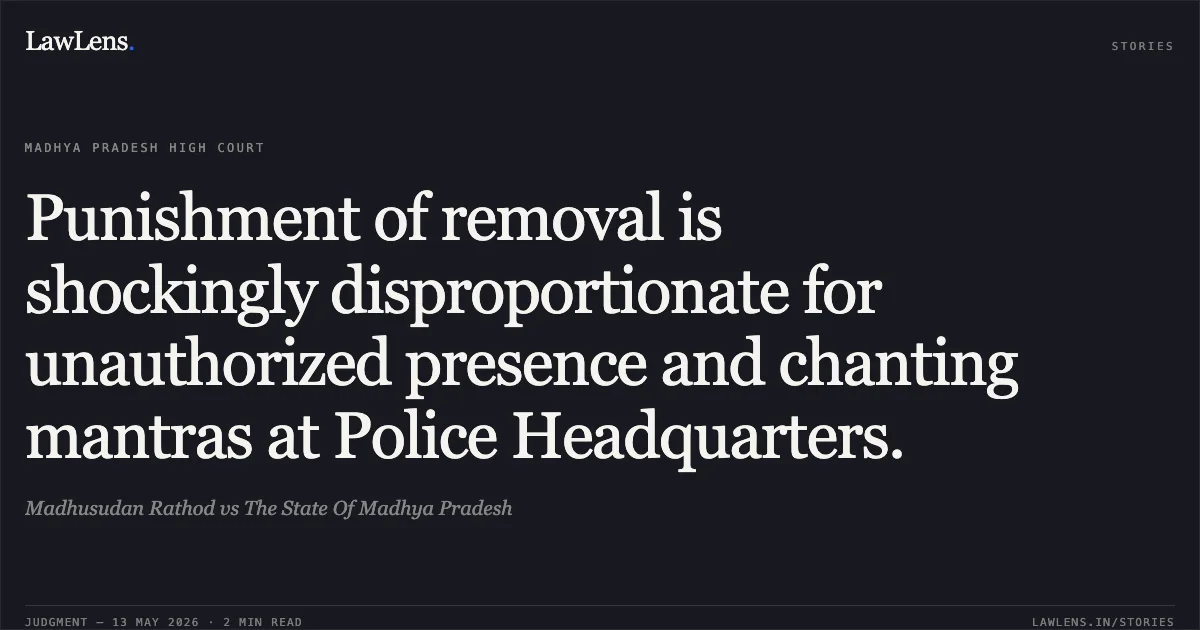
The Court held that the primary charge of a strike was unproven and the punishment was shockingly disproportionate.
The Court quashed the orders of removal, the appellate order, and the mercy petition, ordered immediate reinstatement, and remitted the matter for imposition of a proportionate punishment (excluding removal, dismissal, or compulsory retirement), with back wages to be settled within 90 days.
Source reference: p. 9Acts & Sections Cited
1 provisions across 1 statute referred to in this judgment. Linked provisions open on LawLens.
Madhya Pradesh Police Regulations1
Original Court PDF
Madhusudan RathodvsThe State Of Madhya Pradesh
Click to open original judgment
Original judgment, available to read, download and summarize on LawLens.in


