Facts
Respondent No. 2 filed a complaint alleging that his brother (A-1) conspired with others (A-2 to A-9) to forge their deceased father’s Will dated September 12, 1988, to sell ancestral property.
Source reference: para. 4-5The appellant (A-6) was one of the purchasers who acquired the land via a registered sale deed in 1998.
Source reference: para. 9Following an investigation, a chargesheet was filed for offences under Sections 467, 468, 471, 420, and 120-B of the IPC.
Source reference: para. 7The appellant moved the High Court under Section 482 CrPC to quash the proceedings, claiming he was a bona fide purchaser, was a minor/student at the time of the alleged forgery, and had no role in the conspiracy.
Source reference: para. 9-11The High Court dismissed the petition, citing disputed questions of fact.
Source reference: para. 10Issues
1. Whether the criminal proceedings against a subsequent purchaser for value can be sustained in the absence of evidence showing participation in the initial forgery or conspiracy.
Source reference: para. 20, 232. Whether the continuation of prosecution against the appellant constitutes an abuse of the process of law under Section 482 CrPC.
Source reference: para. 25Law Applied
The Court primarily applied the principles governing the quashing of criminal proceedings under Section 482 of the CrPC.
Source reference: para. 3It relied heavily on the precedent established in Mohammed Ibrahim and Others v. State of Bihar and Another (2009), which held that execution of a sale deed by a person claiming ownership (even if false) does not constitute "making a false document" or cheating against a third party who is not the purchaser.
Source reference: para. 24The court also considered the requirements for 'cheating' under Section 420 of the IPC (now Section 318(4) of the Bharatiya Nyaya Sanhita, 2023), specifically the necessity of fraudulent inducement to deliver property.
Source reference: para. 22Reasoning
The Court observed that the appellant was a purchaser for valuable consideration and there was "not even an iota of evidence" linking him to the fabrication of the 1988 Will.
Source reference: para. 20The Court noted that at the time of the Will's execution, the appellant was only 14-15 years old.
Source reference: para. 11It held that the appellant could not have committed 'cheating' against the complainant because there was no privity of contract or fraudulent inducement between them.
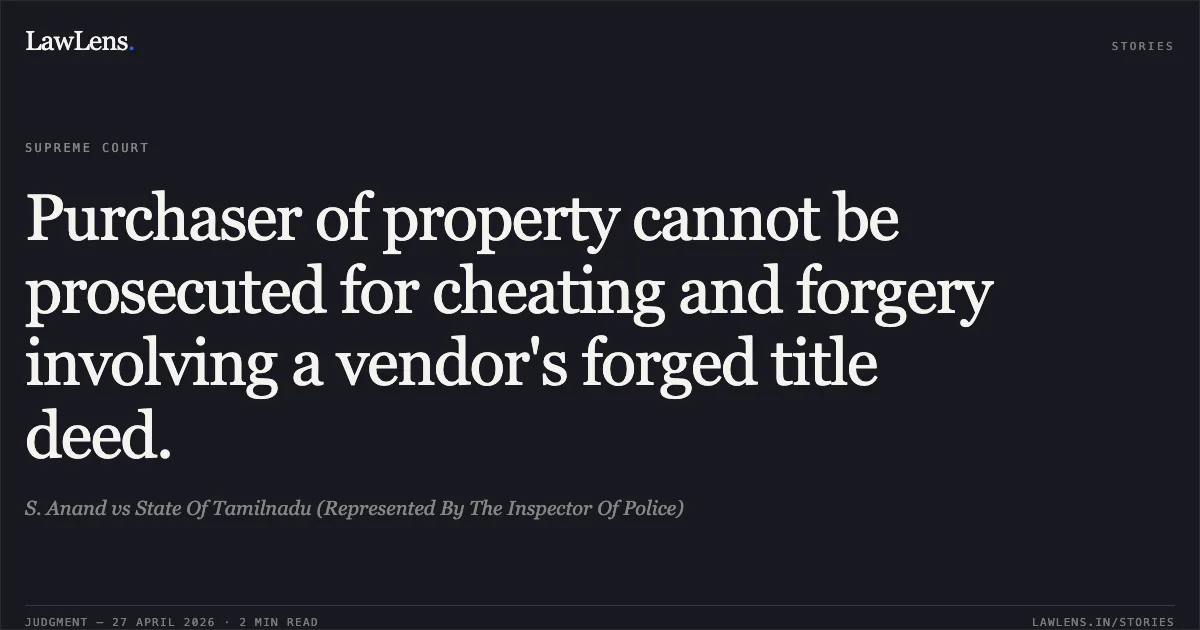
Source reference: para. 22-23Applying Mohammed Ibrahim, the Court reasoned that if a Will is forged, the purchasers are actually the aggrieved parties as their title becomes defective; a third party (the complainant) cannot maintain a charge of cheating against the purchaser.
Source reference: para. 24Furthermore, the Court discredited the FSL report as it was based on a Xerox copy rather than the original document.
Source reference: para. 21Holding
The Supreme Court allowed the appeal and set aside the High Court’s order.
The Court held that allowing the prosecution to continue against the appellant would be a gross abuse of the process of the court as no tangible material substantiated the conspiracy or knowledge of forgery.
Source reference: para. 23, 25The criminal proceedings in C.C. No. 419 of 2018 were quashed specifically regarding the appellant, while the trial was permitted to continue against the remaining accused.
Source reference: para. 26Acts & Sections Cited
8 provisions across 3 statutes referred to in this judgment. Each provision opens on LawLens.
Code of Criminal Procedure, 19732
Indian Penal Code, 18605
Bharatiya Nyaya Sanhita, 20231
Original Court PDF
S. AnandvsState Of Tamilnadu (Represented By The Inspector Of Police)
Click to open original judgment
Original judgment, available to read, download and summarize on LawLens.in