Facts
The petitioners invoked the High Court’s inherent jurisdiction under Section 528 of the Bharatiya Nagarik Suraksha Sanhita, 2023, seeking quashing of the criminal proceedings arising from Complaint Case No. 826 of 2021 and the order dated 28 June 2024 by which the Judicial Magistrate, Ramgarh, took cognizance of offences under Sections 420, 467, 468, 469, 471, 34 and 120B of the Indian Penal Code. The complainant alleged that the co-accused, in conspiracy with others, manipulated Register-II and other revenue records and sold land belonging to the complainant’s father to the petitioners
Source reference: para. 3–4; p. 2The complaint had initially been referred to the police under Section 156(3) of the Code of Criminal Procedure. Following investigation, the police submitted a final form treating the dispute as civil in nature. The complainant thereafter filed a protest-cum-complaint petition, on the basis of which the Magistrate recorded statements and took cognizance
Source reference: para. 5; p. 2–3The petitioners relied upon a memorandum of partition and an enquiry conducted by the Additional Collector, Ramgarh, pursuant to an order of the High Court. The Additional Collector found no illegality in the correction of the revenue records, and the Deputy Commissioner concurred with that finding
Source reference: para. 6–7; p. 3–4The principal co-accused against whom the allegations of manipulation had been made had already obtained quashing of the proceedings
Source reference: para. 8; p. 4Issues
Whether the allegations and unimpeachable revenue-record materials disclosed the commission of offences under Sections 467, 468, 469 and 471 IPC, either independently or with the aid of Sections 34 and 120B IPC?
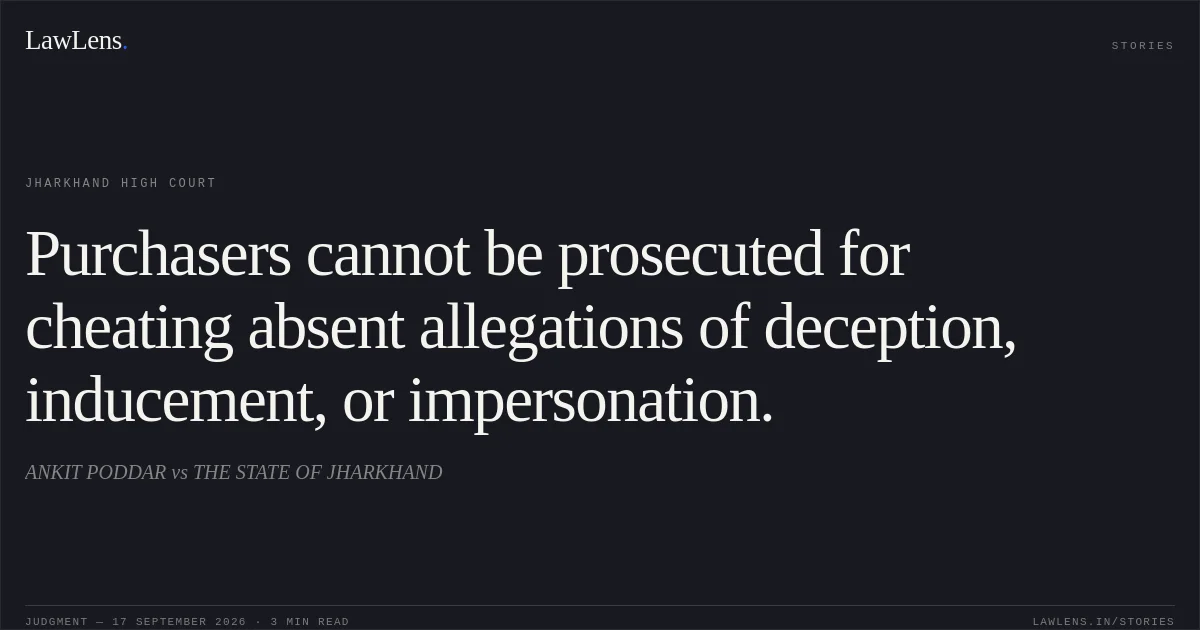
Source reference: para. 9; p. 5Whether the petitioners, who had purchased the property from the co-accused vendors, could be prosecuted under Section 420 IPC when the complainant was not a party to the transaction and there was no allegation that the petitioners had deceived or induced the complainant to part with property?
Source reference: para. 10–11; p. 5–6Whether continuation of the criminal proceedings against the petitioners amounted to an abuse of the process of law warranting exercise of the High Court’s inherent jurisdiction under Section 528 BNSS?
Source reference: para. 12–14; p. 6Law Applied
The Court applied Section 528 of the Bharatiya Nagarik Suraksha Sanhita, 2023, governing the High Court’s inherent power to prevent abuse of process and secure the ends of justice
Source reference: para. 3; p. 2It considered Sections 420, 467, 468, 469, 471, 34 and 120B IPC, holding that the offences under Sections 467, 468, 469 and 471 necessarily require the existence of forgery or a false document; absent forgery, those offences cannot be sustained, including through the operation of Sections 34 or 120B IPC
Source reference: para. 9; p. 5For Section 420 IPC, the Court relied on Mohammed Ibrahim & Others v. State of Bihar, (2009) 8 SCC 751, for the principle that a person who is not a party to a sale transaction cannot ordinarily complain of cheating merely because another person has sold property claimed by the complainant, particularly where there is no allegation of deception, inducement or delivery of property by the complainant
Source reference: para. 10–11; p. 5–6Reasoning
The Court treated the enquiry report of the Additional Collector, as affirmed by the Deputy Commissioner, as material of unimpeachable character. Those findings, together with the undisputed memorandum of partition, negated the allegation that the revenue records had been manipulated or that any false document had been created. Consequently, the foundational element of forgery for Sections 467, 468, 469 and 471 IPC was absent, and Sections 34 and 120B IPC could not independently sustain the prosecution
Source reference: para. 9; p. 5With respect to Section 420 IPC, the petitioners were merely purchasers from the co-accused vendors. The complainant was not a party to the sale transaction, and there was no allegation that the petitioners had induced the complainant to deliver property, deceived him, or impersonated anyone. Applying Mohammed Ibrahim, the Court held that the alleged sale of property claimed by the complainant did not, on the stated facts, constitute cheating by the petitioners
Source reference: para. 10–11; p. 5–6Since none of the alleged offences was prima facie made out, continuation of the proceedings would constitute an abuse of process
Source reference: para. 12; p. 6Holding
The High Court held that the materials did not disclose the offences under Sections 420, 467, 468, 469, 471, 34 or 120B IPC against the petitioners.
It accordingly quashed and set aside the entire criminal proceeding arising from Complaint Case No. 826 of 2021, including the order dated 28 June 2024 taking cognizance, qua the petitioners only
Source reference: para. 12–14; p. 6The criminal miscellaneous petition was allowed to that extent
Source reference: para. 14; p. 6Acts & Sections Cited
8 provisions across 3 statutes referred to in this judgment. Each provision opens on LawLens.
Bharatiya Nagarik Suraksha Sanhita, 20231
Indian Penal Code, 18606
Code of Criminal Procedure, 19731
Original Court PDF
ANKIT PODDARvsTHE STATE OF JHARKHAND
Click to open original judgment
Original judgment, available to read, download and summarize on LawLens.in