Facts
The respondent, a Junior Assistant in the Crime Branch CID, was suspended after a criminal case was registered against him over allegations that he impersonated a police officer and demanded money.
Source reference: p. 2Departmental proceedings under Rule 17(b) of the Tamil Nadu Civil Services (Discipline and Appeal) Rules, 1955, followed, comprising two charges: the alleged extortion and separate allegations of impersonating police officers and conducting “Kangaroo Court” activities.
Source reference: p. 5The respondent sought to keep the disciplinary proceedings in abeyance pending the criminal case.
Source reference: p. 3After the criminal charge sheet was quashed by the High Court and the State’s SLP was dismissed as delayed, the writ court quashed the departmental charge memo. The State appealed.
Source reference: p. 4, 8Issues
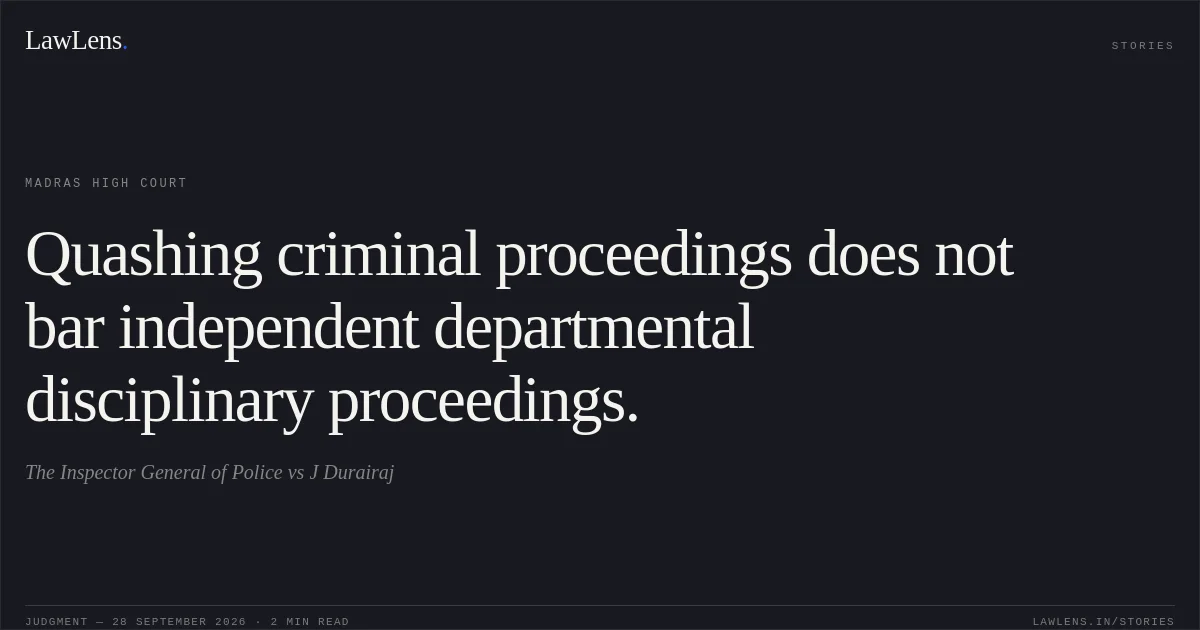
1. Whether quashing of the criminal charge sheet barred the Department from proceeding with the independent disciplinary inquiry.
Source reference: p. 6–82. Whether the writ court exceeded the relief sought by quashing the charge memo when the respondent had sought only to stay the disciplinary proceedings pending the criminal case.
Source reference: p. 8Law Applied
The Court applied Rule 17(b) of the Tamil Nadu Civil Services (Discipline and Appeal) Rules, 1955, governing departmental disciplinary proceedings.
Source reference: p. 6–8It stated that criminal and departmental proceedings are distinct: criminal conviction requires strict proof, whereas disciplinary findings may rest on a preponderance of probabilities; acquittal or quashing of criminal proceedings does not, by itself, exonerate an employee or prevent an independent departmental inquiry.
Source reference: p. 6–8The Court also noted that conduct unbecoming of a government servant may constitute misconduct under the applicable Conduct Rules.
Source reference: p. 6–8Reasoning
The charge memo set out two charges and identified supporting documents and witnesses; the second charge appeared independent of the criminal allegation.
Source reference: p. 5–7The criminal charge sheet’s quashing, and the SLP’s dismissal on limitation grounds, did not determine the merits of the departmental charges or eliminate the Department’s authority to inquire into them.
Source reference: p. 7–9Because disciplinary proceedings could proceed independently on the applicable standard of proof, the writ court erred in treating the criminal outcome as a bar and in quashing the charge memo when the respondent had sought only to keep the inquiry in abeyance.
Source reference: p. 7–9Holding
The Court allowed the writ appeal and set aside the writ court’s order quashing the charge memo.
It directed the appellants to resume the disciplinary proceedings from the stage at which they had stopped, follow the prescribed procedure, and conclude the inquiry and pass final orders as expeditiously as possible.
Source reference: p. 9No costs were ordered.
Source reference: p. 9Acts & Sections Cited
3 provisions across 1 statute referred to in this judgment. Each provision opens on LawLens.
Indian Penal Code, 18603
Original Court PDF
The Inspector General of PolicevsJ Durairaj
Click to open original judgment
Original judgment, available to read, download and summarize on LawLens.in