Facts
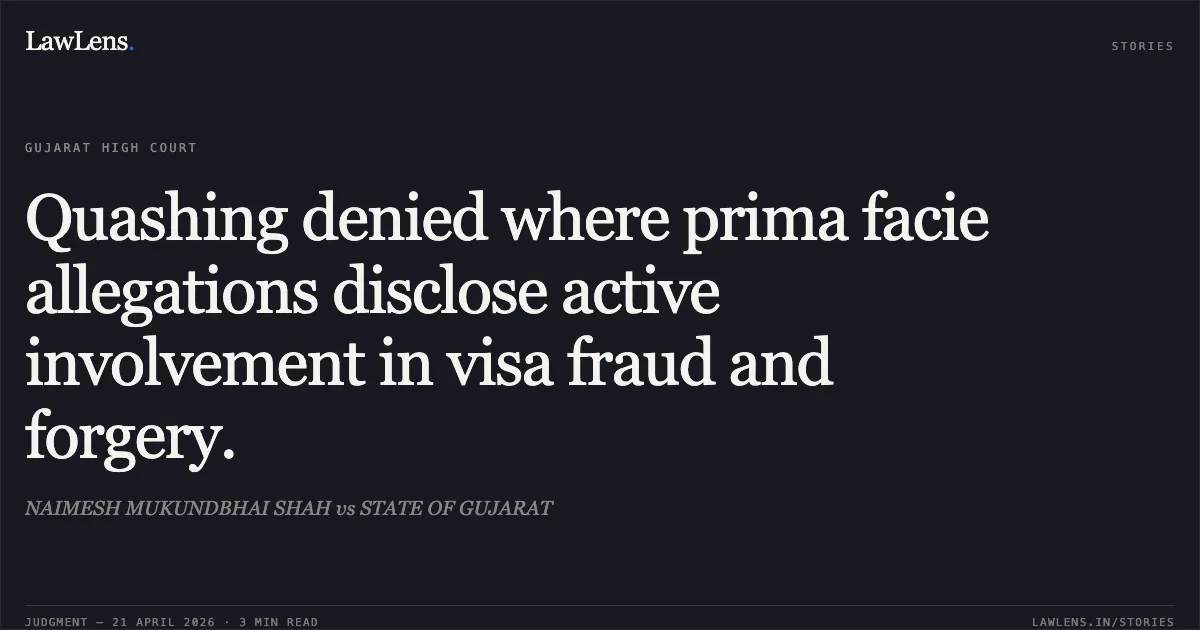
The petitioner, an immigration lawyer, filed a petition under Article 226 of the Constitution to quash an FIR registered under Sections 316(2), 318(4), and 54 of the Bharatiya Nyaya Sanhita (BNS)
Source reference: p. 1The first informant alleged that he contacted the petitioner to secure a visa and work permit for Finland. The petitioner allegedly promised these services for a fee of Rs. 12-13 Lakhs and took the informant’s original documents and blank security cheques
Source reference: p. 5Subsequently, the petitioner provided the informant with a forged offer letter, visa, and residential permit card
Source reference: p. 5-6Following the petitioner's instructions, the informant deposited Rs. 12 Lakhs into a bank account belonging to a co-accused
Source reference: p. 6After the Embassy of Finland flagged the documents as doubtful, the informant lodged the FIR on 03.04.2026
Source reference: p. 6-7The petitioner argued he had no role in the fraud, claiming he merely referred the informant to the co-accused and had even sent a legal notice to said co-accused on 26.11.2025 alleging fraud
Source reference: p. 2, 7Issues
1. Whether the FIR and accompanying material disclose a prima facie case against the petitioner to justify a criminal investigation
Source reference: p. 3, 62. Whether the petitioner's defense of a lack of direct financial benefit and the issuance of a prior notice to a co-accused are sufficient grounds to quash the FIR at the nascent stage of investigation
Source reference: p. 6-7Law Applied
The court considered the inherent powers to quash an FIR under Article 226 of the Constitution of India, emphasizing that such power should not be exercised when a "bare perusal of the F.I.R. indicates a strong prima facie case"
Source reference: p. 3The substantive law applied included Sections 316(2) (Punishment for criminal breach of trust), 318(4) (Cheating and dishonestly inducing delivery of property), and 54 (Abetment/common intention principles) of the Bharatiya Nyaya Sanhita
Source reference: p. 1The court maintained that judicial discretion should not be exercised to stifle an investigation when it is at a "nascent stage" and the allegations involve the furnishing of forged official documents
Source reference: p. 7Reasoning
The court rejected the petitioner's argument that he was a mere intermediary. It noted that the petitioner was the primary point of contact for the informant and handled all negotiations, document collections, and the delivery of the forged visa and residential permit
Source reference: p. 6Although the money was transferred to a co-accused’s account, the court highlighted that this was done specifically upon the petitioner's directions
Source reference: p. 6Regarding the petitioner's reliance on the legal notice sent to the co-accused in November 2025, the court observed that this appeared to be a preemptive "attempt to shift the entire burden" onto others rather than proof of innocence
Source reference: p. 7The court reasoned that since the petitioner was the person who directly furnished the forged documents to the victim, the allegations were serious enough to require a complete investigation
Source reference: p. 6-7Holding
The court held that a prima facie case for the commission of the alleged offences was clearly made out in the FIR
It concluded that it was not inclined to exercise judicial discretion in favor of the petitioner given the stage of the investigation and the specific overt acts attributed to him
Source reference: p. 7The court answered the issues in the negative and dismissed the petition
Source reference: p. 7Acts & Sections Cited
3 provisions across 1 statute referred to in this judgment. Each provision opens on LawLens.
Bharatiya Nyaya Sanhita, 20233
Original Court PDF
NAIMESH MUKUNDBHAI SHAHvsSTATE OF GUJARAT
Click to open original judgment
Original judgment, available to read, download and summarize on LawLens.in