Facts
The prosecution alleged that, following a family-property partition dispute, the deceased was quarrelled with and assaulted by accused Nos. 1–3 on 15 February 2026.
Source reference: para. 2–5, 9It further alleged that accused Nos. 4–8, the petitioners, assaulted and threatened him on 16 February 2026; the deceased later died by suicide in a Gram Panchayat building.
Source reference: para. 2–5, 9The police filed a charge sheet against accused Nos. 1–8, including under Section 108 of the Bharatiya Nyaya Sanhita, 2023 (BNS).
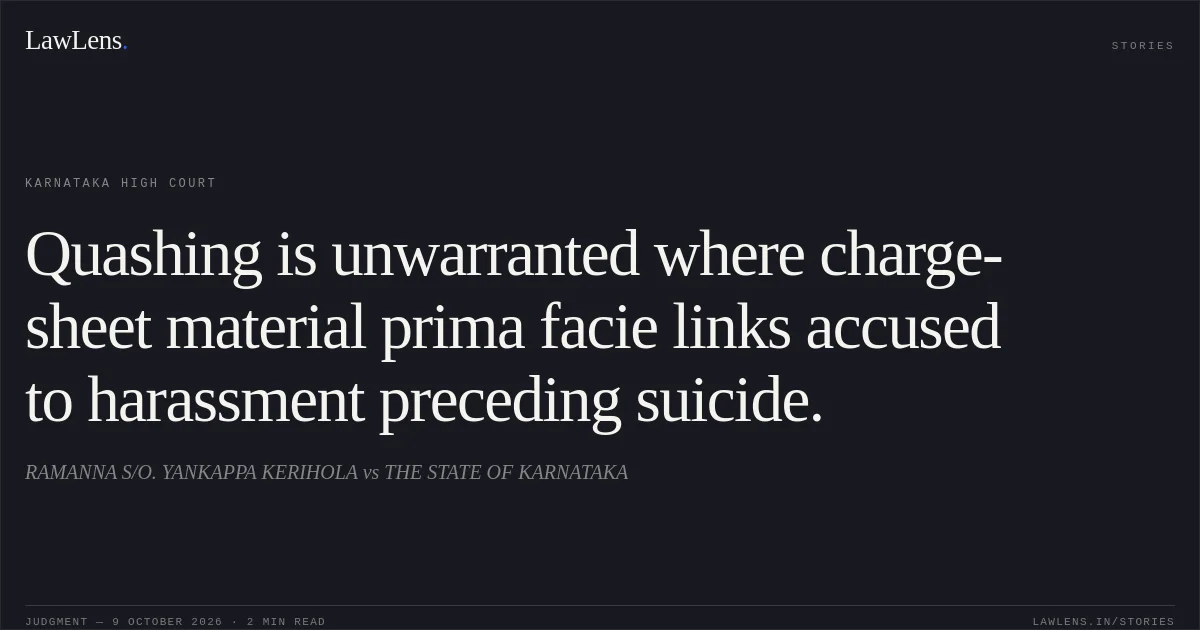
Source reference: para. 2–5, 9Accused Nos. 4–8 sought to quash the proceedings, contending that the allegations did not establish abetment of suicide or connect them to the deceased’s death.
Source reference: para. 2–5, 9Issues
Whether the charge-sheet material disclosed a prima facie case against the petitioners for abetment of suicide under Section 108 of the BNS.
Source reference: para. 9–12, 17–18Whether the criminal proceedings against the petitioners should be quashed in the High Court’s inherent jurisdiction under Section 528 of the BNSS.
Source reference: para. 2, 17–19Law Applied
The petition was brought under Section 528 of the Bharatiya Nagarik Suraksha Sanhita, 2023 (BNSS), corresponding to Section 482 of the Code of Criminal Procedure, 1973, which provides the High Court’s inherent power to prevent abuse of process and secure the ends of justice.
Source reference: para. 2The Court considered Section 108 of the BNS, the provision charged in this case, alongside the principles developed under Sections 306 and 107 of the Indian Penal Code (IPC).
Source reference: para. 13–16The cited authorities—including Kashibai v. State of Karnataka, Vaijnath Kondiba v. State of Maharashtra, Kanchan Sharma v. State of Uttar Pradesh and Geeta v. State of Karnataka—state that abetment of suicide requires material indicating instigation, conspiracy, or intentional aid; the authorities also emphasise the need for the requisite intent and a positive act, rather than merely ordinary quarrels or harassment.
Source reference: para. 13–16At the quashing stage, the Court assessed whether the charge-sheet material disclosed a prima facie case, rather than finally determining disputed facts.
Source reference: para. 17–18Reasoning
The Court noted that the charge sheet and statements of eyewitnesses CWs 6–10 attributed assault, threats, and torture to the petitioners, and stated that the deceased committed suicide following that treatment.
Source reference: para. 9–10Although the petitioners argued that they were neighbours and had no connection to the partition suit, the Court considered that contention insufficient to displace the prima facie material or the alleged nexus between their conduct and the suicide.
Source reference: para. 11–12It declined to resolve disputed factual questions in the quashing petition and concluded that the charge-sheet material warranted the proceedings continuing.
Source reference: para. 17–18Holding
The High Court dismissed the criminal petition and declined to quash the proceedings against accused Nos. 4–8.
It clarified that its observations were limited to disposal of the petition and that the trial court could decide the case independently, uninfluenced by them.
Source reference: no citationActs & Sections Cited
13 provisions across 4 statutes referred to in this judgment. Each provision opens on LawLens.
Bharatiya Nagarik Suraksha Sanhita, 20231
Code of Criminal Procedure, 19731
Bharatiya Nyaya Sanhita, 20237
Indian Penal Code, 18604
Original Court PDF
RAMANNA S/O. YANKAPPA KERIHOLAvsTHE STATE OF KARNATAKA
Click to open original judgment
Original judgment, available to read, download and summarize on LawLens.in