Facts
The petitioner, Accused No. 2, and the complainant were directors and shareholders of Prakruti Building Products Private Limited, which had borrowed from Kotak Mahindra Bank.
Source reference: p.3-4The prosecution alleged that, during the COVID-19 period, the petitioner and others procured an emergency loan of ₹44,64,000 for the company by using a forged “Memorandum of Entry By Constructive Delivery” bearing the complainant’s purported signature.
Source reference: p.3-4The petitioner sought to quash the charge sheet for offences under Sections 120B, 420, 468 and 471 of the IPC, contending, among other things, that the dispute was civil and that he lacked criminal intent.
Source reference: p.4-7The complainant’s counsel relied on the investigation, including a forensic report indicating that the signature was not the complainant’s.
Source reference: p.8The petitioner challenged the charge sheet pending before the II Additional Chief Judicial Magistrate, Bengaluru Rural District.
Source reference: p.2Issues
1. Whether the charge sheet against the petitioner should be quashed on the ground that the allegations were civil in nature and did not disclose criminal intent.
Source reference: p.4-7, 92. Whether the Court could determine, at the quashing stage, the disputed question of who was responsible for the signature on the loan document, despite the forensic material collected during investigation.
Source reference: p.8-9Law Applied
The petition invoked Articles 226 and 227 of the Constitution and Section 482 of the Code of Criminal Procedure, 1973, seeking to quash the charge sheet for alleged offences under Sections 120B, 420, 468 and 471 of the IPC.
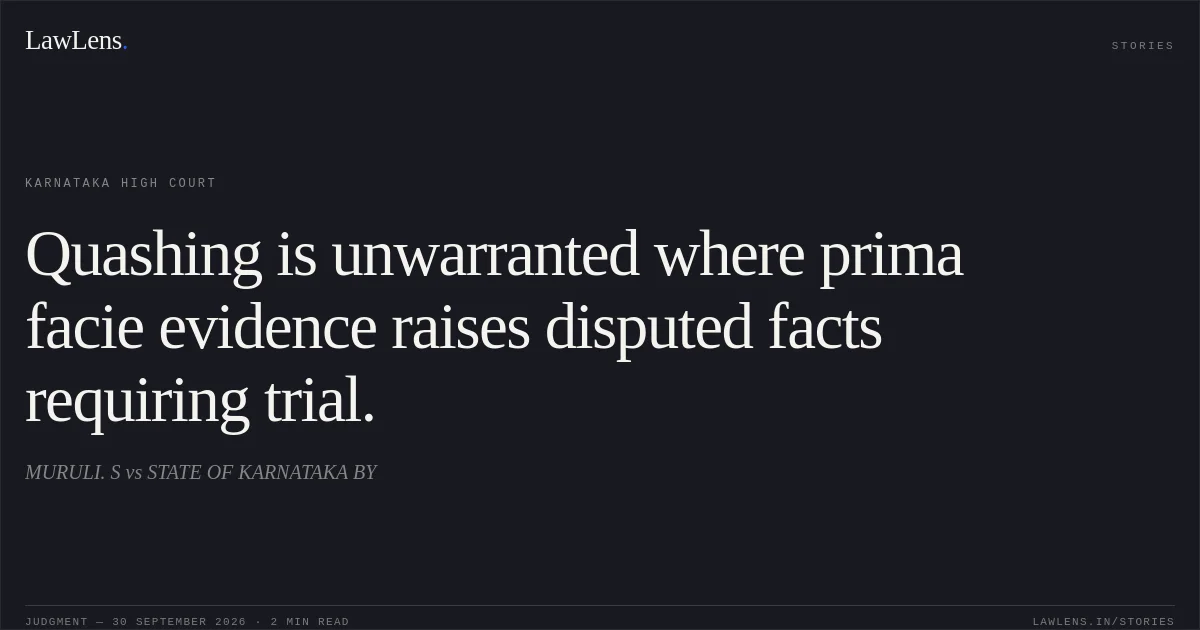
Source reference: p.2The Court’s reasoning proceeded on the limited basis that it should not resolve disputed factual questions by conducting a “mini trial” at this stage, particularly where the investigation had collected prima facie material supporting the allegations.
Source reference: p.8-9Reasoning
The Court considered the petitioner’s civil-dispute and lack-of-intent arguments against the alleged use of a document bearing a signature that the investigation’s forensic report found was not the complainant’s.
Source reference: p.8-9It noted that the loan was obtained during the pandemic, that the disputed document was used to secure ₹44,64,000, and that the alleged conduct came to light following the bank’s demand.
Source reference: p.8-9Determining who signed the document, and whether the complainant was responsible for it, required assessment of disputed facts that the Court declined to undertake in the quashing proceeding.
Source reference: p.8-9In view of the prima facie material collected, the Court found no merit in the grounds for quashing.
Source reference: p.8-10Holding
The Court dismissed the writ petition and declined to quash the charge sheet against the petitioner.
It reserved the petitioner’s contentions and defences for the trial, to be raised in accordance with law.
Source reference: p.10Acts & Sections Cited
4 provisions across 2 statutes referred to in this judgment. Each provision opens on LawLens.
Code of Criminal Procedure, 19731
Indian Penal Code, 18603
Original Court PDF
MURULI. SvsSTATE OF KARNATAKA BY
Click to open original judgment
Original judgment, available to read, download and summarize on LawLens.in