Facts
On 28 May 2022, Police Station Omti, Jabalpur, allegedly received secret information that co-accused Indrajeet Singh was concealing proceeds of illegal betting. A raid resulted in the alleged recovery of ₹47,50,000 from Indrajeet Singh.
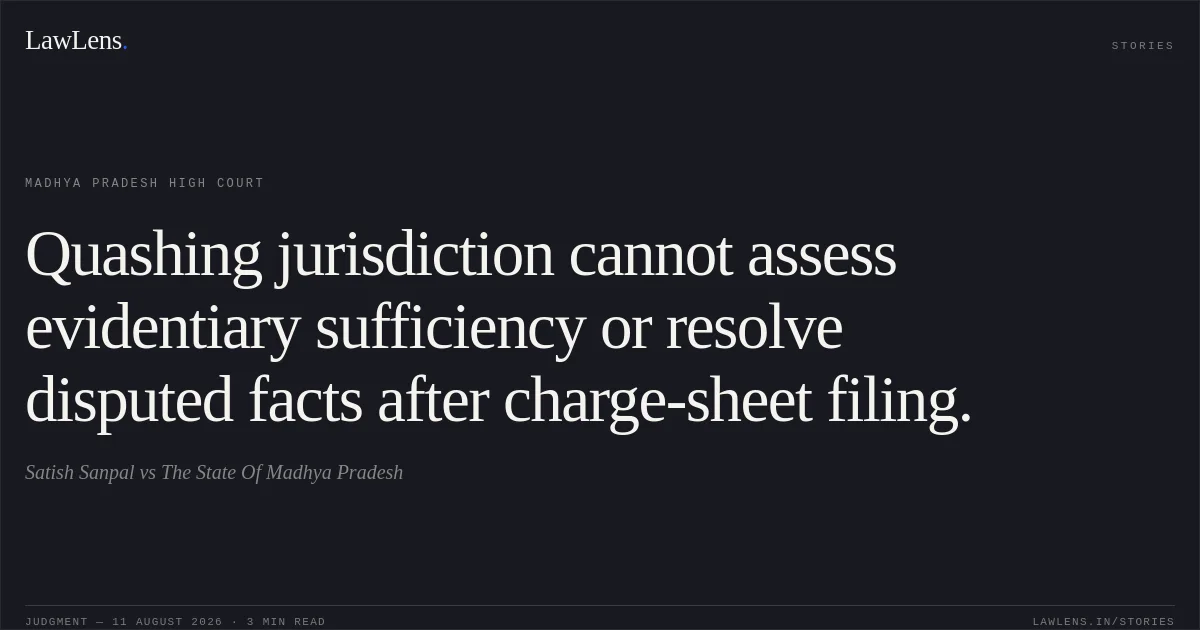
Source reference: paras. 1–2During investigation, memorandum statements of co-accused persons allegedly disclosed the petitioner Satish Sanpal’s connection with the betting operation. The petitioner was subsequently charge-sheeted in RCT No. 3373/2023 for offences under Section 4-A of the Public Gambling Act and Section 120-B IPC, arising from FIR No. 270/2022.
Source reference: paras. 1–2The petitioner sought quashing of the FIR, charge-sheet and consequential proceedings under Section 528 of the Bharatiya Nagarik Suraksha Sanhita, 2023.
Source reference: paras. 3–7He contended that he was not present in India on the date of the alleged raid, no recovery was made from him, and the prosecution lacked any independent financial, electronic or communication-based material linking him to the alleged betting activities.
Source reference: paras. 3–7Issues
Whether the FIR and charge-sheet disclosed a prima facie case against the petitioner under Section 4-A of the Public Gambling Act and Section 120-B IPC so as to justify continuation of the criminal proceedings?
Source reference: paras. 11–14Whether the alleged reliance on memoranda of co-accused, absence of recovery from the petitioner, his absence from India, and the asserted investigative irregularities justified exercise of the High Court’s inherent jurisdiction under Section 528 BNSS to quash the proceedings?
Source reference: paras. 11–14Whether examination of the evidentiary value and sufficiency of the prosecution material at the post-charge-sheet stage would amount to an impermissible mini-trial?
Source reference: paras. 11–13Law Applied
The Court applied Section 528 of the Bharatiya Nagarik Suraksha Sanhita, 2023, corresponding to the inherent jurisdiction under Section 482 CrPC, under which criminal proceedings may be quashed to prevent abuse of process or secure the ends of justice, but only in exceptional cases.
Source reference: para. 11At the quashing stage, the Court must determine whether the allegations and material collected disclose a prima facie offence; it must not conduct a meticulous appreciation of evidence, assess the probability of conviction, or undertake a mini-trial.
Source reference: para. 11The principles relied upon by the petitioner from State of Haryana v. Bhajan Lal, Zandu Pharmaceutical Works Ltd. v. Mohd. Sharaful Haque, Madhavrao Jiwaji Rao Scindia v. Sambhajirao Chandrojirao Angre and other authorities were treated as governing the exercise of inherent jurisdiction, but not as requiring quashing merely because the prosecution relied on circumstantial material or statements of co-accused.
Source reference: para. 13Reasoning
The Court held that the investigation had culminated in a charge-sheet containing material alleging the petitioner’s connection with the betting network.
Source reference: para. 11Whether the memoranda of co-accused were admissible, reliable or corroborated, and what evidentiary value they possessed, were matters for the Trial Court and could not be conclusively determined under Section 528 BNSS.
Source reference: para. 11The discrepancies concerning the timing and contents of the two FIRs, the absence of a Roznamcha entry, the alleged repeated use of the independent witness, and other investigative irregularities did not, at the threshold, demolish the entire prosecution case.
Source reference: para. 11Similarly, the petitioner’s absence from India, the absence of recovery from him, and the fact that he did not claim the seized money did not necessarily negate his alleged involvement in a conspiracy or network-based betting operation, where physical presence at the place of recovery was not an indispensable ingredient.
Source reference: para. 12The Court further declined to dissect the prosecution material to determine whether every specific act under Section 4-A of the Public Gambling Act was ultimately proved, as that would amount to a mini-trial.
Source reference: para. 13Holding
The Court answered the issues against the petitioner.
It held that the allegations and material collected during investigation did not, even at their face value, establish that the prosecution was manifestly frivolous or vexatious, nor did the case fall within the exceptional categories warranting quashing under the Court’s inherent jurisdiction.
Source reference: para. 14The petition was accordingly dismissed, without expressing any final opinion on the merits or evidentiary value of the prosecution case.
Source reference: paras. 15–16The petitioner was granted liberty to raise all factual and legal defences before the Trial Court, and the observations in the order were directed not to prejudice the trial.
Source reference: paras. 15–16Acts & Sections Cited
3 provisions across 3 statutes referred to in this judgment. Each provision opens on LawLens.
Bharatiya Nagarik Suraksha Sanhita, 20231
Public Gambling Act, 18671
Code of Criminal Procedure, 19731
Original Court PDF
Satish SanpalvsThe State Of Madhya Pradesh
Click to open original judgment
Original judgment, available to read, download and summarize on LawLens.in