Facts
The petitioners invoked Sections 482 CrPC and 528 BNSS to seek quashing of the FIR, charge sheet and consequential proceedings in Crime No. 36/2026, registered for offences under Sections 296(B), 115(2), 351(3), 109(1) and 3(5) of the BNS, 2023.
Source reference: paras. 1–4The complainant alleged that four masked persons arrived in a white Bolero and assaulted him.
Source reference: paras. 1–4The petitioners argued, among other things, that the FIR initially named unknown assailants, no test identification parade was held, and the complainant had falsely implicated them after an earlier complaint by the petitioners.
Source reference: paras. 1–4The State and complainant relied on seized articles, call detail records and the complainant’s medical report.
Source reference: paras. 1–4The High Court considered the petition against the record of the FIR and investigation
Source reference: paras. 1–4, 18–19Issues
1. Whether the FIR, charge sheet and consequential criminal proceedings disclosed sufficient prima facie material to proceed against the petitioners, or warranted quashing under Section 482 CrPC/Section 528 BNSS
Source reference: paras. 1, 9, 18–212. Whether the absence of a test identification parade, the petitioners’ allegations of false implication, or the asserted deficiencies in the prosecution material justified quashing at this stage
Source reference: paras. 2–3, 18–19Law Applied
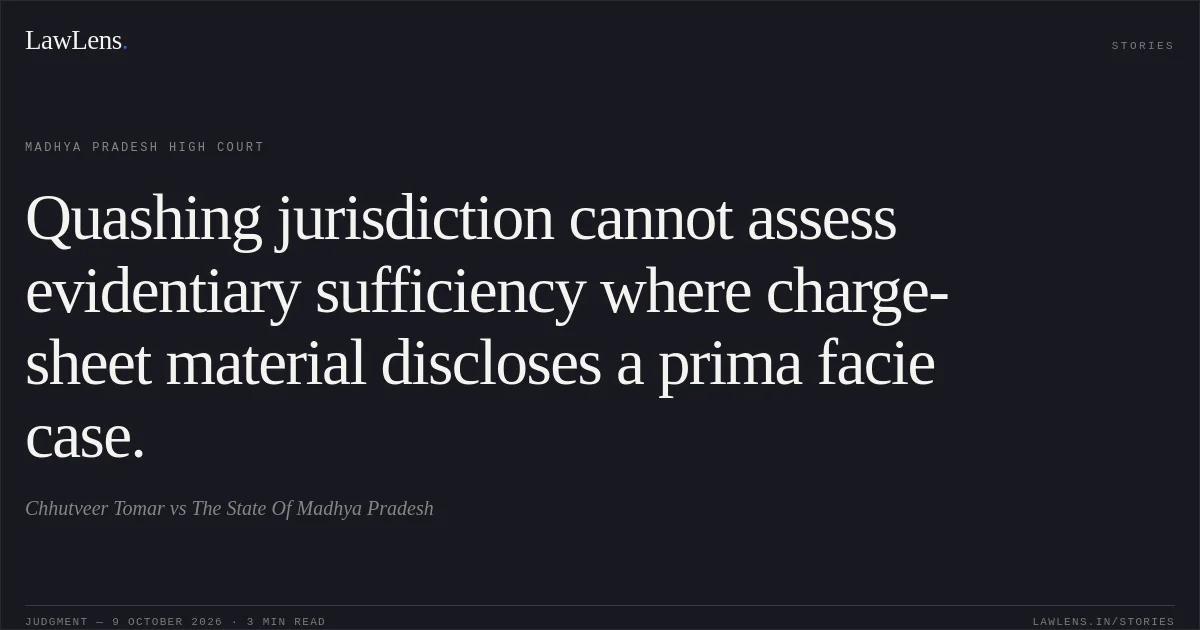
The High Court applied the inherent jurisdiction under Section 482 CrPC, invoked alongside Section 528 BNSS, to prevent abuse of process and secure the ends of justice, while recognising that quashing is to be exercised sparingly.
Source reference: para. 6Under State of Haryana v. Bhajan Lal, proceedings may be quashed where, among other circumstances, the allegations—even taken at face value—do not disclose an offence or the proceeding is manifestly mala fide.
Source reference: para. 6Applying Amit Kapoor v. Ramesh Chander, as discussed in Supriya Jain v. State of Haryana, the court must assess whether the prosecution’s uncontroverted allegations prima facie establish an offence; it must not conduct a mini-trial or determine whether conviction is likely.
Source reference: para. 5CBI v. Aryan Singh and Abhishek v. State of M.P. reiterate that the court should not adjudicate the truth or correctness of the prosecution case at the quashing stage.
Source reference: paras. 7–8The court also relied on State of Maharashtra v. Maroti and Manik B. v. Kadapala Sreyes Reddy for the rule that the sufficiency, admissibility and credibility of evidence are matters for trial, not for determination under Section 482.
Source reference: paras. 16–17Reasoning
The material recorded in the judgment disclosed that the complainant sustained grievous injuries; a white Bolero and alleged weapons used in the assault were seized; and call detail records placed the petitioners’ phones near the scene and showed contact among them during the incident.
Source reference: para. 18The court held that the absence of a test identification parade and the petitioners’ account of prior enmity raised matters for trial, not grounds for quashing.
Source reference: para. 18It also noted that witness statements and co-accused memoranda contained allegations against the petitioners, and that an FIR need not set out every detail of the offence.
Source reference: para. 19Assessing this material for a prima facie case rather than weighing its truth or sufficiency, the court found no basis to terminate the prosecution.
Source reference: paras. 20–21Holding
The High Court held that no ground was made out to quash the FIR, charge sheet or consequential proceedings under the court’s inherent jurisdiction.
The petition was dismissed; the trial court was directed to proceed uninfluenced by the High Court’s observations and to decide the matter in accordance with law.
Source reference: paras. 22–23Acts & Sections Cited
16 provisions across 4 statutes referred to in this judgment. Each provision opens on LawLens.
Code of Criminal Procedure, 1973
Bharatiya Nagarik Suraksha Sanhita, 20231
Bharatiya Nyaya Sanhita, 20235
Indian Penal Code, 18601
Original Court PDF
Chhutveer TomarvsThe State Of Madhya Pradesh
Click to open original judgment
Original judgment, available to read, download and summarize on LawLens.in