Facts
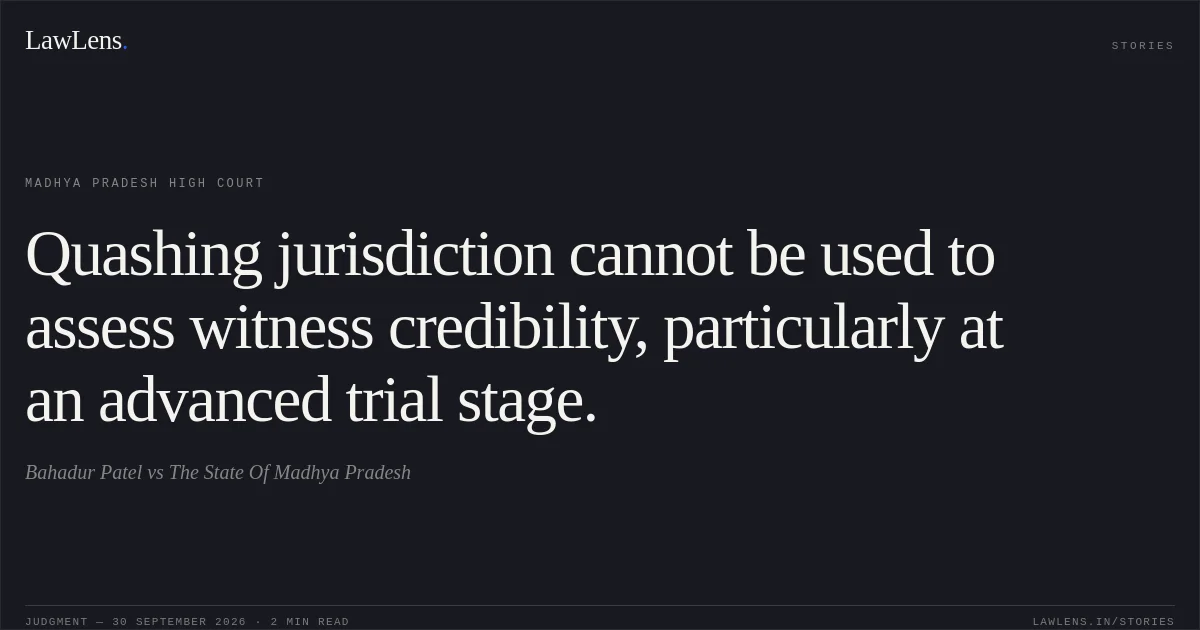
The petitioner sought quashing under Section 528 of the BNSS/Section 482 of the CrPC of the charge-sheet and proceedings in RCT No. 12195/2024, arising from a 2024 incident involving alleged abuse and assault with a knife.
Source reference: para. 1Although the Dehati Nalishi and FIR named Sumit and Aniket, the petitioner was later alleged to have participated in the assault in statements recorded during investigation.
Source reference: paras. 3, 20The State reported that 25 of the 26 prosecution witnesses had been examined by the time the petition was considered.
Source reference: paras. 5, 23–25Issues
Whether the charge-sheet and criminal proceedings against the petitioner warranted quashing where his name was not in the initial Dehati Nalishi and FIR but investigative material later implicated him.
Source reference: paras. 3, 20–22Whether the Court should quash the proceedings at an advanced stage of trial, with 25 of 26 prosecution witnesses examined.
Source reference: paras. 23–26Law Applied
The Court applied Section 528 of the BNSS/Section 482 of the CrPC, under which the High Court may quash proceedings to prevent abuse of process or secure the ends of justice, but must exercise that power sparingly and avoid conducting a mini-trial.
Source reference: paras. 7–8Relying on Amit Kapoor v. Ramesh Chander, as discussed in Supriya Jain v. State of Haryana, and on State of Haryana v. Bhajan Lal, the Court stated that quashing may be warranted where allegations, taken at face value, do not disclose an offence, but not where the factual foundation for prosecution exists.
Source reference: paras. 7–8, 11CBI v. Aryan Singh and Abhishek v. State of M.P. establish that the Court must not assess whether the prosecution will ultimately prove its case; that is for trial.
Source reference: paras. 9–10The Court also relied on State of Maharashtra v. Maroti and Manik B. v. Kadapala Sreyes Reddy for the principle that the truthfulness, sufficiency, and credibility of prosecution material are matters for trial, not quashing proceedings.
Source reference: paras. 18–19Reasoning
The Court found that the injured complainant’s statement recorded on the day of the incident specifically implicated the petitioner, and that statements of other witnesses and the co-accused’s memorandum also contained allegations against him.
Source reference: paras. 20–21It therefore held that the prosecution had collected material against the petitioner; the omission of his name from the initial report did not, on its own, establish that no case was made out.
Source reference: paras. 21–22Assessing the credibility of that material or whether it would sustain conviction would amount to a mini-trial.
Source reference: paras. 21–22The advanced stage of the trial, with 25 witnesses already examined, further supported allowing the proceedings to continue.
Source reference: paras. 23–25Holding
The Court held that no ground was made out to quash the FIR, charge-sheet, or criminal proceedings under its inherent jurisdiction.
The petition was dismissed, with the trial court directed to decide the matter according to law and uninfluenced by the High Court’s observations.
Source reference: paras. 26–28Acts & Sections Cited
17 provisions across 5 statutes referred to in this judgment. Each provision opens on LawLens.
Bharatiya Nagarik Suraksha Sanhita, 20231
Code of Criminal Procedure, 1973
Bharatiya Nyaya Sanhita, 20235
Arms Act, 19591
Indian Penal Code, 18601
Original Court PDF
Bahadur PatelvsThe State Of Madhya Pradesh
Click to open original judgment
Original judgment, available to read, download and summarize on LawLens.in