01Facts
Opposite Party No. 2 (Sharda Devi) married Raju Kumar on 07.03.2014.
¶ 3She alleged that after she returned to her matrimonial home, her in-laws demanded ₹10,00,000 as dowry, abused and assaulted her, and drove her out.
¶ 3She further alleged cruelty by her husband in Delhi, an attempted strangulation on 13.04.2016, snatching of ornaments by her father-in-law, mother-in-law and nanad, pressure to abort, and an attempted assault on 16.07.2017.
¶ 3Police allegedly refused to register a case, so she filed Complaint Case No. 305 of 2017.
¶ 3After examining the complainant on solemn affirmation and four enquiry witnesses under Section 202 CrPC, the Magistrate on 08.12.2017 took cognizance and issued process against the petitioners and others under Sections 406 and 498-A IPC and Section 4 of the Dowry Prohibition Act.
¶ 2, 4The petitioners are Kumari Dimpal (husband's married sister, married in 2006, residing in Patna), Nishant Ranjan (husband's brother, working in Central Government service in Bangalore and Delhi since 2014), and Anita Devi and Rabindranath Choudhary (mother-in-law and father-in-law).
¶ 5, 16The petitioners contend that they have separate residences and that no specific overt act is attributed to them.
¶ 5In Cr. Misc. No. 12290 of 2018, a joint affidavit recorded the parties' willingness to live together and withdraw cases. On 15.03.2018 the Court granted anticipatory bail and left withdrawal to the trial court.
¶ 6A later FIR (Parbatta P.S. Case No. 174 of 2021) was challenged by the husband in Cr. Misc. No. 43478 of 2023, which was dismissed on 24.07.2023 with liberty to raise grounds before the appropriate court.
¶ 7, 19The opposite party's counter-affidavit, including a Women Helpline report, alleged torture and multiple cases to harass her.
¶ 11, 2002Issues
i.1. Whether the allegations in the complaint, taken at face value, disclose offences under Sections 406 and 498-A IPC and Section 4 of the Dowry Prohibition Act against the petitioners.
¶ 12ii.2. Whether general and omnibus allegations against the husband's relatives, without attribution of specific roles or overt acts, can sustain criminal prosecution.
¶ 14–15iii.3. Whether continuation of proceedings against the petitioners, and the cognizance order insofar as it concerns them, amounts to abuse of the process of court under Section 482 CrPC.
¶ 17, 2103Law Applied
Section 482 CrPC preserves inherent powers to prevent abuse of process and is to be exercised sparingly and with circumspection.
¶ 13State of Haryana v. Bhajan Lal, 1992 Supp (1) SCC 335: quashing is justified where the complaint, taken at face value, does not prima facie constitute an offence, or where uncontroverted allegations and supporting evidence do not disclose one, particularly categories (1) and (3).
¶ 13, quoting para. 102Preeti Gupta v. State of Jharkhand, (2010) 7 SCC 667, Geeta Mehrotra v. State of U.P., (2012) 10 SCC 741, and Kahkashan Kausar v. State of Bihar, (2022) 6 SCC 599 hold that general and omnibus allegations against the husband's relatives, without specific instances of active involvement, cannot sustain prosecution and that criminal process must not become an instrument of harassment.
¶ 14Manju Devi v. State of Bihar, 2026 (2) PLJR 166 holds that vague allegations without a specific role or distinct instance of cruelty, and the absence of shared residence or meaningful interaction, are relevant to assessing cruelty allegations against relatives.
¶ 9, 15For Section 406 IPC, the requirement is entrustment of particular property and its dishonest misappropriation by the accused.
¶ 18Provisions in the judgment · 6 · Linked ones open on LawLens
Code of Criminal Procedure, 1973 Section 482Section 202Section 156Section 155
Indian Penal Code, 1860 Section 406
Dowry Prohibition Act, 1961 Section 4
04Reasoning
Although the complaint alleged a ₹10,00,000 dowry demand by "family members," the allegations against the petitioners were collective and lacked any date, time, place or individual participation.
¶ 17Applying Preeti Gupta, Geeta Mehrotra and Kahkashan Kausar, the Court held that a collective allegation cannot justify prosecuting each relative.
¶ 14, 17The Court distinguished the petitioners' positions: Kumari Dimpal lived separately in Patna, Nishant Ranjan had lived outside the home since 2014, and the parents were named without specific acts.
¶ 15–16Under Manju Devi, the facts of separate residence and absence of meaningful interaction supported the conclusion that no individual role was shown.
¶ 15–16On Section 406 IPC, the complaint did not identify any stridhan entrusted to the petitioners or their dishonest misappropriation; the general claim that ornaments were snatched by "family members" did not satisfy the essential ingredients as to them.
¶ 18The Court treated the 2018 joint affidavit, the 2021 FIR and the dismissal of the 2023 challenge only as background, not as independent grounds for quashing.
¶ 19The opposite party's counter-affidavit and Women Helpline report, examined alongside the complaint and enquiry material, still disclosed no specific role or overt act against the petitioners.
¶ 20The Magistrate had not examined the allegations qua each petitioner.
¶ 21Under Bhajan Lal categories (1) and (3), continuing the proceedings against the petitioners would abuse the process of court.
¶ 13, 2105Holding
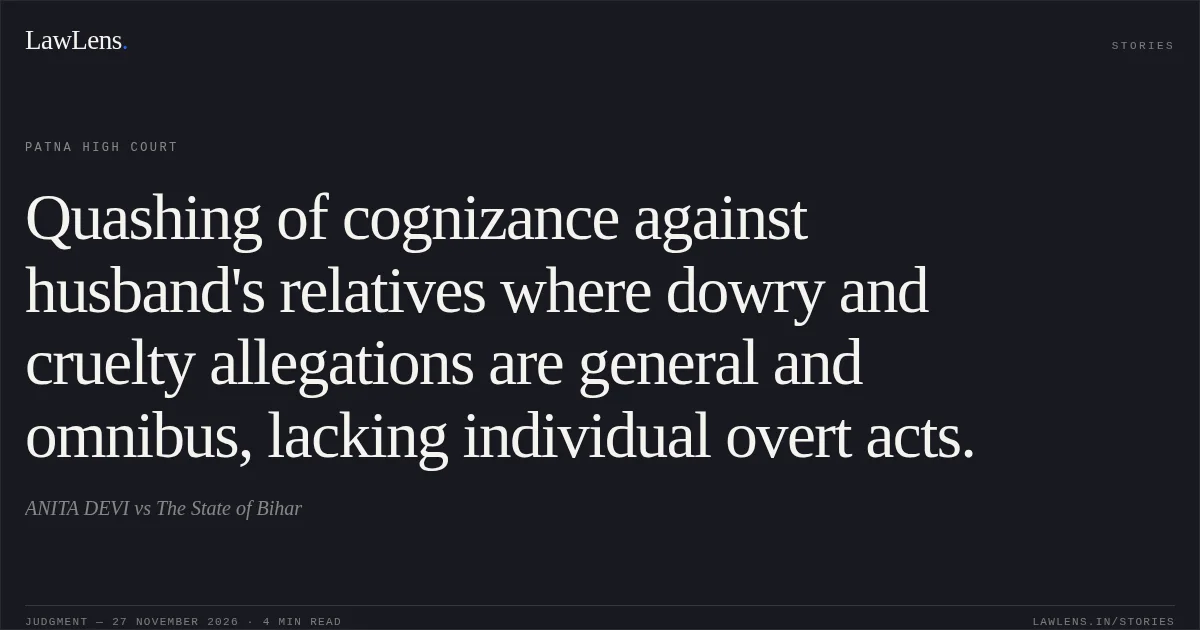
The complaint's allegations against the petitioners are general and omnibus, disclose no individual role or overt act in the alleged dowry demand, cruelty or stridhan misappropriation, and therefore do not establish offences under Sections 406 and 498-A IPC or Section 4 of the Dowry Prohibition Act.
¶ 21–22Both applications under Section 482 CrPC are allowed. The order dated 08.12.2017 in Complaint Case No. 305 of 2017, and the proceeding arising from it, are quashed insofar as they concern the petitioners. The order does not affect the proceedings against other accused persons not before the Court.
¶ 22Original Court PDF
ANITA DEVIvsThe State of Bihar
Click to open original judgment
Original judgment, available to read, download and summarize on LawLens.in